Marginal cost formula: definition, how to calculate it
The marginal cost formula tells you whether producing more will grow your profit or shrink it.

Written by Lena Hanna—Trusted CPA Guidance on Accounting and Tax. Read Lena's full bio
Published Monday 30 March 2026
Table of contents
Key takeaways
- Calculate marginal cost using the formula: change in total costs divided by change in quantity produced — then compare it to your average cost per unit to decide whether increasing production will raise or lower your profitability.
- Aim for the point where marginal cost equals marginal revenue, because beyond this point each extra unit you produce adds less profit than the one before, and oversupply can push down the price customers will pay.
- Use marginal cost alongside contribution margin (sales revenue minus variable costs) to identify which products are worth making more of — when marginal cost is lower than contribution margin, ramping up production adds to your bottom line.
- Watch for rising marginal costs as warning signs: overtime pay, sourcing materials from pricier suppliers, or hitting capacity limits can all push your cost per extra unit up and erode the profit gains you were counting on.
What is marginal cost?
Marginal cost is the additional expense your business incurs when producing one more unit of a product or service. You calculate it by dividing the change in total costs by the change in quantity produced.
This concept helps you understand the risks and opportunities of producing more. It's a key tool in cost accounting and helps you manage finances to make informed business decisions.
Calculating your marginal cost helps shape a business plan. It helps you assess cash flow impact, cost changes, and long-term considerations like market demand and pricing strategies.
Why is marginal cost important to grasp?
Marginal cost helps you make fundamental decisions about how to grow your business profitably. It answers key questions:
- Should you expand production? Growing too little means you miss out on spreading fixed costs across more units.
- How quickly should you grow? Expanding too fast can cause costs to spiral without matching increases in sales.
- What price should you charge? Your marginal cost informs a pricing strategy that maximises revenue.
What are the main components of marginal cost?
To calculate marginal cost, you need to account for all costs involved in production. There are two main categories:
- Variable costs change with the level of output. Examples include materials, hourly wages, and energy bills. When you produce more units, these costs increase.
- Fixed costs stay the same regardless of output. Examples include machinery, building rent, and salaries. Increasing production spreads these costs across more units, bringing down your cost per unit.
What is the formula for marginal cost?
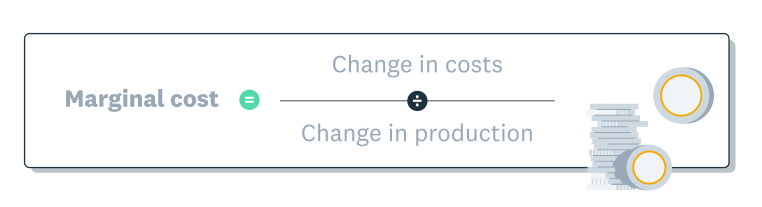
The marginal cost formula shows how your total costs change when you increase production by one unit. Here's the formula:
Marginal cost = Change in total costs ÷ Change in quantity
How to calculate marginal cost
Follow these steps to calculate your marginal cost:
- Determine your current total costs at your present production level.
- Calculate your new total costs if you produce one additional unit.
- Find the change in total costs by subtracting current costs from new costs.
- Divide the change in costs by the change in quantity (typically one unit).
For example, if producing one more computer increases your total costs from R10,000 to R10,050, your marginal cost is R50 (R50 ÷ one = R50).
The benefits of calculating marginal cost
Once you've calculated your marginal cost, compare it to your average cost of production (total costs divided by units produced):
- Marginal cost is lower than average cost: Consider increasing production to capture additional profit
- Marginal cost is higher than average cost: Keep production levels the same to avoid reducing profitability
Whether to increase output ultimately depends on whether the additional revenue from that extra unit exceeds its marginal cost.
Marginal cost example
Let's say Mohammed wants to expand his bakery. He currently makes 100 cakes and wants to make one more. His usual production costs are R1000 (R10 per cake); these costs increase to R1005 if he makes that additional cake.
First, he works out the change in total cost: R1005 – R1000 = R5
Second, he works out the marginal cost: R5 / one = R5
This marginal cost of R5 is lower than Mohammed's current average cost of R10 per cake, which means producing one more cake would reduce his average cost per unit. It would increase his profit only if that extra cake can be sold for more than R5 in additional revenue.
Marginal revenue vs marginal cost
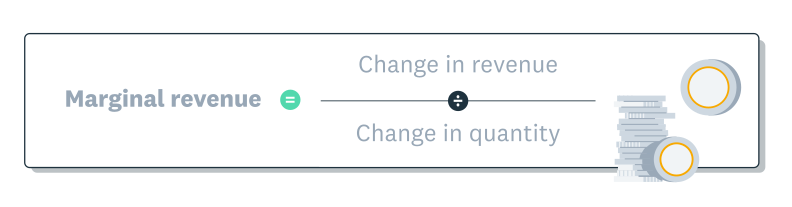
Marginal revenue is the income you receive from selling one additional unit. While marginal cost focuses on expenses, marginal revenue focuses on how your income changes when you increase production.
Marginal revenue = Change in revenue ÷ Change in quantity sold
To maximise your profits, aim for your marginal cost to equal your marginal revenue. At this point, each additional unit you produce adds as much to your revenue as it costs to make.
Beyond this point, each additional unit adds less profit than the one before. Too much supply dampens demand and lowers the price customers will pay per unit.
Example of marginal revenue
Let's say Alison sells wallets at a market stall for R30 each. If she can't sell all her stock, she could supply the surplus wallets to another vendor across town at a rate of R20. But is this worth it? How many wallets does she need to sell to increase her profits or just to break even?
Her marginal revenue would be R20 for the sale of one extra wallet. If her marginal cost is higher than this – say, R22 – then she would not make a profit on this single-unit transaction. Since marginal cost exceeds marginal revenue, selling that extra wallet at R20 would reduce her overall profit.
To make this sale worthwhile, Alison needs to either increase the revenue per wallet or reduce the cost of supplying it. She has a few options:
- She could negotiate a higher unit price for a larger wholesale order.
- If she has significant fixed costs, selling more units may reduce her average cost per unit by spreading those fixed costs across more sales.
- She might sell to a vendor nearer to where she is, which would cost less to reach.
- She might find a less expensive way to travel.
Alison would benefit from analysing her revenue to cost ratios to find the most profitable approach.
Why you should calculate your marginal cost accurately
Knowing your true marginal cost helps you maximise profits in three ways:
- Optimal pricing decisions: Find the price point where customers will pay while you maximise revenue.
- Better production decisions: Determine whether producing one extra unit would increase or decrease your average costs.
- Allocate resources efficiently: Decide which products to make, when to buy machinery, and where to invest your time and energy based on profitability per unit.
Use Xero to manage your business finances with confidence
Understanding your numbers helps you make smart business decisions. Xero accounting software helps you:
- Track costs accurately: Automatic calculations keep your data up-to-date.
- See the full picture: Customised reports give you oversight into revenue and costs.
- Collaborate easily: Cloud-based access lets you work with your accountant or bookkeeper in one central place.
FAQs on marginal cost
Here are answers to common questions about marginal cost and how it applies to your business.
What causes marginal cost to increase?
Your marginal cost can rise due to several factors:
- Rising labour costs: paying overtime or hiring additional staff
- Production inefficiencies: buying materials from more expensive sources or using slower processes
- Capacity limits: investing in new equipment, premises, or staff when you reach maximum output
How does marginal cost relate to supply and demand?
Marginal cost directly influences supply decisions. If your marginal cost is lower than the selling price, you're incentivised to produce more. If marginal cost exceeds the selling price, reducing output helps you avoid losses.
This relationship connects to how you analyse profit margins. Calculate your gross profit margins to see the full picture.
What's the relationship between marginal cost and contribution margin?
Marginal cost measures the expense of producing one more unit. Contribution margin measures how much revenue remains after covering variable costs.
Calculate contribution margin by subtracting variable costs from sales revenue. When marginal cost is less than contribution margin, producing more units is profitable.
How do you calculate contribution margin per unit?
Contribution margin per unit shows how much each sale contributes toward covering fixed costs and generating profit.
Contribution margin = Sales revenue − Variable costs
Contribution margin ratio = (Sales revenue − Variable costs) ÷ Sales revenue
For example, if you sell jeans for R50 with variable costs of R20 per unit:
- Contribution margin = R50 − R20 = R30
- Contribution margin ratio = R30 ÷ R50 = 60%
Compare contribution margin ratios across products to identify which to produce for maximum profit.
What's the difference between marginal cost and average cost?
Marginal cost is the expense of producing one additional unit. Average cost is your total costs divided by the total number of units produced.
As production increases, marginal cost helps you determine whether average cost will rise or fall.
Disclaimer
Xero does not provide accounting, tax, business or legal advice. This guide has been provided for information purposes only. You should consult your own professional advisors for advice directly relating to your business or before taking action in relation to any of the content provided.
Start using Xero for free
Access Xero features for 30 days, then decide which plan best suits your business.