Margin of safety formula: how to calculate your buffer
Learn the margin of safety formula to spot risk early, set smarter prices, and protect your profit.
Written by Shaun Quarton—Accounting & Finance Content Writer and Growth Marketer. Read Shaun's full bio
Published Tuesday 24 February 2026
Table of contents
Key takeaways
- Calculate your margin of safety by subtracting your break-even sales from current sales, then dividing by current sales to get a percentage that shows how much sales can drop before you start losing money.
- Aim for a margin of safety of 20% or higher to create a healthy buffer against unexpected changes in sales or costs, though the ideal percentage varies by industry and business stability.
- Use your margin of safety to make smarter business decisions by setting realistic sales targets, reviewing pricing strategies, controlling costs, and evaluating new products before launch.
- Review your margin of safety monthly or quarterly to track changes in your financial position, and more frequently during periods of significant change like product launches or market shifts.
What is the margin of safety?
The margin of safety measures how far your sales can drop before your business stops making a profit. It's the gap between your current sales and your break-even point, where revenue equals costs.
Think of it as your financial buffer. A wider margin means more protection against falling demand or rising costs.
What is the margin of safety formula?
The margin of safety formula is:
(Current sales − Break-even sales) ÷ Current sales = Margin of safety
This calculation gives you a percentage showing how much your sales can decline before you reach break-even.
- Current sales: your total revenue from selling goods and services over a specific period
- Break-even sales: the exact revenue needed to cover all fixed and variable costs, where your business makes zero profit and zero loss
For example:
A business has current sales of $50,000 and needs $30,000 to break even.
Margin of safety = ($50,000 − $30,000) ÷ $50,000 = 0.4 (40%)
This means sales could drop by 40% before the business hits break-even. Any further decline would result in a loss.
How to calculate margin of safety
Follow these steps to calculate your margin of safety.
1. Find your current sales
Start by determining your current sales, whether actual or forecasted. You can find actual sales figures through your existing sales tools.
Forecasting takes more analysis. Four common approaches include:
- Historical data: analyse your financial reports for past sales trends and seasonal patterns
- Market research: study your target market, industry trends, and competitor performance
- Qualitative forecasting: gather insights from your sales team or industry experts
- Quantitative forecasting: use statistical methods to analyse historical and market data
You can find historical data in your POS system, eCommerce platform, or accounting software like Xero. The best approach depends on your business type and the data you have available.
For example, a craft business uses a POS system to track monthly sales. Last month, sales were $5,000. This figure is used in the steps below.
2. Calculate your break-even sales revenue point
For the margin of safety calculation, you need your break-even point as a sales revenue figure, not a unit count.
Use this formula:
Fixed costs ÷ ((Sales price − Variable cost) ÷ Sales price) = Break-even sales
In the formula:
- Fixed costs: expenses that stay the same regardless of sales volume, such as salaries and rent
- Variable costs: expenses that change with sales volume, such as raw materials and sales commission
Find more information on variable costs and how they differ from fixed costs. Your accountant can also help you distinguish between them, as many already provide management accounting services like risk management and budgeting to clients.
Using the craft business example:
- Fixed costs: $2,000
- Variable costs: $5 per unit
- Sales price: $25 per unit
The calculation:
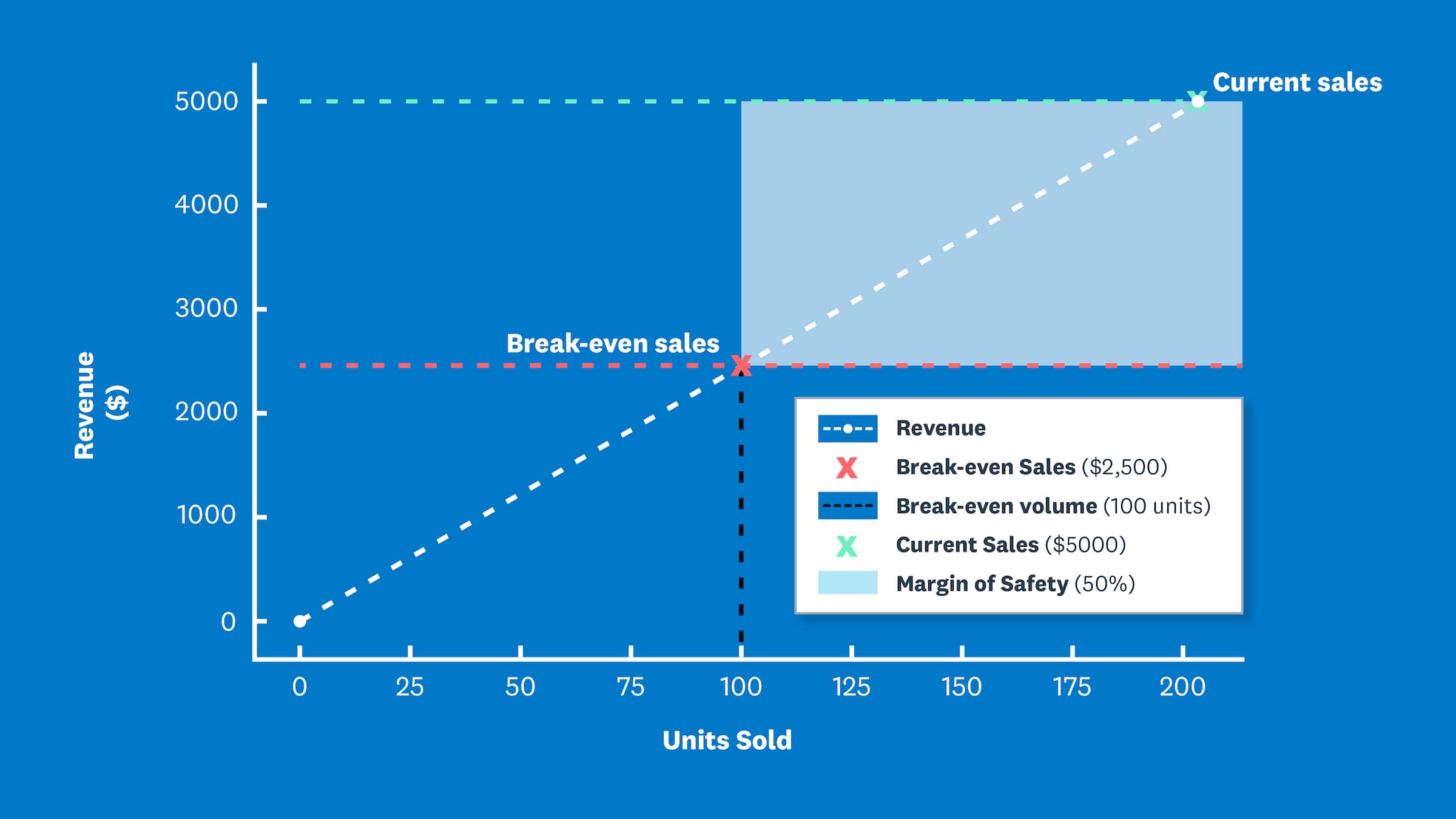
$2,000 ÷ (($25 − $5) ÷ $25) = $2,000 ÷ 0.8 = $2,500
With a sales price of $25, the business needs $2,500 in revenue (100 units) to break even.
Learn more about your break-even point.
3. Apply the margin of safety formula
Apply the margin of safety formula:
(Current sales − Break-even sales) ÷ Current sales = Margin of safety
The result is your margin of safety ratio: the percentage by which sales can fall before your business starts operating at a loss.
Using the craft business example:
- Current sales: $5,000
- Break-even sales: $2,500
($5,000 − $2,500) ÷ $5,000 = 0.5 (50%)
The craft business has a 50% margin of safety. Sales could fall by half before reaching break-even.
What is a good margin of safety percentage?
A higher percentage is always better because it means you have a larger cushion against losses. There's no single number that's right for every business.
Many businesses aim for a margin of safety of 20% or more. This generally indicates a healthy buffer between your sales and your break-even point. However, what's considered 'good' can vary by industry and business model. A business with predictable sales might be comfortable with a lower margin, while a seasonal or new business may want a larger one to handle uncertainty.
The importance of the margin of safety for your small business
The margin of safety is essential to your risk management strategy. Small and medium-sized enterprises represent over 90% of the business population in developed economies. This metric shows exactly how far sales can fall before your business starts losing money.
- High margin of safety: Your risk is low, and your business can absorb shifts in demand without major disruption
- Low margin of safety: Your risk is higher, and you're operating close to break-even with less room to adjust
Consider how an external shock would affect your business. For example, a jump in supplier prices increases your variable costs.
Higher variable costs push up your break-even point. This eats into your margin of safety and leaves your business more exposed to further cost increases or falling sales.
Your margin of safety also supports smarter financial decisions across your business. This is vital as responsibilities have grown for financial leaders to include areas like digital activities.
How the margin of safety supports your business decisions
Your margin of safety helps you make better decisions in key areas:
- Set performance targets: Calculate a clear break-even point to establish achievable sales goals
- Review pricing: Check whether each sale contributes enough to cover costs if your margin is shrinking
- Control costs: Identify where to cut expenses when your margin signals higher risk
- Evaluate new products: Assess how proposed costs affect your margin before launching
Your margin of safety works best alongside other key financial metrics. For example, combining it with CVP analysis gives you a clearer view of both profitability and risk than either metric alone.
Margin of safety and CVP analysis
Cost-volume-profit (CVP) analysis is a forward-looking exercise that models how your cost structure, sales volume, and pricing affect profitability. It shows how adjusting any of these factors changes your bottom line.
Your margin of safety is an output of CVP analysis. While CVP helps you plan for different scenarios, margin of safety shows the financial buffer you have today.
Learn more about decision-making
Master your margin of safety with Xero
Xero simplifies margin of safety calculations by bringing your figures together automatically.
With Xero, you get:
- Quick access to financial data: Find the figures you need in one place
- Streamlined reporting: Generate the reports you need to calculate your margin of safety faster
- Confident decision-making: Use real-time data to make informed choices about your business
Ready to simplify your financial management? Get one month free.
FAQs on margin of safety
Find answers to common questions about the margin of safety below.
What is a good margin of safety percentage for small businesses?
A margin of safety of 20% or higher is often considered healthy for a small business. This provides a solid buffer against unexpected changes in sales or costs. The ideal percentage depends on your industry and revenue stability.
What does a 50% margin of safety mean?
A 50% margin of safety means your sales could fall by half before your business reaches its break-even point. For the craft business in our example, with $5,000 in sales and a $2,500 break-even point, this provides a very strong cushion against risk.
How often should I calculate my margin of safety?
Calculate your margin of safety monthly or quarterly to track changes in your financial position. Review it more frequently during periods of significant change, such as launching new products or facing market shifts.
What should I do if my margin of safety is low?
If your margin is low, consider three options: increase sales volume, raise prices, or reduce costs. Start by reviewing your largest expenses and identifying where you can improve efficiency without affecting quality.
Can my margin of safety be negative?
Yes. A negative margin of safety means your current sales are below your break-even point. Your business is operating at a loss. This signals an urgent need to increase revenue or cut costs.
Disclaimer
Xero does not provide accounting, tax, business or legal advice. This guide has been provided for information purposes only. You should consult your own professional advisors for advice directly relating to your business or before taking action in relation to any of the content provided.
Start using Xero for free
Access Xero features for 30 days, then decide which plan best suits your business.