Gross profit margin formula: calculate it step by step
Learn the gross profit margin formula to price smarter, cut costs, and grow your profit.
Written by Lena Hanna—Trusted CPA Guidance on Accounting and Tax. Read Lena's full bio
Published Tuesday 24 February 2026
Table of contents
Key takeaways
- Calculate your gross profit margin by dividing gross profit by revenue and multiplying by 100, ensuring you accurately categorise direct costs in COGS while excluding operating expenses like rent and marketing.
- Compare your margin against industry benchmarks to assess performance, as service businesses typically achieve 50% or higher while retail operates at 25% to 35%.
- Improve your margins by negotiating better supplier rates, reducing waste in production, and strategically adjusting prices based on market conditions and competitor analysis.
- Track your gross profit margin monthly or quarterly to identify trends early, and reassess whenever costs change, sales shift significantly, or market conditions evolve.
What is gross profit margin?
Gross profit margin is the percentage of revenue remaining after you subtract the cost of goods sold (COGS). It shows how efficiently your business produces and sells products or services.

Understanding why gross profit margin matters helps you make better business decisions. Here's what it reveals:
- Measures production efficiency: Reveals how much you keep from each sale after direct costs
- Identifies profitable areas: Highlights which products or services generate the strongest returns
- Affects bottom-line health: Low margins make it harder to cover operating expenses and reduce your chances of net profit
After paying operating expenses like rent and utilities, the remainder becomes your net profit.
Gross profit margin vs gross profit
Gross profit is a dollar amount: your revenue minus cost of goods sold.
Gross profit margin is a percentage: your gross profit divided by revenue, multiplied by 100.
The term 'gross margin' means the same thing as gross profit margin. They're used interchangeably.
Gross profit margin formula
The gross profit margin formula is:
Gross Profit Margin = (Gross Profit ÷ Revenue) × 100
Here's what each component means:
- gross profit: revenue minus cost of goods sold (COGS)
- revenue: total sales income
- result: expressed as a percentage
For example, if your gross profit is $12,000 and revenue is $20,000, your gross profit margin is 60%.
How to calculate gross profit margin
Calculating your gross profit margin involves a few simple steps. Here's how to work through the process.
Understanding cost of goods sold
Before you calculate your gross profit margin, you need to understand what goes into your cost of goods sold (COGS). COGS includes all the direct costs of producing your products or delivering your services, such as raw materials, labour directly involved in production, and manufacturing overhead.
Make sure you estimate your COGS correctly, as it strongly affects the gross profit margin calculation.
Step by step calculation
Follow these steps to calculate your gross profit margin:
- Find your revenue: add up your total sales for the period
- Calculate COGS: total the direct costs of producing your goods or services
- Subtract COGS from revenue: this gives you gross profit
- Divide gross profit by revenue: this gives you a decimal
- Multiply by 100: convert to a percentage
Gross profit margin example
Here's how a cleaning business would calculate gross profit margin:
- Revenue: $20,000 (from cleaning services)
- COGS: $8,000 (supplies, equipment, direct labour)
- Gross profit: $20,000 − $8,000 = $12,000
- Gross profit margin: ($12,000 ÷ $20,000) × 100 = 60%

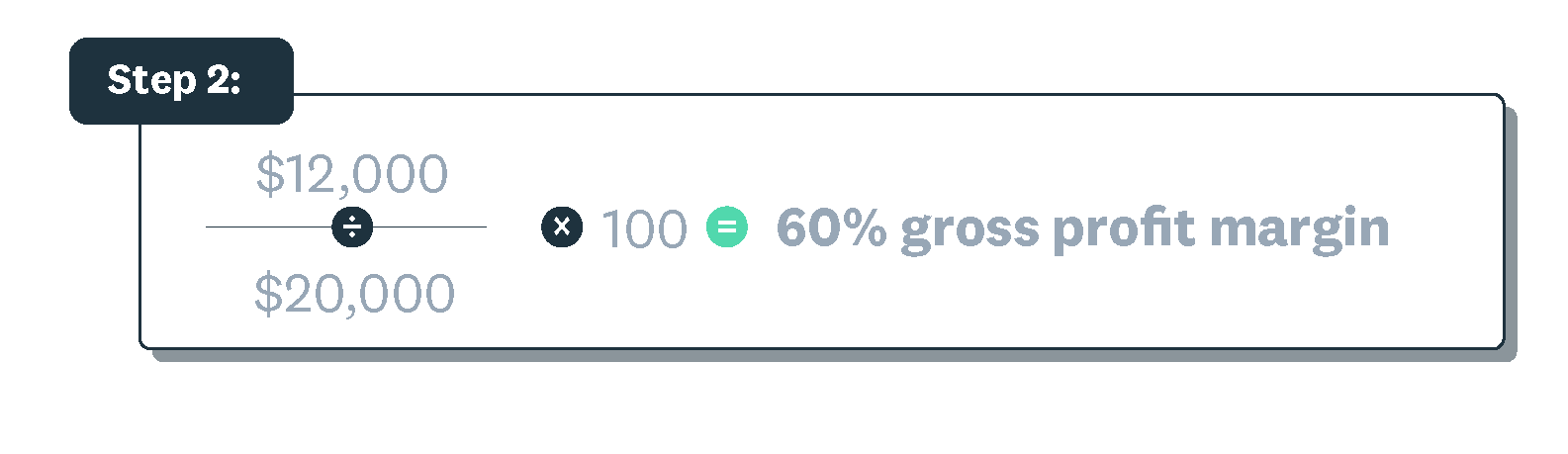
This means the business keeps $0.60 of every dollar earned after covering direct costs.
Avoid common calculation mistakes
Accurate cost of goods sold (COGS) is essential for a reliable gross profit margin. Common mistakes can skew your calculations significantly. Watch out for these errors:
- including operating expenses in COGS: rent, marketing, and admin costs belong in operating expenses, not COGS
- forgetting direct labour: wages for staff who produce goods or deliver services count as COGS
- omitting shipping costs: freight and delivery for materials typically belong in COGS
- using inconsistent time periods: match your revenue and COGS to the same reporting period
Your accountant can help you categorise costs correctly.
What is a good gross profit margin?
A good gross profit margin typically ranges from 25% to 50%, though this varies widely by industry. Service businesses often achieve 50% or higher, while retail may operate at 25% to 35%.
Your gross profit margin must be high enough to sustain your business operations. It needs to cover:
- cost of goods sold (COGS)
- operating expenses (rent, utilities, salaries)
- taxes and other obligations
The right target depends on your industry, business size, and market conditions.
Factors affecting your margins
Here are some of the factors that typically impact your gross profit margin:
- Industry: Hospitality typically has high overhead and lower margins, while financial services often achieve higher margins through service fees
- Region: Local taxes, rent costs, and customer traffic vary significantly between locations
- Business type: Ecommerce stores often have lower overhead than physical retail, allowing higher margins. Analysis of over 5,000 online stores shows that a gross profit margin in the 60%–70% range makes profitable scaling possible.
- Market competition: Competitive industries like electronics retail face price pressure that squeezes margins
Industry benchmarks for gross profit margin
Gross profit margins vary significantly across industries. Here are typical ranges:
- jewellery and cosmetics: 55% or higher
- professional services: 50% to 70%. As an example of a high-margin service business, the Bank of America Corporation reported a gross margin of 97.8% at the end of 2016.
- restaurants and hospitality: 30% to 40%
- retail (general): 25% to 35%, though some sectors have much lower margins. For example, the auto and truck industry has the lowest average gross profit at just 12.45%.
- electronics and beverages: below 45%
Your accountant or bookkeeper can find specific benchmarks for small to medium businesses in your industry.
Benchmarking your gross profit margin
Compare your margin against similar businesses in your industry, region, and size bracket for an accurate performance picture.
Effective benchmarking requires comparing like with like. Here's how to do it:
- find industry data: check trade associations, accounting firms, or government statistics
- match business size: compare against businesses with similar revenue
- consider location: regional cost differences affect what's achievable
- ask your accountant: they can access benchmark data for your specific industry
When to reassess your gross profit margin
Regular margin reviews help you stay ahead of problems. Review your margins when:
- costs change: supplier prices increase or new expenses arise
- sales shift: revenue grows or declines unexpectedly
- you miss targets: growth or profit goals aren't met
- market conditions change: competitors adjust pricing or new players enter
Xero's financial reports let you track margin changes in real time and spot trends before they become problems.
Analysing gross profit margin for business insights
Gross profit margin analysis reveals which products, services, or business areas generate the strongest returns. Use this insight to guide pricing and cost decisions.
Margin analysis provides valuable insights for decision-making. Here's what it shows you:
- product-level profitability: which items earn the most after direct costs
- pricing opportunities: where you can adjust prices without losing customers
- cost reduction targets: which expenses most affect your margins
Interpreting gross profit margin trends
Tracking your gross profit margin over time reveals important patterns. Regular monitoring helps you identify trends early:
- rising margins: your pricing strategy or cost controls are working
- falling margins: costs may be increasing or prices may need adjustment
- seasonal fluctuations: some products or services perform better at certain times
- product variations: compare margins across offerings to identify top performers
Review trends monthly or quarterly to catch changes early. Some finance teams move even faster; one survey found that 36% of CFOs report their teams alter their forecasts at least weekly.
Factors affecting gross profit margin
External forces can shift your margins even when your operations stay the same. Understanding these factors helps you respond quickly:
- demand changes: falling demand may force price reductions to attract customers
- supplier cost increases: rising material or labour costs narrow your margins
- customer spending power: economic conditions affect how much customers can pay
- competitor pricing: market pressure may limit how much you can charge
Gross profit margin compared with other metrics
Gross profit margin measures profitability after direct costs. Two related metrics, operating profit margin and net profit margin, provide deeper insight into your overall financial health.
Gross profit margin vs operating profit margin
- Gross profit margin: revenue minus COGS only
- Operating profit margin: revenue minus COGS and operating expenses (rent, utilities, salaries)
Operating profit margin shows whether your business covers all day-to-day costs, not just production costs.
Gross profit margin vs net profit margin
- Gross profit margin: revenue minus COGS
- Net profit margin: revenue minus all costs (COGS, operating expenses, interest, and taxes)
Net profit margin is your 'bottom line.' It shows what percentage of revenue becomes actual profit after every expense. While it varies by industry, a 10% net profit margin is generally considered average, while 20% is seen as high.
How to use each metric
- Gross profit margin: evaluate pricing decisions and production efficiency
- Operating profit margin: assess whether revenue covers all operating costs
- Net profit margin: guide long-term planning and measure overall financial resilience
Track all three to get a complete picture of your business's profitability.
How to improve gross profit margin
Improving your gross profit margin increases the money available for operating costs, growth, and profit. Focus on three key areas: pricing, costs, and efficiency.
Adjust your prices
Strategic pricing directly affects your margin. Small adjustments can significantly improve profitability. Consider these approaches:
- review regularly: update prices as costs and market conditions change
- respond to competitors: adjust when rivals change their pricing
- add value first: improve products or services to justify higher prices
- test increases: small price rises often have minimal impact on sales volume
Reduce your cost of goods sold
Lower COGS means higher margins without changing prices. Here are effective ways to reduce your direct costs:
- negotiate with suppliers: ask for bulk discounts or better payment terms
- compare vendors regularly: prices change, and new suppliers may offer better rates
- reduce waste: track materials closely to minimise losses
- review labour costs: ensure staffing levels match production needs
Streamline your operations
Efficient operations reduce costs without sacrificing quality. Focus on these areas to streamline your business:
- automate repetitive tasks: use software to handle invoicing, inventory, and reporting
- manage inventory tightly: avoid excess stock that ties up cash and increases storage costs
- review processes regularly: identify bottlenecks that slow production or delivery
- track time and resources: measure where effort goes and eliminate waste
Accounting software like Xero automates financial tasks so you can focus on margin-improving decisions.
Use Xero to track your gross profit margin
Xero makes it easy to monitor your gross profit margin alongside other key metrics. With real-time financial reports, you can spot margin changes early and make informed pricing and cost decisions.
Track your margins, automate your bookkeeping, and focus on growing your business. Get one month free.
FAQs on gross profit margin
Here are answers to common questions about gross profit margin.
How do you calculate gross profit margin?
Divide your gross profit by revenue, then multiply by 100. For example, $12,000 gross profit ÷ $20,000 revenue × 100 = 60% gross profit margin.
What does a 20% gross profit margin mean?
A 20% gross profit margin means you keep $0.20 of every dollar in revenue after covering direct costs. The remaining $0.80 goes towards producing your goods or services.
What's the difference between gross profit and gross margin?
Gross profit is a dollar amount (revenue minus COGS). Gross profit margin is a percentage (gross profit divided by revenue, times 100).
Can I improve my gross profit margin without raising prices?
Yes. Negotiate better supplier rates, reduce waste, buy in bulk, or streamline operations to lower your cost of goods sold.
How often should I review my gross profit margin?
Review monthly or quarterly. Also reassess when you change pricing, switch suppliers, or notice significant cost fluctuations.
Disclaimer
Xero does not provide accounting, tax, business or legal advice. This guide has been provided for information purposes only. You should consult your own professional advisors for advice directly relating to your business or before taking action in relation to any of the content provided.