What is profit margin? Definition, formula and examples
Profit margin is the share of revenue you keep as profit. Learn the formula, see examples and find ways to improve it.
Written by Jotika Teli—Certified Public Accountant with 24 years of experience. Read Jotika's full bio
Published Tuesday 6 October 2026
Table of contents
Key takeaways
- Profit margin is the share of revenue you keep as profit, worked out as (profit ÷ revenue) × 100. Track gross, operating and net profit margins together for a full picture of your business health.
- Net profit is gross profit minus operating expenses and taxes. That’s why a healthy gross margin can shrink to a thin net margin.
- Improve your margins by controlling costs, making your operations more efficient and pricing on the value you deliver rather than on cost alone.
- Compare your margins with businesses in your own sector and watch the trend over time. A 3% net margin can be excellent for retail but concerning for consulting.
What is profit margin?
Profit margin is the percentage of revenue your business keeps as profit after paying expenses. The formula is (profit ÷ revenue) × 100 = profit margin %.
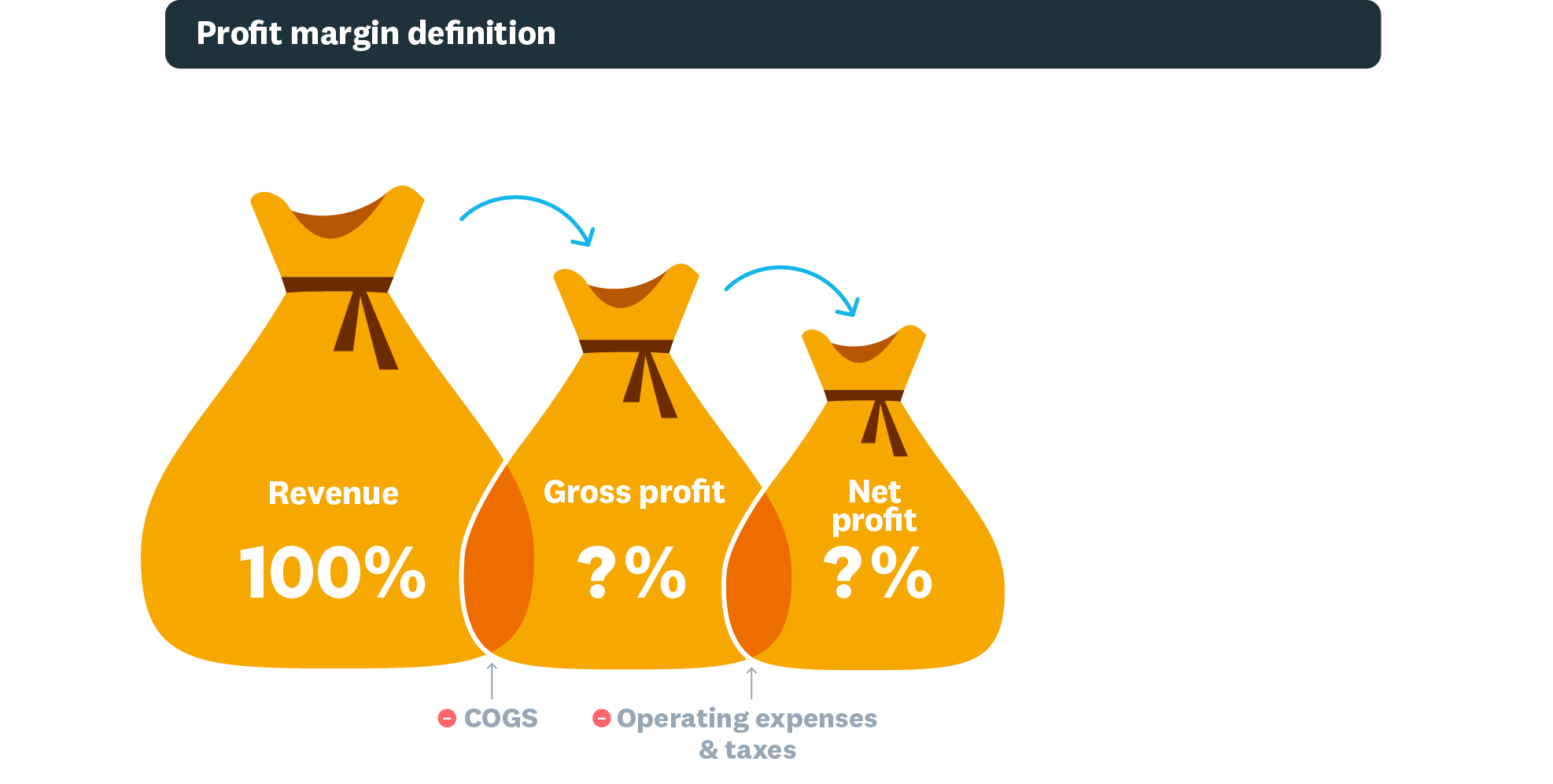
The higher the percentage, the more profit you keep from each sale. A strong profit margin signals your business earns enough to cover costs and fund growth. It also reveals which areas perform well and where you may need to cut expenses.
Profit margin vs net profit
Net profit is the ringgit amount remaining after you subtract all expenses from revenue. Profit margin expresses that profit as a percentage of your total revenue.
The key difference: net profit tells you how much money you made, while profit margin shows how efficiently you made it relative to your sales.
Types of profit margins
Businesses track three main types of profit margins, each measuring profitability at a different level.
- Gross profit margin: The percentage of revenue remaining after subtracting the cost of goods sold (COGS). Use it to set pricing, spot inefficiencies and compare performance across periods.
- Operating profit margin: The percentage of revenue left after paying COGS and operating expenses (such as wages, rent and utilities) but before taxes and interest. Investors and lenders use it to assess how profitable your core operations are.
- Net profit margin: The percentage of revenue remaining after all costs, expenses and taxes. It’s the most complete measure of your business’s financial health because it accounts for everything.
Learn more about net profit margin.
How to calculate profit margin
To calculate profit margin, divide profit by revenue and multiply by 100: (profit ÷ revenue) × 100 = profit margin %. This formula works for all three margin types.
Expressing profit as a percentage makes it easier to compare your performance across different time periods, track trends and benchmark against competitors. The only thing that changes between margin types is which costs you subtract to get profit.
Gross profit margin calculation
Gross profit margin = (revenue − COGS) ÷ revenue × 100. It shows how much you keep from each sale before paying operating expenses and taxes.
To check your figures quickly, try the gross profit margin calculator.
Operating profit margin calculation
Operating profit margin = (gross profit − operating expenses) ÷ revenue × 100. It shows how much you earn from core operations before taxes and interest.
Net profit margin calculation
Net profit margin = (gross profit − operating expenses − taxes) ÷ revenue × 100. Subtract operating expenses as well as tax to get an accurate net margin.
Try the net profit margin calculator to run your own numbers.
Worked examples of profit margin
These two examples walk through all three margins, step by step. The tax amounts are example figures only, so use your own numbers when you calculate.
Example 1 is a service business. Say your office cleaning business earns RM 20,000 in a month. Direct costs such as cleaners’ wages and supplies come to RM 8,000.
Subtract those direct costs from revenue for a gross profit of RM 12,000. Divide RM 12,000 by RM 20,000 and multiply by 100 for a gross margin of 60%. You keep 60 sen of every ringgit before paying operating expenses and tax.
Next, subtract RM 3,000 of operating expenses, such as rent and admin costs. That leaves RM 9,000 in operating profit, and RM 9,000 ÷ RM 20,000 × 100 gives an operating margin of 45%. Your core operations earn 45 sen per ringgit.
Finally, subtract an example tax bill of RM 2,000 from operating profit. Net profit is RM 7,000, and RM 7,000 ÷ RM 20,000 × 100 gives a net profit margin of 35%. You keep 35 sen of every ringgit once all costs and tax are paid.
Example 2 is a product business. Picture a batik shop with RM 50,000 in monthly revenue and RM 30,000 in COGS for the fabric and finished pieces it buys to sell.
Gross profit is RM 20,000, and RM 20,000 ÷ RM 50,000 × 100 gives a gross margin of 40%. The shop keeps 40 sen of every ringgit after paying for stock.
Rent, wages and utilities add RM 12,000 in operating expenses. Operating profit drops to RM 8,000, an operating margin of 16%, or 16 sen per ringgit.
After an example tax bill of RM 2,000, net profit is RM 6,000. Divide RM 6,000 by RM 50,000 and multiply by 100 for a net profit margin of 12%, or 12 sen per ringgit.
The shop’s healthy 40% gross margin shrank to a thin 12% net margin once overheads and tax came out. Tracking all three margins shows you exactly where costs eat into your profit.
Profit margin vs markup
Profit margin and markup use the same profit figure, but they divide it by different numbers. Here’s how they compare.
- Profit margin definition: Profit margin is profit as a percentage of the selling price.
- Markup definition: Markup is profit as a percentage of the cost.
- Profit margin formula: Margin = (price − cost) ÷ price × 100.
- Markup formula: Markup = (price − cost) ÷ cost × 100.
- When to use profit margin: Use it for reporting, benchmarking against your industry and conversations with lenders.
- When to use markup: Use it to set selling prices from your costs. A markup calculator does the maths for you.
- Example: An RM 10 item sold for RM 15 has a 50% markup (RM 5 ÷ RM 10) and a 33% margin (RM 5 ÷ RM 15).
Because margin divides by the larger number, it’s always lower than markup on the same sale. Keep this in mind so a 50% markup doesn’t lead you to expect a 50% margin.
Download a profit margin worksheet
A worksheet keeps your monthly figures in one place, so you can see changes in your margins as they happen. It’s a simple sheet you fill in by hand or on screen.
The worksheet includes:
- revenue and COGS lines
- operating expense and tax lines
- the gross, operating and net profit margin formulas
- space to record your margins each month
When you’re ready, download the profit margin worksheet and fill in last month’s figures to set your starting point.
What is a good profit margin?
What counts as good varies by industry, business model and margin type. As a general benchmark:
- 5% net profit margin: Low but acceptable for high-volume industries like grocery or retail
- 10% net profit margin: Average for most industries
- 20%+ net profit margin: Strong performance, common in software, consulting and luxury goods. In consulting, Mosaic’s benchmarks treat a net margin above 20% as a key sign of a financially healthy firm.
Your gross margin will always be higher than your net margin because it doesn’t include all costs. Focus on your operating and net margins for the clearest picture of financial health.
Industry matters significantly. A 3% net margin might be excellent for a supermarket but concerning for a consulting firm. Compare your margins against businesses in your sector, not across all industries.
Why profit margins matter for your business
Profit margins are profitability ratios that reveal your business’s financial health at a glance. They show how efficiently you convert revenue into profit.
Use your profit margins to:
- Set pricing: Determine if your prices cover costs and generate adequate profit.
- Control costs: Identify where expenses eat into your earnings.
- Allocate resources: Direct investment toward your most profitable products or services.
- Secure funding: Demonstrate financial viability to banks and investors.
When you apply for a loan or seek investment, lenders and investors examine your margins closely. Strong margins signal a sustainable, well-managed business.
Benefits of high profit margins for growth
Wider margins give you more room to invest and adapt. They typically mean your business:
- Attracts investment more easily because it demonstrates financial stability.
- Reinvests in growth with surplus funds for expansion, hiring or equipment.
- Experiments with pricing and innovation without risking viability.
Review your margins regularly to spot trends and opportunities. Benchmark against competitors in your industry to gauge your position.
High margins don’t guarantee growth. A Yale study of public and private firms found that companies often fail to improve their margins over time, even as they grow.
Rapid expansion can temporarily compress margins if short-term costs spike. Focus on growing sustainably rather than chasing the highest possible margin.
Factors affecting profit margins
Several factors influence your profit margins, some within your control and others not:
- Industry: Retail and hospitality typically have tighter margins due to higher overheads. Consulting and software often enjoy wider margins.
- Economic conditions: Inflation raises supply costs. High interest rates increase borrowing expenses. Both compress margins.
- Location: Rent, local taxes and labour costs vary significantly by region and directly affect your bottom line.
- Business model: Online businesses often achieve higher net margins than physical stores due to lower overhead.
- Scale: Bulk purchasing can lower your marginal cost per unit. Rapid growth can temporarily squeeze margins.
Factor these variables into your pricing strategy and margin expectations.
How to increase your profit margins
Improving your margins comes down to three levers: reducing costs, increasing efficiency and adjusting pricing. Work on all three to grow your profits steadily.
Control your costs
Reduce operational expenses by targeting common cost drains:
- Audit subscriptions: Cancel software, services or memberships you no longer use.
- Negotiate with suppliers: Request volume discounts or better payment terms.
- Manage labour costs: Align staffing levels with demand and reduce overtime where possible.
- Review recurring expenses: Question every line item on your monthly outgoings.
Small savings across multiple categories add up to meaningful margin improvements.
Make your operations more efficient
Boost operational efficiency to get more output from the same resources:
- Automate repetitive tasks: Use software to handle invoicing, scheduling and data entry.
- Streamline workflows: Identify bottlenecks and eliminate unnecessary steps.
- Train your team: Skilled staff work faster and make fewer costly errors, and retaining them is a key factor in profitability. For example, high-performing consulting firms often maintain an employee turnover below 10%.
- Improve customer retention: Keeping existing customers costs less than acquiring new ones.
Greater efficiency means lower costs per unit of revenue, which directly improves your margins.
Adjust your pricing
A strong pricing strategy directly impacts your margins. Consider these approaches:
- Value-based pricing: Charge based on the value you deliver, not just your costs.
- Dynamic pricing: Adjust prices to match demand, seasonality or market conditions.
- Premium packages: Bundle products or services to increase average transaction value.
- Price increases: Raise prices gradually if your costs have risen or your value has improved.
Test different strategies to find what your market will bear without losing customers.
Learn from high-profit-margin businesses
Some industries consistently achieve higher profit margins due to lower overhead, strong demand or unique value propositions.
Industries known for high margins include:
- Software and software as a service (SaaS): While elite companies can achieve gross margins of 70–90%, industry benchmarks define high performers as having a gross profit margin (GPM) higher than 45% due to low marginal costs.
- Consulting and professional services: 15–25% net margins with minimal inventory.
- Financial services: Strong margins from fee-based revenue.
- Luxury goods: Premium pricing supports margins of 10–20%+.
What these businesses have in common:
- Clear value proposition: Customers understand why they’re paying premium prices.
- Operational efficiency: Streamlined processes minimise waste.
- Customer loyalty: Repeat business reduces acquisition costs.
Tips for maintaining high profit margins
Apply these practices from high-margin businesses, regardless of your industry:
- Communicate your value clearly: Help customers understand why you’re worth the price. A strong value proposition builds trust and justifies premium pricing.
- Eliminate operational waste: Review processes regularly and cut steps that don’t add value. Efficiency gains flow directly to your margins.
- Build customer loyalty: Repeat customers cost less to serve than new ones. As a benchmark, successful consulting firms aim to retain over 80% of clients over three years to ensure stability. Use loyalty programmes, excellent service and consistent quality to keep them coming back.
Analyse your profit margins for better business decisions
Use your profit margin data to make smarter business decisions:
- Adjust pricing: Identify which products or services deliver healthy margins and which need price increases or cost reductions.
- Allocate budget: Direct resources toward high-margin offerings that provide better returns on investment.
- Guide investments: Focus expansion efforts on the most profitable areas of your business.
- Spot problems early: Declining margins signal issues before they become critical.
What profit margin trends reveal
These trends reveal whether your business is becoming more or less efficient over time. A single margin snapshot tells you where you stand; trends tell you where you’re heading.
Watch for these patterns:
- Rising margins: Your efficiency is improving, costs are under control, or pricing power is increasing.
- Stable margins: Your business is maintaining performance, which may be positive or signal missed opportunities.
- Declining margins: Costs may be rising faster than revenue, competition may be intensifying, or pricing may need adjustment.
Compare your trends against industry benchmarks and direct competitors. A 10% margin might be excellent if competitors average 5%, or concerning if they average 15%.
Track your profit margins with Xero
Tracking your profit margins is easier when your financial data is accurate and up to date. Xero accounting software helps you:
- See margins in real time: Access dashboards and reports that show profitability at a glance.
- Track trends over time: Compare margins across periods to spot patterns and issues early.
- Make confident decisions: Use accurate data to guide pricing, budgeting and investment choices.
Ready to see your profit margin more clearly? You can get one month free and start tracking your margins with confidence.
FAQs on profit margin
Here are answers to common questions about profit margins.
What does a 20% profit margin mean?
A 20% profit margin means you keep 20 sen of every ringgit in revenue after expenses. If your business earns RM 100,000 in revenue with a 20% net margin, your profit is RM 20,000.
What does a 30% profit margin mean?
A 30% profit margin means you keep 30 sen of every ringgit earned. Most industries consider this strong performance, and it indicates efficient cost management relative to revenue.
How often should I calculate my profit margins?
Calculate your profit margins monthly at minimum to catch trends early. Review them quarterly for strategic planning and annually for year-over-year comparisons and goal setting.
Can a profit margin be negative?
Yes, a negative profit margin means your costs are higher than your revenue, so the business is making a loss. For example, RM 11,000 in total costs on RM 10,000 of revenue gives a net margin of −10%.
Disclaimer
Xero does not provide accounting, tax, business or legal advice. This guide has been provided for information purposes only. You should consult your own professional advisors for advice directly relating to your business or before taking action in relation to any of the content provided.