Marginal cost: formula, examples and pricing guide
Learn how marginal cost helps you price right, plan smarter, and grow profits.

Written by Jotika Teli—Certified Public Accountant with 24 years of experience. Read Jotika's full bio
Published Thursday 2 April 2026
Table of contents
Key takeaways
- Calculate your marginal cost by dividing the change in total costs by the change in quantity produced to determine the expense of making one additional unit.
- Use marginal cost as your minimum pricing floor and never price below it for regular sales, as this ensures you don't lose money on each additional unit sold.
- Aim to produce until your marginal cost equals your marginal revenue to maximise profits, as producing beyond this point leads to diminishing returns.
- Recalculate your marginal cost whenever production costs change significantly, such as when supplier prices increase or you purchase new equipment, to maintain accurate pricing decisions.
What is marginal cost?
Marginal cost is the extra expense you incur when producing one additional unit of a product or service. This metric helps you understand whether increasing production will boost your profits or eat into your margins.
Knowing your marginal cost helps you decide whether expansion makes financial sense, both for short-term cash flow and long-term pricing. It's a practical first step when shaping your business plan.
What are the main components of marginal cost?
To calculate marginal cost, you need to understand the two main cost categories:
- Variable costs: These change with your output level. Examples include materials, hourly wages, and energy bills. When you produce more, these costs rise.
- Fixed costs: These stay the same regardless of output. Examples include machinery, rent, and salaries. Producing more units spreads these costs across a larger base, lowering your cost per unit.
How to calculate marginal cost
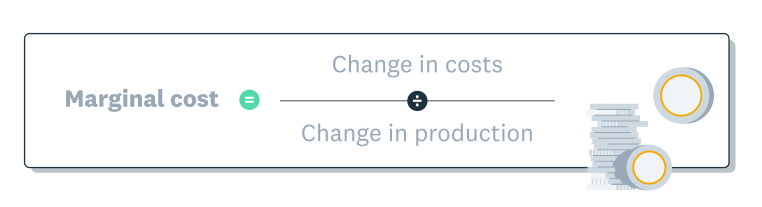
The marginal cost formula is:
Marginal cost = Change in total costs ÷ Change in quantity produced
To use it, calculate how much your total costs increase when you produce one additional unit, then divide by one. For example, if making one more product adds $5 to your costs, your marginal cost is $5.
Marginal cost example
Example: Mohammed's bakery
Mohammed currently makes 100 cakes at a total cost of $1,000 ($10 per cake). If he makes one additional cake, his total costs rise to $1,005.
- Calculate the change in total cost: $1,005 – $1,000 = $5
- Calculate the marginal cost: $5 ÷ 1 = $5
Mohammed's marginal cost of $5 is lower than his average cost of $10 per cake. This means he could increase his profit by producing that extra unit.
Marginal revenue vs marginal cost
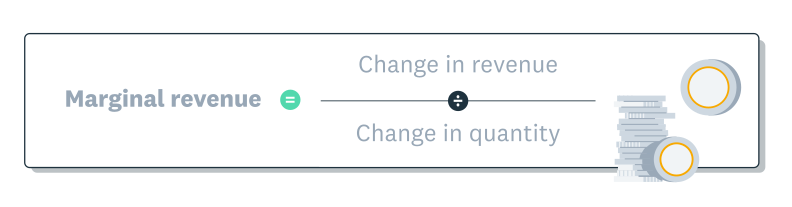
Marginal revenue is the additional income you earn from selling one more unit. While marginal cost tracks your expenses, marginal revenue tracks your earnings.
The marginal revenue formula is:
Marginal revenue = Change in revenue ÷ Change in quantity sold
To maximise profits, aim for your marginal cost to equal your marginal revenue. Beyond this point, producing more leads to diminishing returns because increased supply can lower demand and reduce your price per unit.
Example of marginal revenue
Example: Alison's wallet stall
Alison sells wallets at a market for $30 each. She could sell surplus stock to another vendor across town for $20 per wallet. Her marginal revenue would be $20 for each extra wallet sold.
If her marginal cost is $22 (including travel), she would lose $2 on each transaction. To make this worthwhile, she needs her marginal cost to equal or fall below her marginal revenue.
Her options include:
- negotiate a higher wholesale price for bulk orders
- sell to a vendor closer to her location to reduce travel costs
- find a cheaper way to transport the wallets
Analysing these revenue-to-cost ratios helps Alison decide whether the extra sales are worth pursuing, a process that some management accounting systems formalise to analyse profitability through detailed contribution margin statements.
How to use marginal cost in pricing decisions
Your marginal cost directly influences how you price your products or services. It sets the floor for your pricing, showing you the minimum amount you need to charge to cover the cost of producing one more unit.
Here's how to apply marginal cost to pricing:
- Set your minimum price: Never price below your marginal cost for regular sales, or you'll lose money on every additional unit sold. This principle is a key part of making effective cost-related decisions.
- Evaluate discount offers: When considering bulk orders or promotions, check whether the discounted price still exceeds your marginal cost.
- Adjust for demand: If demand is high, you can price well above marginal cost. If demand drops, pricing closer to marginal cost may help you move excess inventory.
- Compare products: Calculate the marginal cost for each product line to identify which items offer the best profit margins.
For example, if your marginal cost is $15 per unit and you typically sell at $30, you have $15 of margin to work with. You might offer a 20% discount ($24) to a wholesale buyer and still make $9 per unit.
Why marginal cost matters for your business
Calculating your marginal cost accurately helps you make smarter decisions about production, pricing, and growth. Here's how:
- Pricing decisions: Find the price point where you cover costs and maximise revenue without losing customers.
- Production decisions: Determine whether making one more unit increases or decreases your overall profitability.
- Resource allocation: Decide which products to prioritise and when to invest in equipment or larger premises.
- Growth planning: Avoid overproduction that drives up costs or underproduction that leaves money on the table.
- Profit margins: Identify the production level where your costs and revenue are optimally balanced.
Understanding these factors helps you grow your business at the right pace without overextending your resources.
Track your costs with confidence using Xero
Understanding your marginal cost is just the start. You need accurate, real-time data to make it work for your business.
Xero accounting software automatically tracks your costs and revenue, giving you the insights you need to make smarter pricing and production decisions. With customisable reports and automatic calculations, you can see exactly how each unit affects your bottom line.
FAQs on marginal cost
Here are answers to common questions about marginal cost and how to use it in your business.
What causes marginal cost to increase?
Your marginal cost can increase due to several factors:
- rising labour costs, such as overtime pay for additional production
- production inefficiencies, like sourcing materials from more expensive suppliers
- capacity limits that require new investments in equipment, premises, or staff
Theoretically, when you hit these limits, each additional unit becomes more expensive to produce, though in practice, many firms report constant or even decreasing marginal costs.
How does marginal cost relate to supply and demand?
Marginal cost directly influences your production decisions based on market conditions. If your marginal cost is lower than your selling price, you're incentivised to produce more. If it exceeds your selling price, reducing output helps you avoid losses.
How do I use marginal cost in pricing decisions?
Use your marginal cost as a baseline minimum price. Any price above your marginal cost generates some profit on additional units, but to sustain your business long-term, ensure your overall pricing covers fixed costs too. Marginal cost is most useful when deciding whether to accept bulk orders, offer discounts, or produce more.
When should I recalculate my marginal cost?
Recalculate your marginal cost whenever production costs change significantly, such as when supplier prices increase, you hire additional staff, or you purchase new equipment. For most small businesses, reviewing quarterly or before you decide on major pricing changes provides enough insight to stay profitable.
What's the difference between marginal cost and average cost?
Marginal cost is the expense of producing one additional unit, while average cost is your total production cost divided by the number of units produced. Marginal cost helps you decide whether to produce more, while average cost shows your overall production efficiency. To maximise profit, produce until marginal cost equals marginal revenue, while keeping prices above your average cost.
Disclaimer
Xero does not provide accounting, tax, business or legal advice. This guide has been provided for information purposes only. You should consult your own professional advisors for advice directly relating to your business or before taking action in relation to any of the content provided.
Start using Xero for free
Access Xero features for 30 days, then decide which plan best suits your business.