How to calculate operating profit
Learn how to calculate operating profit using a simple formula and a worked ringgit example.
Published Monday 17 August 2026
Table of contents

How to calculate operating profit
Key takeaways
- Operating profit shows how much money your business earns from core operations after subtracting operating expenses and depreciation from gross profit.
- The formula excludes loan interest and tax because these costs don't reflect how well your day-to-day operations perform.
- Operating profit is also known as EBIT (earnings before interest and tax), making it a standard measure for comparing businesses.
- Tracking your operating profit margin helps you understand how efficiently your business converts revenue into profit from operations.
What is operating profit?
Operating profit is the amount of money your business earns from its core activities after deducting operating expenses and depreciation from gross profit. It's also called EBIT, which stands for earnings before interest and tax.

This metric focuses purely on how well your business operations perform. By excluding loan interest and tax, operating profit gives you a clearer view of profitability that isn't influenced by financing decisions or tax rates. It's a useful figure for understanding whether your everyday business activities generate healthy returns.
Operating profit formula
The operating profit formula is straightforward once you understand its components.
Operating profit = gross profit – operating expenses – depreciation
Handy resources
Advisor directory
You can search for experts in our advisor directory
How to manage your finances and cash flow
Learn about money management for your small business
Financial reporting
Keep track of your performance with accounting reports
Gross profit is your revenue minus the direct cost of goods sold. Operating expenses include costs like rent, utilities, wages and marketing, but exclude loan interest. Depreciation accounts for the gradual reduction in value of your business assets over time.
Interest is excluded because it depends on the lender's rate rather than your operational performance. Tax is also left out, which is why operating profit is known as EBIT (earnings before interest and tax). This makes the figure more useful for comparing businesses with different financing structures or tax situations.
How to calculate operating profit
Follow these steps to calculate your operating profit. You'll need your revenue figures, cost of goods sold and operating expense totals.
- Calculate your gross profit by subtracting the cost of goods sold from your total revenue.
- Add up all your operating expenses, including rent, utilities, wages, marketing and other day-to-day costs. Don't include loan interest or tax.
- Calculate depreciation for any business assets that lose value over time.
- Subtract your operating expenses and depreciation from your gross profit to get your operating profit.
Example of an operating profit calculation
Here's a worked example using ringgit to show how the calculation works in practice.
Suppose your business sold RM20,000 worth of products and services during the month. The direct cost to provide those products and services was RM8,000. Your gross profit is RM20,000 – RM8,000 = RM12,000.
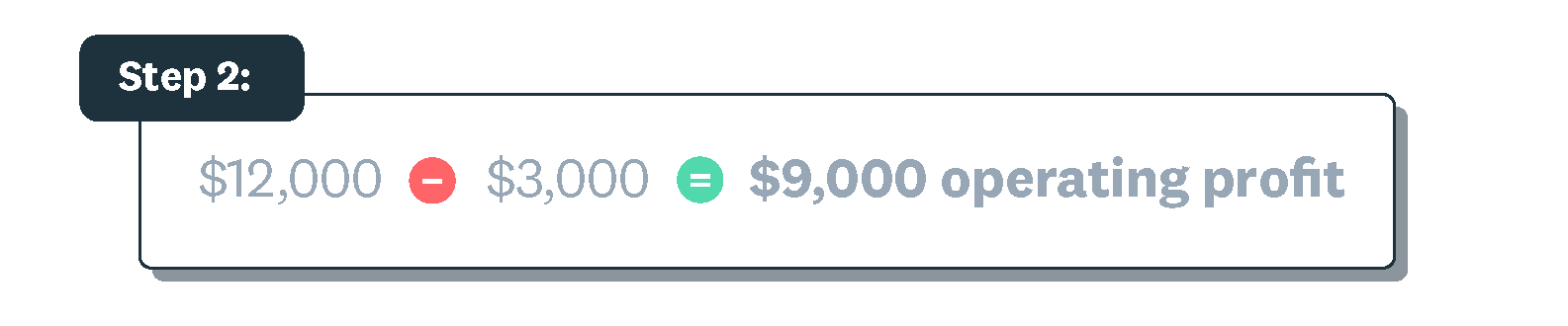
Your operating expenses for the month were RM3,000, covering rent, electricity and phone. Subtracting these from gross profit gives you an operating profit of RM12,000 – RM3,000 = RM9,000.
Operating profit margin
Your operating profit margin shows what percentage of revenue remains as operating profit. It helps you assess how efficiently your business turns sales into profit from core operations.
The formula is: operating profit margin = (operating profit ÷ revenue) × 100
Using the example above, your operating profit margin would be (RM9,000 ÷ RM20,000) × 100 = 45%. This means 45 sen of every ringgit in revenue becomes operating profit. A higher margin indicates stronger operational efficiency. Comparing your profit margin over time or against industry benchmarks helps you spot trends and areas for improvement.
Operating profit vs other profit measures
Operating profit is one of several profit metrics, and each tells you something different about your business finances.
- Gross profit is your revenue minus the cost of goods sold. It shows how much you earn before accounting for operating expenses, depreciation, interest or tax.
- Operating profit (EBIT) is gross profit minus operating expenses and depreciation. It reflects your earnings from core operations before interest and tax.
- Net profit is what remains after all expenses, including interest and tax. It's your bottom-line profit figure.
- EBITDA (earnings before interest, tax, depreciation and amortisation) adds back depreciation and amortisation to operating profit. It's often used to compare businesses with different capital structures.
- NOPAT (operating profit after tax) is your operating profit with tax deducted. It shows operational earnings after accounting for the tax impact.
Why operating profit matters
Operating profit helps you measure profitability from your core business activities. It strips away financing and tax factors, giving you a clearer picture of operational performance.
Tracking this metric regularly helps you make informed decisions about pricing, cost control and business growth. You can review operating profit in your profit and loss report to see how your operations perform over time.
Watch out for these common mistakes when calculating operating profit:
- Including loan interest or tax in your calculation, which belong in net profit instead.
- Forgetting to subtract depreciation, which can overstate your operating profit.
- Confusing operating profit with net profit, which accounts for all expenses including interest and tax.
Track your operating profit with Xero
Xero makes it simple to monitor your operating profit alongside other key financial metrics. With automated bank feeds and real-time reporting, you can see how your business performs without manual calculations.
Try Xero accounting software and get one month free. You'll have the tools to track profitability, manage expenses and make confident business decisions.
FAQs on operating profit
Here are answers to common questions about operating profit and how to use it in your business.
What does operating profit tell you?
Operating profit tells you how much money your business earns from its core operations. It shows whether your day-to-day activities are profitable before factoring in financing costs and tax.
What is excluded from operating profit?
Operating profit excludes loan interest and tax. These are left out because they depend on financing arrangements and tax rates rather than operational performance.
Is operating profit the same as EBIT?
Yes, operating profit and EBIT (earnings before interest and tax) are the same thing. Both terms describe profit from operations before deducting interest and tax expenses.
How do you calculate operating profit margin?
Divide your operating profit by total revenue, then multiply by 100 to get a percentage. This shows what portion of each ringgit in sales becomes operating profit.
Related terms
Learn more about operating profit
Handy resources
Advisor directory
You can search for experts in our advisor directory
Profit & Loss template
Download Xero’s profit and loss statement template to show how much money you business is making
Financial reporting
Keep track of your performance with accounting reports
Disclaimer
This glossary is for small business owners. The definitions are written with their requirements in mind. More detailed definitions can be found in accounting textbooks or from an accounting professional. Xero does not provide accounting, tax, business or legal advice.