Marginal cost explained: formula, examples and tips
Learn how marginal cost helps you price right, plan smarter, and grow profit.

Written by Lena Hanna—Trusted CPA Guidance on Accounting and Tax. Read Lena's full bio
Published Thursday 2 April 2026
Table of contents
Key takeaways
- Calculate marginal cost by dividing the change in total costs by the change in quantity produced to determine whether increasing production will boost or reduce your profits.
- Compare your marginal cost to your average cost of production - if marginal cost is lower than average cost, increasing production can boost profit margins.
- Find your profit maximisation point by ensuring marginal cost equals marginal revenue, as producing beyond this point costs more than you earn from selling additional units.
- Review your marginal cost regularly before major business decisions like expanding production, adjusting prices, or investing in new equipment to make data-driven choices.
What is marginal cost?
Marginal cost is the additional expense of producing one more unit of a product or service. This concept helps you understand whether increasing production will boost or reduce your profits.
Before expanding operations, you need to understand how additional production affects your costs, cash flow, and pricing. Calculating your marginal cost is the first step in making that decision.
Why marginal cost matters for your business
Understanding your marginal cost helps you make smarter business decisions:
- Set profitable prices: Find the price point that covers costs while staying competitive
- Determine production levels: Know when to scale up and when to hold steady
- Allocate resources efficiently: Identify which products or services deliver the best returns
- Plan sustainable growth: Avoid expanding too fast and driving up costs without matching revenue
Grow by too little and you won't fully benefit from spreading your fixed costs and bringing down your price per unit. But grow too much and your costs might spiral without enough of an uptick in production and sales.
What are the main components of marginal cost?
To calculate marginal cost, understand the two main cost categories:
- Variable costs: expenses that increase with output, such as materials, hourly wages, and energy bills
- Fixed costs: expenses that stay the same regardless of output, such as machinery, rent, and salaries
Increasing production spreads your fixed costs across more units, which can lower your cost per unit.
How to calculate marginal cost
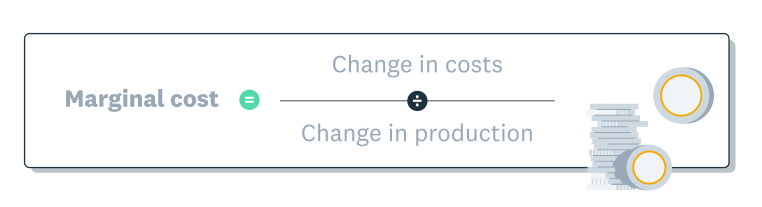
The marginal cost formula shows how your total costs change when you produce one additional unit.
Marginal cost = Change in total costs ÷ Change in quantity
Each part means:
- Change in total costs: how much your expenses increase when producing more units
- Change in quantity: the number of additional units you produce (often one)
Compare marginal cost to average cost
Compare your marginal cost to your average cost of production to guide your next steps:
- Marginal cost lower than average cost: increasing production can boost your profit margins
- Marginal cost higher than average cost: maintaining current production levels is likely the better choice
Step-by-step calculation example
Mohammed, a bakery owner, calculates his marginal cost like this:
Current situation: Mohammed makes 100 cakes at a total cost of $1,000 ($10 per cake). Making one additional cake increases his total cost to $1,005.
- Calculate the change in total cost: $1,005 – $1,000 = $5
- Calculate the change in quantity: one additional cake
- Apply the formula: $5 ÷ 1 = $5 marginal cost
- Interpret the result: The marginal cost of $5 is lower than his average cost of $10 per cake, so expanding production could increase his profits.
Marginal revenue vs marginal cost
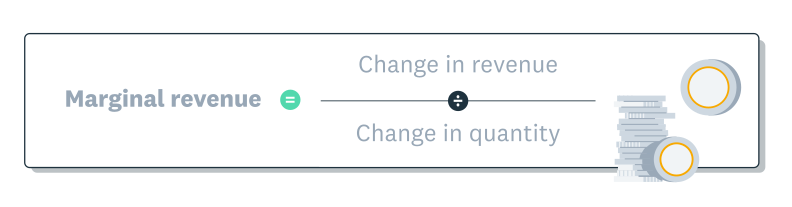
Marginal revenue is the additional income you earn from selling one more unit. While marginal cost measures the expense of producing that unit, marginal revenue measures what you earn from selling it.
The formula for marginal revenue is:
Finding your profit maximisation point
Profit maximisation occurs when your marginal cost equals your marginal revenue. Beyond this point, producing more units costs more than you earn from selling them. Too much supply can also reduce demand and lower your price per unit.
Example of marginal revenue
Let's say Alison sells wallets at a market stall for $30 each. If she can't sell all her stock, she could supply the surplus wallets to another vendor across town at a rate of $20.
If selling one additional wallet to the other vendor increases total revenue by $20, then the marginal revenue of that extra sale is $20. If her marginal cost is higher than this – say, $22 – then she would not make a profit on this single-unit transaction.
Alison's marginal revenue is $20 per wallet. If her marginal cost is $22, she loses money on each sale. To make the deal profitable, she needs to bring her marginal cost down to match her marginal revenue.
Her options:
- Negotiate a higher price: secure a larger wholesale order to increase revenue per unit
- Reduce transport costs: sell to a closer vendor to lower delivery expenses
- Find cheaper logistics: explore less expensive shipping or travel methods
Track your costs with confidence in Xero
Xero accounting software helps you track costs and make data-driven decisions:
- Automatic calculations: keep your cost data accurate and up-to-date
- Customisable reports: get clear visibility into revenue and expenses
- Real-time insights: monitor how production changes affect your bottom line
- Cloud-based collaboration: work with your accountant or bookkeeper in one place
Ready to simplify your cost management? Get one month free and see how Xero helps you make smarter business decisions.
FAQs on marginal cost
Common questions about marginal cost and how to use it in your business.
What causes marginal cost to increase?
Factors that can increase your marginal cost:
- Rising labour expenses: overtime pay or hiring additional staff
- Higher material costs: sourcing from more expensive suppliers
- Capacity limits: needing new equipment or larger premises to produce more
How does marginal cost relate to supply and demand?
When your marginal cost is lower than your selling price, increasing production makes sense. When marginal cost exceeds the selling price, reducing output helps you avoid losses.
When should I calculate my marginal cost?
Calculate your marginal cost before major business decisions, such as expanding production, adjusting prices, or investing in new equipment. Review it regularly during growth phases or when your costs change significantly.
How do I know if my marginal cost is too high?
Your marginal cost may be too high if it exceeds your marginal revenue or your average cost of production. Compare your costs to industry benchmarks and review whether you can reduce expenses through better suppliers, improved efficiency, or economies of scale.
Disclaimer
Xero does not provide accounting, tax, business or legal advice. This guide has been provided for information purposes only. You should consult your own professional advisors for advice directly relating to your business or before taking action in relation to any of the content provided.
Start using Xero for free
Access Xero features for 30 days, then decide which plan best suits your business.