Payroll
Learn what payroll is, how it works in Indonesia, and what PPh 21, BPJS and THR mean for your business.
Published Wednesday 30 September 2026
Table of contents
Key takeaways
- Payroll is how you work out and pay employee wages, then record the tax and social security amounts that go with them
- Indonesian employers withhold income tax (PPh 21) monthly using average effective rates, then recalculate the full year in December
- You and your employees share BPJS Kesehatan and BPJS Ketenagakerjaan contributions, and some wage caps change annually
- Indonesian law requires a payslip every payday and a religious holiday allowance (THR) for staff with at least one month’s service
What is payroll?
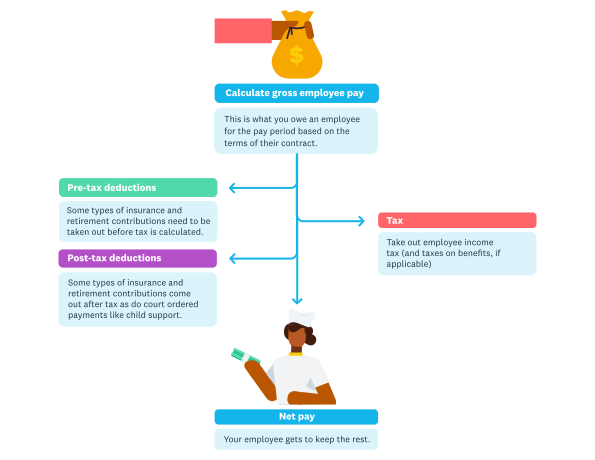
Payroll is what happens each payday and involves sending the right amounts of money to the employee, but also to a number of other locations.
Payroll is the process of calculating and paying your employees’ wages, including the tax and social security contributions you withhold and report. The word also describes the list of people you pay and your total wage bill.
Salary is the amount one employee earns under their contract. Payroll is the system that turns each salary into take-home pay, plus the tax and BPJS (Badan Penyelenggara Jaminan Sosial, social security) payments you owe.
Picture a café in Bandung with six staff. Each person’s salary stays fixed in their contract, while the monthly wage bill shifts as overtime hours and deductions change.
Many Indonesian businesses open a dedicated payroll account with their bank. It lets you pay every employee in one mass transfer, rather than sending each payment separately.
How payroll works in Indonesia
The payroll process in Indonesia runs in three stages each pay period. Splitting the work this way helps you catch errors before money leaves your account.
1. Pre-payroll: gather and check data
Before each pay run, you confirm who’s on the team and what they’re owed. That means updating new starters and leavers, attendance, overtime, leave and any salary changes.
Checking this data first keeps payslips accurate.
2. Payroll: calculate and pay wages
Next, you calculate gross pay and subtract employee BPJS contributions and income tax to reach each person’s net pay. You then transfer wages, often as a single bulk payment from your dedicated account, and give each employee a payslip.
3. Post-payroll: pay tax and file reports
After payday, you pay the tax and BPJS contributions you’ve withheld, along with your employer share. You also file the monthly tax return and record wage costs in your books.
What is included in payroll?
Your payroll includes all amounts you pay an employee and all amounts you deduct from their pay. In Indonesia, these components usually appear on a payslip:
- Base salary (gaji pokok) is the fixed monthly amount set in the employment contract
- Fixed allowances (tunjangan tetap) are regular monthly amounts, such as a position allowance, paid regardless of attendance
- Variable allowances (tunjangan tidak tetap) are amounts linked to attendance or activity, such as meal or transport allowances
- Overtime pay (upah lembur) is extra pay for approved hours beyond normal working time
- Bonuses and incentives are performance-based or discretionary payments
- Religious holiday allowance (Tunjangan Hari Raya, THR) is a legal entitlement paid once a year before a religious holiday
- Deductions are employee BPJS contributions, income tax and any agreed amounts, such as loan repayments
Payroll deductions and contributions
Deductions in Indonesia fall into two groups: income tax and social security contributions. Some amounts come out of the employee’s pay, while others are costs you pay on top as the employer.
PPh 21 income tax
Pajak Penghasilan Pasal 21 (PPh 21) is the income tax you withhold from employment income and pay to the Directorate General of Taxes (DJP). Since 1 January 2024, Government Regulation (PP) 58/2023 and Minister of Finance Regulation (PMK) 168/2023 have set how you calculate it.
In the 11 months before December, you multiply each employee’s gross monthly income by an average effective rate (tarif efektif rata-rata, TER). That rate depends on the employee’s non-taxable income (Penghasilan Tidak Kena Pajak, PTKP) category and their gross income. The TER method changes the timing of withholding, and the employee’s total tax for the year stays the same.
In December, you recalculate the employee’s tax for the whole year using progressive rates, then withhold the balance. The basic PTKP allowance is Rp54 million a year, plus Rp4.5 million for a married employee and Rp4.5 million for each dependant, up to three.
The annual progressive rates apply to taxable income after PTKP:
- 5% on income up to Rp60 million
- 15% on income over Rp60 million up to Rp250 million
- 25% on income over Rp250 million up to Rp500 million
- 30% on income over Rp500 million up to Rp5 billion
- 35% on income over Rp5 billion
A temporary government-borne PPh 21 incentive (ditanggung pemerintah, DTP) runs through December 2026 under PMK 105/2025. It’s limited to employees earning up to Rp10 million a month in listed sectors, such as textiles, footwear, furniture and tourism.
BPJS Kesehatan
BPJS Kesehatan is the agency that runs Indonesia’s national health insurance. Under Presidential Regulation (Perpres) 64/2020, the contribution is 5% of monthly wages: you pay 4% and the employee pays 1%.
As of September 2026, the wage used for this calculation is capped at Rp12 million a month. The minimum base is the local minimum wage for your regency or city.
BPJS Ketenagakerjaan
BPJS Ketenagakerjaan covers employment social security through several programmes, each with its own rate. As of 2026, the contribution rates for formal employees are:
- Old-age savings (Jaminan Hari Tua, JHT) at 5.7% of wages, with 3.7% from you and 2% from the employee
- Work accident insurance (Jaminan Kecelakaan Kerja, JKK) at 0.24–1.74%, paid by you based on the job’s risk level
- Death insurance (Jaminan Kematian, JKM) at 0.3%, paid by you
- Pension (Jaminan Pensiun, JP) at 3%, with 2% from you and 1% from the employee
JP contributions apply to wages up to a ceiling that’s adjusted every March. From 1 March 2026, the JP wage ceiling is Rp11,086,300 a month.
Job-loss insurance (Jaminan Kehilangan Pekerjaan, JKP) comes with no separate deduction. Under PP 6/2025, the government funds JKP together with 0.14% redirected from your JKK contribution.
Payroll calculation example
Here’s a simple example for one employee in Jakarta earning Rp8,000,000 a month, above the 2026 provincial minimum wage. Assume there’s no overtime or bonus that month.
The employee’s BPJS deductions come to:
- Rp80,000 for BPJS Kesehatan at 1%
- Rp160,000 for JHT at 2%
- Rp80,000 for JP at 1%, as the wage sits below the Rp11,086,300 ceiling
That leaves Rp7,680,000 before income tax. Next, apply the TER rate for the employee’s PTKP category and gross income. Subtracting that PPh 21 gives you the final take-home pay.
Your own contributions sit on top of the salary. At the lowest JKK risk level, they come to:
- Rp320,000 for BPJS Kesehatan at 4%
- Rp296,000 for JHT at 3.7%
- Rp160,000 for JP at 2%
- Rp24,000 for JKM at 0.3%
- Rp19,200 for JKK at 0.24%
That’s Rp819,200 in employer contributions, so this employee costs you Rp8,819,200 a month before THR.
How to set up payroll for the first time
Most set-up tasks happen once, before your first payday. Work through these steps in order and each later pay run gets quicker.
1. Register your business for tax
Your business needs a taxpayer identification number (Nomor Pokok Wajib Pajak, NPWP) before it can withhold and pay PPh 21. Register with the DJP and check that your account is active in Coretax, the online tax system.
2. Register employees with BPJS
Indonesian law requires you to register your employees with BPJS Kesehatan and BPJS Ketenagakerjaan. Enrol each person when they join, so their cover and contributions begin promptly.
3. Collect employee data
Gather each employee’s national identity number (Nomor Induk Kependudukan, NIK), NPWP, PTKP status and bank account details. Adding this to your employee onboarding means new starters are ready to be paid from day one.
4. Check your provincial minimum wage
Each province sets its own minimum wage (Upah Minimum Provinsi, UMP) every year, and your wages must meet it. For example, DKI Jakarta’s UMP for 2026 is Rp5,729,876 a month.
Check your own province’s current decree before you finalise salaries. Some regencies and sectors set higher minimums.
5. Choose a payroll method
Decide whether you’ll handle pay runs yourself, hand them to a professional or use software. The next section compares each option.
6. Run your first payroll and issue payslips
Calculate pay and make the transfers, then give each employee a payslip showing how you worked out their pay. A payslip template gives you a consistent format from the first month.
After payday, pay and report the tax and contributions by their deadlines.
Ways to run payroll
The best option depends on how many people you employ and how much time you can spare. Here are the three main options.
Manual or spreadsheet payroll
A spreadsheet can work when you have one or two employees on simple pay. You’ll update TER rates, BPJS caps, minimum wages and overtime rules yourself, so accuracy rests on your formulas.
Accountant or bookkeeper
An accountant or bookkeeper can take over your pay runs and tax filings, and advise you on compliance. You can find a certified professional near you in the Xero Advisor Directory.
Payroll software
Dedicated payroll software calculates pay and produces payslips each pay run, using employee records you store once. Choose an option that connects with your accounting, so wage costs flow straight into your books.
Software for pay runs is one part of wider business automation. It cuts repeat data entry across invoicing, bills, bank reconciliation and pay runs.
Payroll compliance and legal requirements
Several regulations shape how you pay staff in Indonesia. Here are the main requirements for small employers.
Pay frequency and minimum wage
Under PP 36/2021 on wages, you must pay employees at least once a month. Wages must also meet your provincial UMP, which changes each year.
Payslips
Article 53(2) of PP 36/2021 requires you to give each employee a payslip every time you pay them. The payslip must show a breakdown of the wages they receive.
Overtime
PP 35/2021 sets overtime pay using an hourly wage of 1/173 of the monthly wage. On a normal workday, you pay 1.5 times that rate for the first hour and 2 times for each hour after.
For the Rp8,000,000 employee above, the hourly rate is about Rp46,243. Two overtime hours on a workday earn about Rp161,850.
Overtime is capped at four hours a day and 18 hours a week. Staff working four or more overtime hours must get food and drink of at least 1,400 kilocalories, provided as a meal rather than cash.
Religious holiday allowance (THR)
Minister of Manpower Regulation (Permenaker) 6/2016 requires THR for employees with at least one month of continuous service. Staff with 12 months or more receive one month’s wages. Newer staff get a pro-rated amount: months worked, divided by 12, times one month’s wages.
For example, an employee on Rp8,000,000 with six months’ service receives Rp4,000,000. You must pay THR in full no later than seven days before the religious holiday, separately from any bonus you choose to give.
PPh 21 payment and filing deadlines
Under PMK 81/2024, you pay withheld PPh 21 by day 15 of the following month. You then file the monthly return (SPT Masa PPh 21/26) by day 20. For September wages, that means paying by 15 October and filing through Coretax by 20 October.
If a deadline falls on a weekend or public holiday, it moves to the next working day. After the tax year ends, you also give each employee an annual withholding slip showing the tax you deducted.
Record keeping
The Law on General Provisions and Tax Procedures (UU KUP), Article 28(11), requires you to keep books and supporting documents for 10 years in Indonesia. That includes payroll records such as payslips, timesheets, tax calculations and BPJS payments, whether on paper or stored electronically.
Simplify your payroll with Xero
Getting set up properly from the start turns each pay run into a routine task. Xero brings your bookkeeping and payroll together with real-time cash flow reporting, so you can see exactly what your team costs.
You can also invite your accountant or bookkeeper to work alongside you on the same numbers. Try Xero today and get one month free to see how it fits your business.
FAQs on payroll
Here are quick answers to common questions about paying employees in Indonesia.
Is payroll the same as salary?
No, salary is the gross amount in an employee’s contract. Payroll also covers pay outside that figure, such as overtime and THR, plus the deductions and employer contributions linked to it.
Is a payslip the same as payroll?
A payslip is one output of payroll: the record each employee receives showing their pay for that period. PP 36/2021 backs this duty with administrative sanctions, including written warnings and business suspension.
How often do you need to pay employees in Indonesia?
You can pay daily, weekly or monthly, as long as no more than one month passes between paydays. Wages must be paid in Indonesian Rupiah.
Is THR part of payroll?
Yes, you pay THR through payroll to both permanent and fixed-term contract employees. If your company regulations or collective agreement offer more generous THR terms, those terms apply.
Do you need payroll for just one employee?
Yes, a single employee brings the same duties as a larger team, including BPJS registration and PPh 21 withholding. A monthly checklist keeps a one-person payroll quick to run.
Related terms
Learn more about payroll
Handy resources
Advisor directory
You can search for experts in our advisor directory
Your guide to hiring
Learn tips for hiring, onboarding and paying an employee, while keeping everyone happy
Payroll with Xero
Learn how Xero can help with your payroll requirements
Disclaimer
This glossary is for small business owners. The definitions are written with their requirements in mind. More detailed definitions can be found in accounting textbooks or from an accounting professional. Xero does not provide accounting, tax, business or legal advice.