What is an accounting period?
Learn what an accounting period is, the main types, and how Indonesian tax rules shape your book year.
Published Tuesday 27 October 2026
Table of contents
Key takeaways
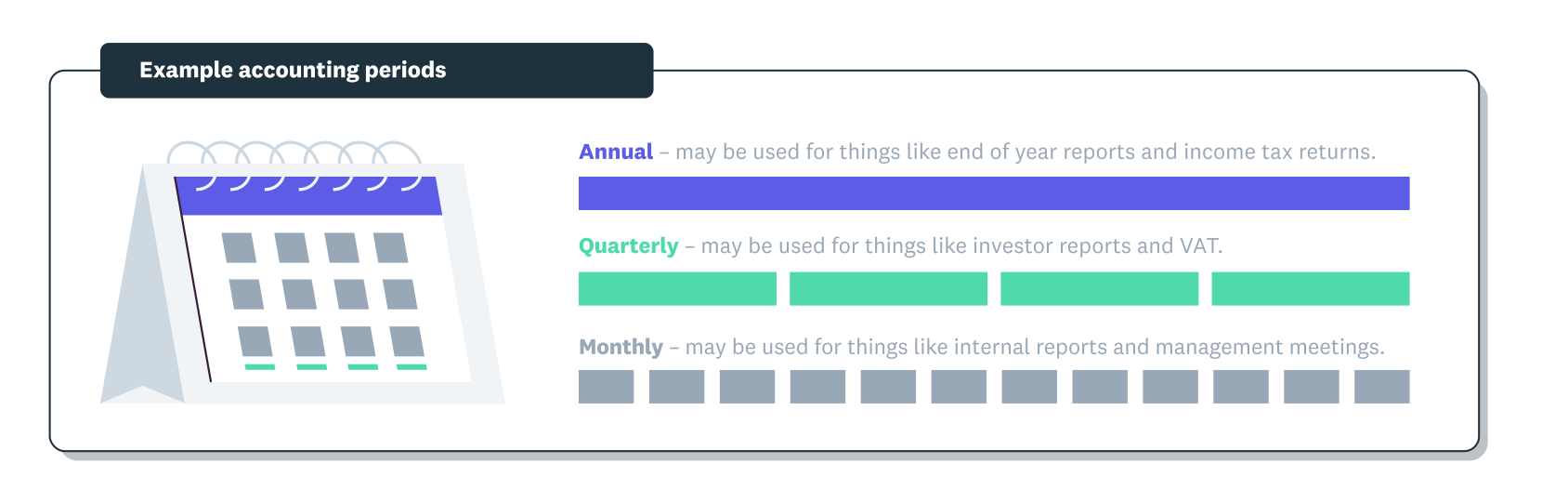
Annual accounting periods don’t have to start in January. Nor do monthly accounting periods have to start on the first of the month.
- An accounting period is a set timeframe your business uses to record, report, and analyse financial activity, typically covering a month, quarter, or year.
- The most common types are the calendar year (January to December), fiscal year (any 12-month cycle), quarterly periods, and monthly periods.
- Choosing the right accounting period depends on your industry's seasonal patterns, tax filing requirements, and how often you need financial updates.
- At the end of each accounting period, you'll close your books, prepare financial statements, and use those results to plan your next steps.
What is an accounting period?
An accounting period is a specific timeframe during which your business records and reports all of its financial transactions. It creates a consistent window for measuring revenue, expenses, and overall performance as part of your small business accounting process.
Most businesses use 12-month accounting periods, but shorter intervals like quarters or months also count. The key requirement is consistency: once you select an accounting period, you should use the same cycle each year so your financial data stays comparable over time.
Handy resources
Advisor directory
You can search for experts in our advisor directory
Xero Small Business Guides
Discover resources to help you do better business
Try Xero for free
Try Xero’s fast, simple, powerful online accounting software for your small business
Disclaimer
This glossary is for small business owners. The definitions are written with their requirements in mind. More detailed definitions can be found in accounting textbooks or from an accounting professional. Xero does not provide accounting, tax, business or legal advice.
Accounting periods form the foundation of your financial statements, including your income statement, balance sheet, and cash flow statement. A defined period gives you a reliable way to track whether your business is growing, shrinking, or staying steady.
Handy resources
Advisor directory
You can search for experts in our advisor directory
Xero Small Business Guides
Discover resources to help you do better business
Try Xero for free
Try Xero’s fast, simple, powerful online accounting software for your small business
Why accounting periods matter for your business
Accounting periods give your financial data structure and meaning. They let you compare performance from one period to the next, spot trends, and make informed decisions about spending, pricing, and growth.
Here are some of the reasons accounting periods matter for small businesses:
- Track performance by comparing revenue and expenses across consistent timeframes
- Pay most monthly taxes by day 15 and file SPT Masa PPh (monthly income tax returns) by day 20 of the following month, under Finance Ministry Regulation 81/2024
- Prepare accurate annual tax returns (SPT Tahunan) by 31 March for individuals and 30 April for companies
- Satisfy lender and investor requirements for organised financial reporting
- Identify seasonal patterns in your cash flow so you can plan ahead
- Simplify budgeting and forecasting by working with predictable reporting cycles
If you're applying for a loan, seeking investors, or filing taxes, having clearly defined accounting periods shows that your finances are well organised. Lenders and tax authorities expect to see financial statements tied to specific date ranges.
Types of accounting periods
Businesses can choose from several types of accounting periods depending on their reporting needs. Here are the four most common options for small businesses.
Calendar year
A calendar year accounting period runs from 1 January to 31 December. It's the most straightforward option for many small businesses.
This period works well if your business doesn't have strong seasonal cycles. In Indonesia, the tax year (tahun pajak) normally follows the calendar year, which simplifies filing. You can still keep a different book year (tahun buku) if it suits your business better.
Fiscal year
A fiscal year is any 12-month period that doesn't follow the standard January-to-December calendar. For example, a fiscal year might run from 1 July to 30 June or from 1 October to 30 September.
Businesses with strong seasonal revenue often prefer a fiscal year. A seasonal business, for instance, might end its fiscal year after peak season wraps up, giving a clearer picture of annual performance. If you want to change your book year for tax purposes, you'll need approval from the Director General of Taxes under Article 28(6) of the General Tax Provisions and Procedures Law (UU KUP).
Quarterly period
A quarterly accounting period divides the year into four equal segments of three months each. Many businesses use quarters for internal reporting even if they file taxes annually.
Quarterly periods are especially useful for keeping your monthly tax instalments on track. If you're not on the final micro, small and medium enterprise (MSME) tax regime, you pay income tax Article 25 (PPh 25) instalments monthly, generally net income × tax rate ÷ 12, due by day 15 of the following month.
Quarterly reviews also help you catch financial problems early, since you're reviewing your numbers every three months instead of waiting until year-end.
These quarterly snapshots can reveal meaningful shifts in your sales, such as growth that speeds up one quarter and slows the next; patterns like this only show up when you compare one accounting period to the next.
Monthly period
A monthly accounting period closes your books every month, giving you the most frequent view of your financial position. This is common for businesses with high transaction volumes or tight cash flow.
Monthly periods work best when you need to track expenses closely or report to stakeholders regularly. The tradeoff is more administrative work each month, but cloud accounting software can automate much of the closing process.
How to choose the right accounting period
Selecting the right accounting period comes down to matching your reporting cycle with your business's rhythm. There's no single best option; the right choice depends on a few practical factors.
Consider these when deciding on your accounting period:
- Seasonality: if your revenue peaks at a certain time of year, choose an accounting period that captures a full business cycle so your results aren't skewed
- Tax requirements: in Indonesia, your book year sets your tax year, and changing it needs approval from the Directorate General of Taxes (DJP)
- Reporting frequency: if you need regular financial updates for investors or lenders, quarterly or monthly periods add more checkpoints
- Industry norms: some industries have common reporting cycles; retailers, for example, may want a period that captures the full Ramadan and Lebaran trading peak
- Administrative capacity: shorter periods mean more frequent closings, so make sure you have the time or tools to manage the workload
If you're just starting out, the calendar year is usually the simplest choice and pairs well with a straightforward accounting system. You can always request a change later by applying to DJP at least one month before the new book year starts, though switching mid-stream takes some extra paperwork.
Key accounting principles for accounting periods
Several core accounting principles shape how you record transactions within each accounting period. Understanding these helps you keep your books accurate and compliant.
Accrual method of accounting
The accrual method records revenue when you earn it and expenses when you incur them, regardless of when cash changes hands. This approach gives you a more complete picture of your financial position within each accounting period.
For example, if you deliver a service in March but don't receive payment until April, the accrual method records that revenue in March. This matters because it keeps your income statement aligned with the period where the work actually happened.
Revenue recognition
The revenue recognition principle says you should record revenue in the accounting period when you've fulfilled your obligation to the customer. You don't wait until the cash arrives, and you don't record it before you've delivered.
This principle is especially relevant if you offer subscriptions, long-term contracts, or milestone-based projects. Each accounting period should reflect only the revenue you've actually earned during that window.
Matching principle
The matching principle requires you to record expenses in the same accounting period as the revenue they helped generate. This gives you an accurate view of profitability for each period.
If you spend Rp20.000.000 on materials in June to complete a project that earns Rp80.000.000 in June, both the cost and the income belong in the same period. Mismatching them would distort your profit margins and make it harder to see how your business is really performing.
What happens at the end of an accounting period?
At the end of each accounting period, you close your books by recording final adjustments and preparing your financial statements. This process ensures your records are accurate and ready for analysis or filing.
End-of-period tasks typically include:
- Reconciling your bank accounts to confirm all transactions are recorded
- Making adjusting entries for prepaid expenses, depreciation, and accrued revenue
- Closing temporary accounts like revenue and expenses so they reset for the next period
- Preparing your income statement, balance sheet, and cash flow statement
- Reviewing your results to inform budgets and plans for the upcoming period
For small businesses, the closing process can be quick and manageable. Automated reporting tools can help handle much of the heavy lifting, from bank reconciliation to generating financial statements.
Simplify your accounting with Xero
Managing your accounting periods is simpler when your financial data is organised in one place. Xero's cloud accounting software automates data ingestion through bank feeds and document uploads, and brings your accounting data into easy-to-read reports so you can close each period with confidence.
Whether you're running monthly, quarterly, or annual accounting periods, Xero helps you stay on top of your numbers and spend less time on manual admin. Choose a plan today and get one month free.
FAQs on accounting periods
Here are some frequently asked questions about accounting periods.
Is an accounting period always 12 months?
No, an accounting period can be any consistent timeframe. While 12 months is the most common choice for annual reporting and tax filing, businesses also use quarterly (3-month) and monthly periods for internal tracking.
What is the difference between a fiscal year and a calendar year?
A calendar year always runs from 1 January to 31 December. A fiscal year is any 12-month period you choose, such as 1 April to 31 March, and it doesn't need to follow the calendar.
Can a business change its accounting period?
Yes, with DJP approval, and under Director General of Taxes Regulation PER-8/PJ/2025 you apply electronically through the taxpayer portal. DJP decides within 15 working days or the application is deemed approved, and you then report the leftover part-year in a separate SPT Tahunan (Bagian Tahun Pajak).