Payroll
Learn how payroll works in Hong Kong, from MPF and salaries tax to paying your team correctly and on time.
Published Thursday 6 August 2026
Table of contents
Key takeaways
- Payroll is the process of calculating and paying your employees, along with their Mandatory Provident Fund (MPF) contributions and any statutory entitlements.
- Hong Kong has no PAYE system, so you do not deduct salaries tax from each pay run. Your employees are assessed by the Inland Revenue Department (IRD), and you report their pay once a year on the Employer’s Return.
- You and each employee contribute 5% of the employee’s relevant income to the MPF, and you must pay wages within seven days of the end of the wage period.
- Getting payroll right keeps you compliant with the IRD, the MPF rules and the Employment Ordinance, and keeps your team paid accurately and on time.
What is payroll?
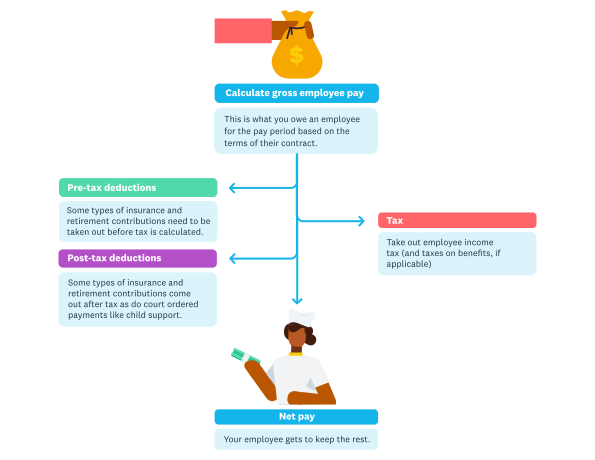
Payroll is what happens each payday and involves sending the right amounts of money to the employee, but also to a number of other locations.
Payroll is the process of calculating, managing and paying wages or salaries to your employees. It covers working out gross pay, applying MPF and any agreed deductions, keeping accurate records and reporting your employees’ pay to the IRD.
If you employ anyone in Hong Kong, payroll is one of the most important responsibilities you take on. Whether you have one employee or 50, the same core duties apply, and it helps to know how much to pay your employees before you run your first pay period.
How does payroll work in Hong Kong?
Running payroll in Hong Kong follows a cycle that repeats every pay period. Each time, you calculate gross pay, deduct the employee’s MPF contribution and any agreed deductions, then pay the net amount to your employee.
Unlike some countries, Hong Kong has no monthly income-tax withholding, so you do not take salaries tax out of each pay run. You do, however, have to pay wages promptly: under the Employment Ordinance, wages must be paid within seven days after the end of the wage period.
Salaries tax and payroll in Hong Kong
Hong Kong does not use a Pay As You Earn (PAYE) system, so you do not deduct salaries tax from your employees’ pay. Instead, each employee is assessed and pays salaries tax directly to the IRD, and you report every employee’s pay once a year on the annual Employer’s Return.
Salaries tax is charged on an employee’s net chargeable income at progressive rates of 2%, 6%, 10%, 14% and 17%, or at a standard rate of 15% (16% on net income above HK$5 million), whichever produces the lower tax. Because you are not the tax collector, your main duty is to report pay accurately and on time.
What is included in payroll?
Payroll is more than transferring money into a bank account. Several elements make up a complete pay run:
- Gross pay: the wages or salary an employee earns before any deductions
- MPF contributions: the employer and employee contributions to the employee’s retirement scheme
- Statutory entitlements: such as maternity, paternity and sickness allowance
- End of year payment or bonus: where this is provided for in the employment contract
- Extra earnings: overtime, commission and allowances that affect the final pay
Payroll deductions in Hong Kong
Deductions are the amounts taken from an employee’s gross pay before they receive their net pay. In Hong Kong the main statutory deduction is the employee’s 5% MPF contribution.
Other deductions, such as agreed voluntary deductions, must follow the Employment Ordinance, which limits the total you can deduct in any one wage period. Keep a clear record of the reason for every deduction so your payslips are easy to check.
How to set up payroll for the first time
Setting up payroll becomes manageable when you break it into clear steps. Follow this process to get started.
1. Register your business and keep employer records
Make sure your business is registered and set up to keep employment records. When you take on a new employee who is likely to be chargeable to salaries tax, you notify the IRD using Form IR56E.
2. Collect employee information
Gather the details you need from each employee, including their full name, Hong Kong Identity Card number, address, bank details for payment and MPF scheme details. Having this ready makes hiring employees and paying them far smoother.
3. Choose how you will run payroll
Decide whether you will run payroll yourself, use an accountant or bookkeeper, or use payroll software. Payroll software is often the most practical option for a small business because it automates calculations and record keeping.
4. Enrol eligible employees in an MPF scheme
You must enrol eligible employees in an MPF scheme soon after they start. Set up your payroll so it calculates and deducts the correct MPF contributions each pay period.
5. Run your first pay run and issue a payslip
Calculate each employee’s gross pay, deduct MPF and process the payment within seven days of the wage period ending. Give each employee an itemised payslip and keep a copy of all payroll records.
Ways to run payroll
There is no single right way to run payroll. The best approach depends on the size of your business, your budget and how much time you can give it.
Run payroll manually
You can run payroll yourself using a spreadsheet or a simple template. This works if you have a small team and straightforward pay, but you carry the risk of errors, and mistakes with MPF or wage timing can be costly.
Use an accountant or bookkeeper
Outsourcing payroll to an accountant or bookkeeper takes the admin off your plate. They handle the calculations, MPF and record keeping, which is a good option if you would rather focus on running your business, and it helps to know when to hire an accountant.
Use payroll software
Payroll software automates the calculation of pay and MPF contributions and generates payslips for your employees. Many tools connect with your accounting software, so payroll data flows straight into your books, keeping your small business accounting up to date without manual entry.
Payroll compliance and legal requirements
Getting payroll wrong can lead to fines and legal problems. Staying compliant means understanding your duties and meeting them consistently. As an employer, you are legally required to:
- Pay at least the Statutory Minimum Wage, which is HK$43.1 per hour from 1 May 2026
- Pay wages within seven days of the end of the wage period
- Give each employee an itemised payslip
- Enrol eligible employees in an MPF scheme and pay contributions on time
- Report your employees’ pay to the IRD on the annual Employer’s Return
- Keep proper payroll and employment records
Paying wages late is a criminal offence, so accurate, on-time pay runs are the simplest way to stay on the right side of the law.
Key payroll documents
Several documents are part of the payroll process. Knowing what each one is and when to use it helps you stay organised and meet your obligations.
Payslip
A payslip is an itemised record of an employee’s gross pay, deductions such as MPF, and net pay for each wage period. You must give every employee a payslip each payday, in paper or electronic form.
Employer’s Return (BIR56A and IR56B)
The IRD issues the Employer’s Return (Form BIR56A) each April. You submit it together with a Form IR56B for each employee, reporting their pay and benefits for the tax year.
IR56E, IR56F and IR56G
The IRD’s obligations for employers set the deadlines: file the annual BIR56A and IR56B within one month, Form IR56E for a new hire within three months of them starting, Form IR56F not later than one month before an employee stops working for you but stays in Hong Kong, and Form IR56G not later than one month before an employee leaves Hong Kong.
Statutory entitlements paid through payroll
Certain entitlements are set by the Employment Ordinance and are processed through your payroll for employees on a continuous contract. The main entitlements you may need to handle include:
- Maternity leave: 14 weeks of paid leave for an eligible employee
- Paternity leave: five days of paid leave for an eligible employee
- Sickness allowance: paid sick days that build up with length of service
- Statutory holidays: paid holidays set each year under the Employment Ordinance
- Annual leave: 7 to 14 paid days, rising with length of service
These entitlements are generally paid at four-fifths of the employee’s average daily wages.
MPF and payroll
The MPF is closely linked to payroll, and enrolling eligible staff is a legal duty. Both you and each employee contribute 5% of the employee’s relevant income, and you must enrol employees aged 18 to 64 within 60 days of them starting.
For monthly-paid staff, the minimum relevant income is HK$7,100 and the maximum is HK$30,000, so each side’s mandatory contribution is capped at HK$1,500 a month. Staff earning below HK$7,100 pay nothing, but you must still contribute 5%. Enrol eligible employees within 60 days and remit contributions by the 10th of each month through the eMPF Platform.
Since 1 May 2025, you can no longer use your mandatory MPF contributions to offset severance or long service payments for service after that date. If you are a company director, it also pays to understand the rules on paying yourself from your business.
Simplify your Hong Kong payroll with Xero
Payroll does not have to be complicated. When your accounting and payroll data sit together in one place, you save time, cut manual entry and get a clearer picture of your business finances.
Xero brings your finances together, helping you manage everything from invoicing and bank reconciliation to expenses and reporting. Whether you are running payroll for the first time or looking for a simpler way to manage it, you can get one month free and see how it fits your business.
FAQs on payroll
These are common questions employers ask about running payroll in Hong Kong.
How often do you have to run payroll in Hong Kong?
You run payroll on whatever pay cycle you set, most often monthly. Whichever cycle you choose, wages are due within seven days of the wage period ending.
Do employers deduct salaries tax from pay in Hong Kong?
No. Hong Kong has no PAYE system, so employees are assessed and pay salaries tax directly to the IRD while you report their pay on the annual Employer’s Return.
How much MPF does an employer contribute?
You contribute 5% of an employee’s relevant income, capped at HK$1,500 a month for monthly-paid staff. Your employee contributes the same 5% unless they earn below HK$7,100 a month.
Do you need to run payroll for just one employee?
Yes. Even with one employee you must pay wages on time, enrol them in the MPF if eligible and report their pay to the IRD.
Can you change your pay frequency after you have started?
Yes, you can change your pay cycle, but give employees reasonable notice and update your payroll records so their pay and MPF stay accurate.
Related terms
Learn more about payroll
Handy resources
Advisor directory
You can search for experts in our advisor directory
Your guide to hiring
Learn tips for hiring, onboarding and paying an employee, while keeping everyone happy
Payroll with Xero
Learn how Xero can help with your payroll requirements
Disclaimer
This glossary is for small business owners. The definitions are written with their requirements in mind. More detailed definitions can be found in accounting textbooks or from an accounting professional. Xero does not provide accounting, tax, business or legal advice.