What is a chart of accounts?
A chart of accounts lists every account you use to record transactions and organise your financial reports.
Published Thursday 6 August 2026
Table of contents
Key takeaways
- A chart of accounts is a complete list of every account your business uses to record financial transactions in the general ledger.
- There are five main account types: assets, liabilities, equity, revenue and expenses.
- Each account has a name, description and numeric general ledger code that groups similar transactions together.
- A well-organised chart of accounts makes financial reporting clearer and helps you make better business decisions.
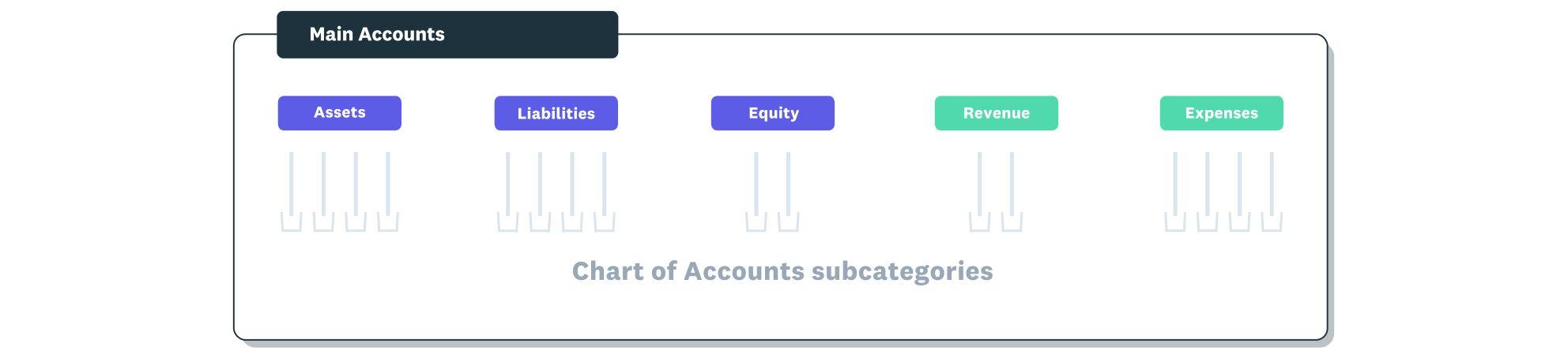
The chart of accounts is organised under the five main account types.
What is a chart of accounts?
A chart of accounts (COA) is a complete list of every account your business uses to record financial transactions in the general ledger. Think of it as a map or index of your finances.
The chart of accounts groups similar transactions together so you can produce accurate financial reports. For example, all your bank accounts sit under assets, while office costs and rent fall under expenses. This structure gives you a clear picture of where money comes from and where it goes.
The five main types of accounts
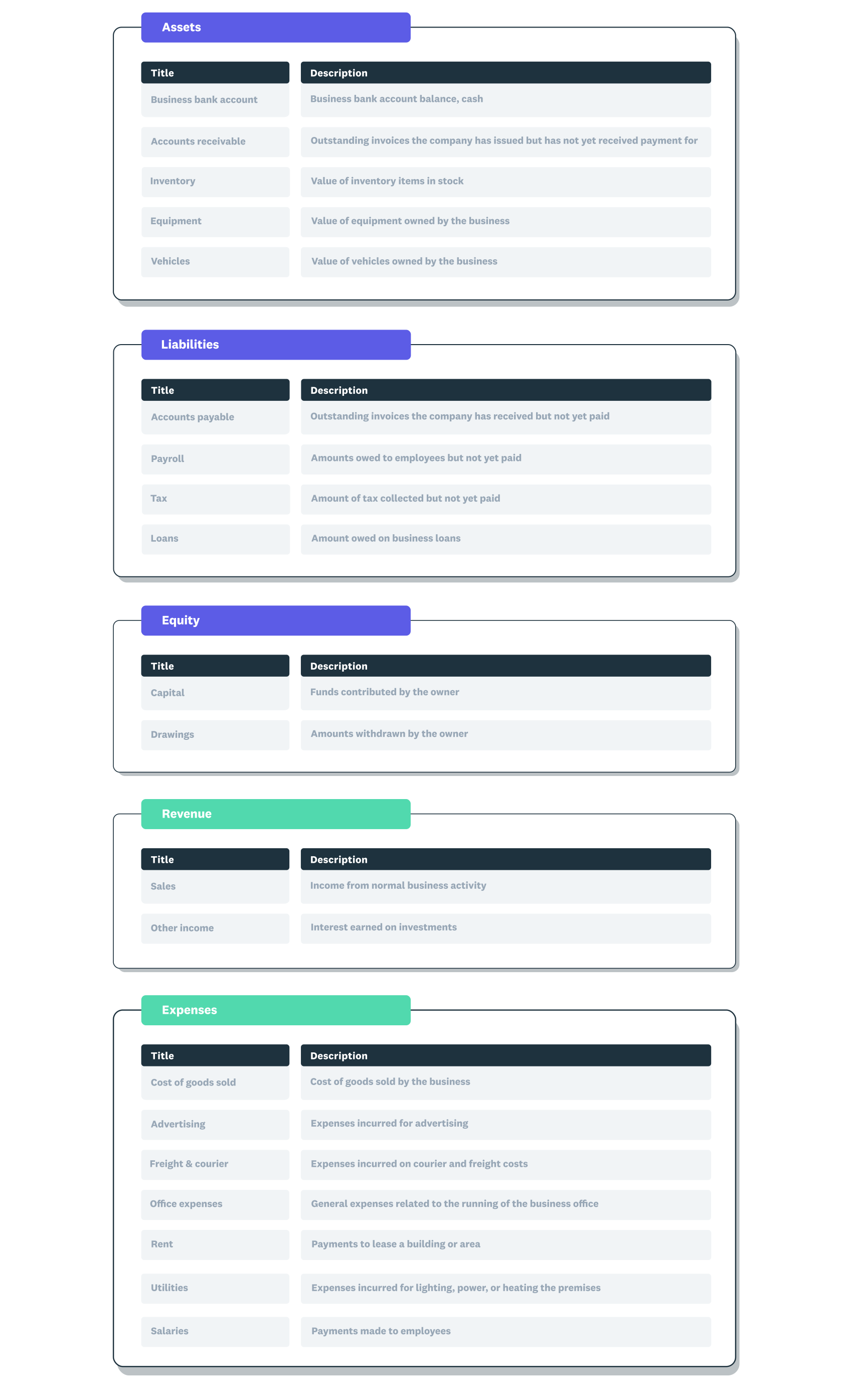
A chart of accounts example showing the five main account types with subcategories within each.
Every chart of accounts is built on five main account types. These top-level categories stay the same for every business, while the sub-accounts beneath them can be customised to fit your needs.
- Asset accounts: things your business owns, such as cash, bank accounts, equipment and inventory
- Liability accounts: debts your business owes, such as loans, credit cards and accounts payable
- Equity accounts: funds the owner puts into the business, plus retained earnings and drawings
- Revenue accounts: money your business earns from sales and other income
- Expense accounts: money your business spends on costs like utilities, office supplies and rent
How a chart of accounts works
Accounts in the chart of accounts are usually ordered to mirror the financial statements. Balance sheet accounts come first (assets, liabilities, equity), followed by income statement accounts (revenue, expenses).
When you record a transaction, you assign it to the relevant account in the chart. Using double-entry bookkeeping, each transaction affects at least two accounts. The totals from these accounts roll up into reports like the balance sheet and profit and loss statement, giving you a complete view of your financial position.
General ledger codes and account numbering
Each account in your chart of accounts has a name, a short description and a numeric general ledger code. These codes help organise accounts by type and make it easier to find and reference them.
A common numbering convention groups codes by account type. For example, assets might use codes in the 1000s, liabilities in the 2000s, equity in the 3000s, revenue in the 4000s and expenses in the 5000s and above. When you record a journal entry, you use these codes to assign the transaction to the correct account.
Small businesses often begin with only a couple of dozen accounts, then add more as their reporting needs grow.
Chart of accounts example
Here is a sample chart of accounts for a small Hong Kong business. Each account is grouped by type and assigned a general ledger code. The accounts would feed into your trial balance and financial statements.
- Assets (1000–1999): 1000 Cash on hand, 1010 Business bank account, 1100 Accounts receivable, 1200 Office equipment
- Liabilities (2000–2999): 2000 Accounts payable, 2100 Credit card, 2200 Business loan
- Equity (3000–3999): 3000 Owner's capital, 3100 Retained earnings, 3200 Drawings
- Revenue (4000–4999): 4000 Sales revenue, 4100 Service income
- Expenses (5000–5999): 5000 Rent, 5100 Utilities, 5200 Office supplies, 5300 Salaries
How to set up a chart of accounts
Setting up a chart of accounts takes some planning, but the process is straightforward. Follow these steps to create a structure that supports clear small business accounting.
- Start with the five main account types: assets, liabilities, equity, revenue and expenses.
- Add sub-accounts under each type that match how you want to track and report your finances.
- Assign a logical numbering system, grouping codes by account type.
- Keep account names clear and consistent so anyone reviewing your books can understand them.
- Review your chart of accounts periodically and add or remove accounts as your business changes.
Chart of accounts for Hong Kong businesses
If you run a business in Hong Kong, your chart of accounts should support local reporting and compliance requirements. This means structuring accounts so you can produce financial statements under the Hong Kong Financial Reporting Standards (HKFRS) and maintain records for the Inland Revenue Department.
Under the Inland Revenue Ordinance, Hong Kong businesses must keep business records for at least seven years. A well-organised chart of accounts makes it easier to retrieve transaction details during this period. For practical guidance on organising your records, see this guide to bookkeeping.
Why a good chart of accounts matters
The way you structure your chart of accounts affects how useful your financial reports are. A thoughtful setup pays off in several ways.
- Clearer financial reporting that shows exactly where money comes from and goes
- Easier and faster decision-making because data is organised and accessible
- Simpler tax preparation and compliance with local regulations
- Better ability to spot trends in revenue and spending
Simplify your chart of accounts with Xero
Xero comes with a customisable default chart of accounts, so you can start with a ready-made structure and adjust it to fit your business. Bank feeds and automated transaction categorisation save time on data entry, keeping your accounts up to date with less manual work.
Sign up and get one month free.
FAQs on chart of accounts
Here are answers to common questions about setting up and using a chart of accounts.
How many accounts should a chart of accounts have?
There is no set number. Many small businesses begin with a couple of dozen accounts and add more as they grow, while keeping the chart small enough to stay manageable.
What are the five types of accounts?
The five types are assets, liabilities, equity, revenue and expenses. These categories form the foundation of every chart of accounts.
Is a chart of accounts the same as a general ledger?
No. The chart of accounts is the list of accounts you use to categorise transactions. The general ledger is the record of all transactions posted to those accounts.
How do I set up a chart of accounts?
Start with the five main account types, add sub-accounts that match your reporting needs, assign a logical numbering system and keep names clear. Review it periodically as your business changes.
Do Hong Kong businesses need a specific chart of accounts?
No set format is mandated. However, your chart of accounts should support reporting under HKFRS and meet the Inland Revenue Department's record-keeping requirements.
Related terms
Learn more about chart of accounts
Handy resources
Advisor directory
You can search for experts in our advisor directory
Xero Small Business Guides
Discover resources to help you do better business
Online accounting with Xero
Automate your accounting in the cloud
Disclaimer
This glossary is for small business owners. The definitions are written with their requirements in mind. More detailed definitions can be found in accounting textbooks or from an accounting professional. Xero does not provide accounting, tax, business or legal advice.