Debit vs credit in accounting: a guide for Canadian small businesses
Learn how debits and credits work, how they affect your accounts, and how to record them correctly.

Written by Lena Hanna—Trusted CPA Guidance on Accounting and Tax. Read Lena's full bio
Published Wednesday 27 May 2026
Table of contents
Key takeaways
- Every business transaction requires both a debit entry and a credit entry of equal value, keeping your books balanced under the double-entry bookkeeping system.
- Debits increase asset and expense accounts but decrease liability, equity, and revenue accounts. Credits do the opposite for each account type.
- Recording transactions in journal entries and T-accounts helps you track where money flows and catch errors before they affect your financial statements.
- Accounting software can automate debit and credit matching, reducing manual errors and giving you more time to focus on running your business.
What are debits and credits in accounting?
Debits and credits are the foundation of every accounting transaction. Understanding them is essential for keeping accurate financial records, whether you manage your own books or work with an accountant.
In accounting, a debit (DR) is an entry recorded on the left side of a ledger, and a credit (CR) is an entry recorded on the right side. These terms have nothing to do with debit cards or credit cards. In everyday banking, "debit" often means money leaving your account and "credit" means money coming in. In accounting, debits and credits simply describe which side of an account a transaction is recorded on.
Every transaction affects at least two accounts. One account receives a debit, and another receives a credit of the same amount. This keeps the accounting equation in balance:
Assets = Liabilities + Equity
That equation is the backbone of all financial reporting. As long as your debits and credits are equal, your books stay balanced and your financial statements remain reliable.
Single-entry vs double-entry bookkeeping
Before diving into how debits and credits work in practice, it helps to understand the two main bookkeeping methods. The method you choose determines how you record transactions and how much detail your financial records capture.
Single-entry bookkeeping
Single-entry bookkeeping records each transaction once, typically as a single line in a cash book or spreadsheet. It tracks money coming in and going out, similar to a personal chequing account register.
This method is simple, but it has limitations. You can see your cash position, yet you cannot easily track what you owe, what others owe you, or the overall financial health of your business.
Double-entry bookkeeping
Double-entry bookkeeping records every transaction in at least two accounts: one debit and one credit of equal value. This is where debits and credits become essential.
Double-entry is the standard method used by businesses of all sizes because it provides a complete picture of your finances. It catches errors automatically, since any imbalance between debits and credits signals a mistake. Most accounting software, including Xero accounting software, uses double-entry bookkeeping behind the scenes.
5 types of accounts and how debits and credits affect them
All business transactions flow through five main account types. Each type responds differently to debits and credits, so knowing how they interact is key to recording transactions correctly.
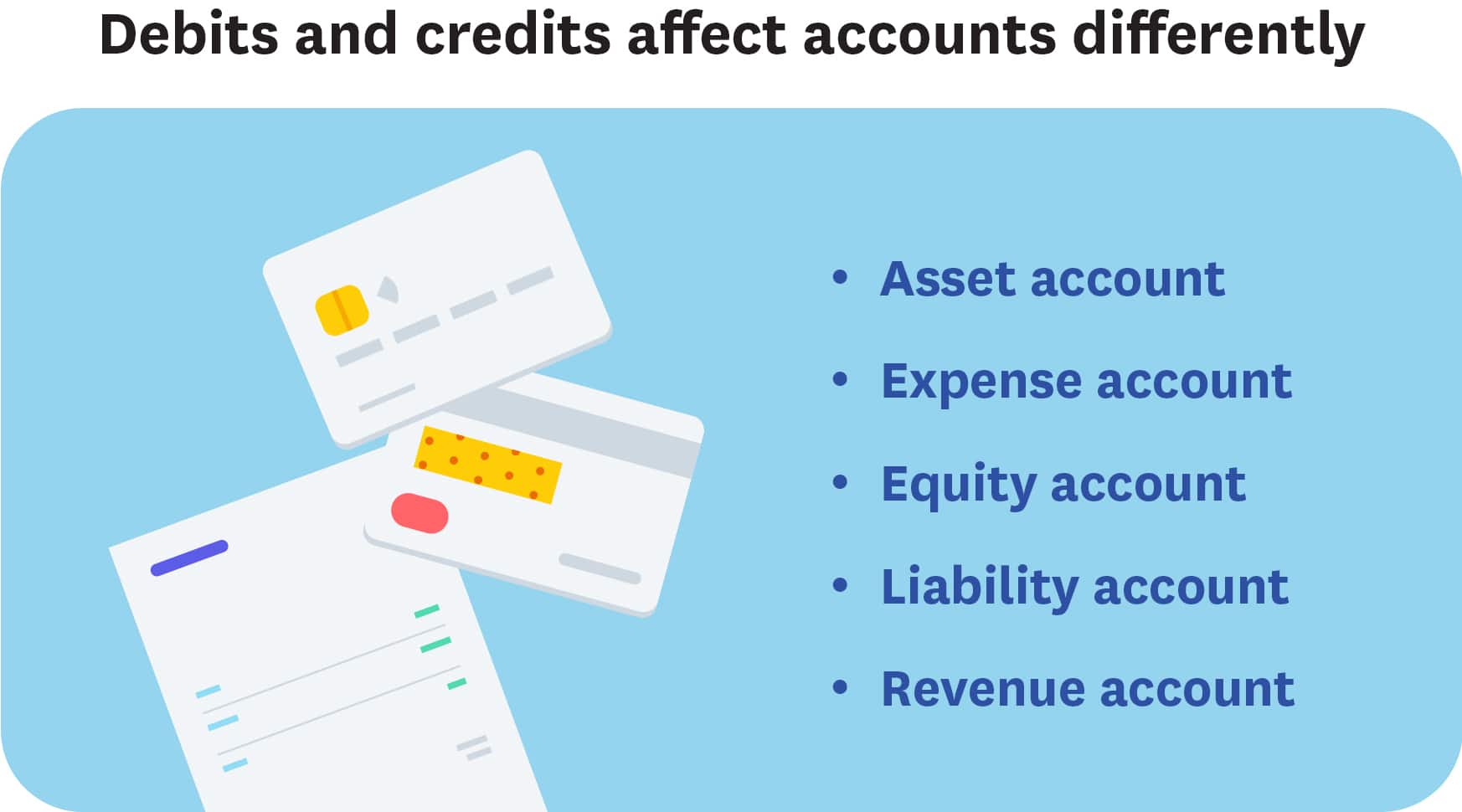
The five account types are:
- Asset accounts: what your business owns
- Liability accounts: what your business owes
- Equity accounts: your business's net worth
- Revenue accounts: income your business earns
- Expense accounts: costs of running your business
Asset accounts
Assets are anything your business owns that has value, from cash and inventory to equipment and trademarks. A debit increases an asset account, and a credit decreases it.
For example, when you deposit a customer payment into your bank account, you debit your bank account (increasing it). Common asset sub-accounts include:
- Petty cash
- Inventory
- Accounts receivable
- Bank accounts
Liability accounts
Liabilities are amounts your business owes but has not yet paid, such as loans, accounts payable, and collected sales tax. A debit decreases a liability account, and a credit increases it.
When you take on a new loan, you credit your loan payable account (increasing what you owe). Common liability sub-accounts include:
- Accounts payable
- Collected sales tax
- Payroll tax
- Loan payable
Equity accounts
Equity represents the net worth of your business, calculated by subtracting total liabilities from total assets. A debit decreases an equity account, and a credit increases it.
When your business earns a profit and retains those earnings, retained earnings (an equity account) increases through a credit. Common equity sub-accounts include:
- Owner's equity
- Retained earnings
Revenue accounts
Revenue accounts track all the income your business earns, from product sales to investment returns. A debit decreases a revenue account, and a credit increases it.
When you make a sale, you credit your sales revenue account (increasing your income). You can create sub-accounts to see exactly where your revenue comes from:
- Product sales
- Service revenue
- Investment income
Expense accounts
Expenses are the costs of running your business, including wages, rent, office supplies, and advertising. A debit increases an expense account, and a credit decreases it.
When you pay rent, you debit your rent expense account (increasing your expenses). Common expense sub-accounts include:
- Cost of goods sold (COGS)
- Insurance expenses
- Payroll expenses
- Rent
- Office expenses
The importance of debits and credits
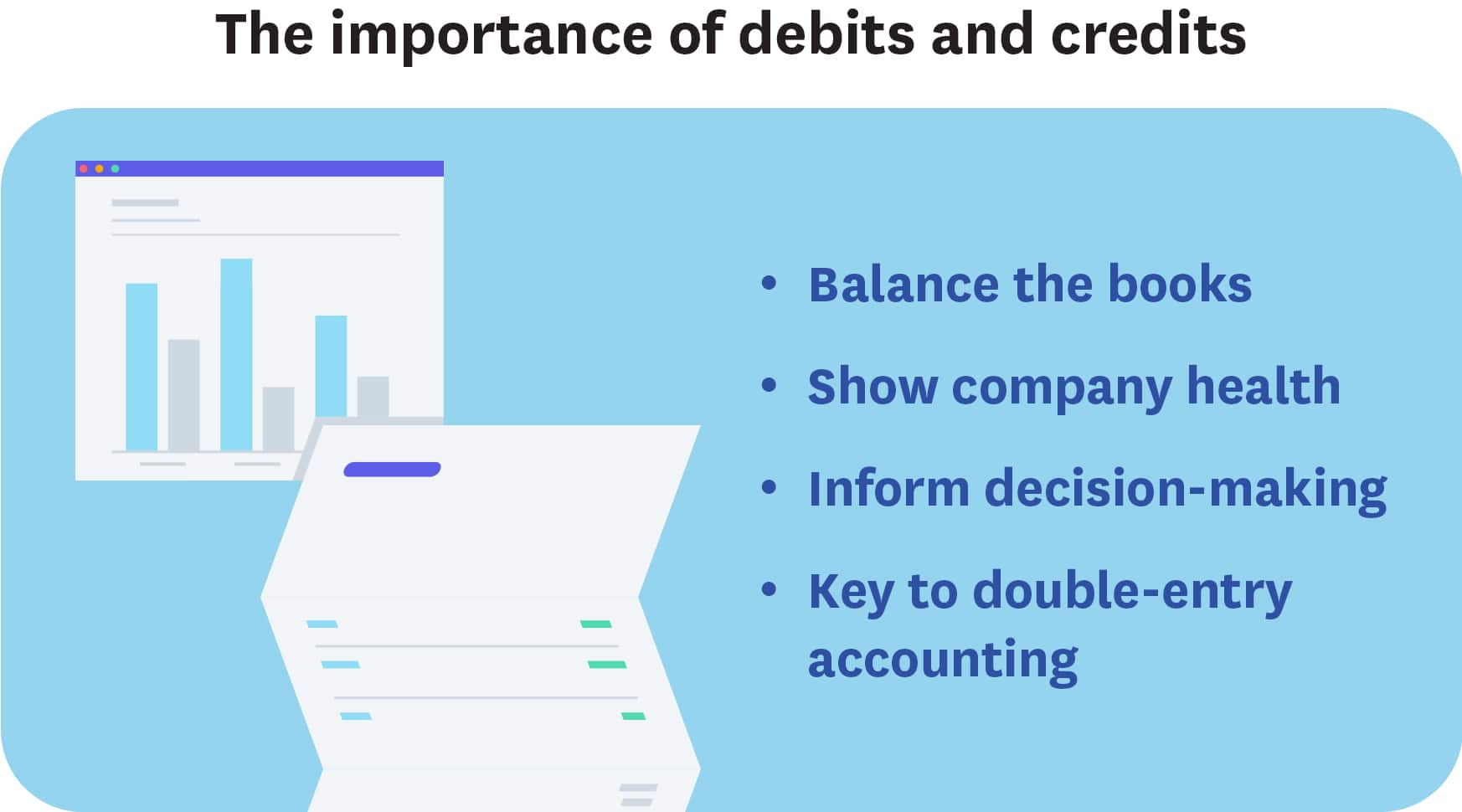
Balanced books mean your total debits equal your total credits. When they match, you know your financial records are accurate and your business decisions are based on reliable data.
Accurate records matter for several reasons:
- Lenders review them when you apply for a loan.
- The Canada Revenue Agency (CRA) requires them for tax compliance.
- Investors use them to assess the health of your business.
- You need them to make informed decisions about cash flow and growth.
Errors in recording debits and credits are more common than you might expect. Even trained accountants make bookkeeping mistakes regularly, so for small business owners handling their own books, having a structured system of balanced debits and credits is essential.
Debits and credits are the mechanism that makes double-entry bookkeeping work. Every transaction needs both a debit and a credit of equal value. Without that balance, your financial statements will not be accurate, and you could miss problems until they become costly.
Rules you need to know
A few core rules govern how debits and credits work. Once you understand them, every transaction follows the same logic.
The fundamental rule is that total debits must always equal total credits. This applies to every single transaction and to your books as a whole. If your debits and credits do not match, there is an error somewhere.
Here are the essential rules to remember:
- Debits are always recorded on the left side of an account. Credits are always on the right.
- Every transaction must have at least one debit and one credit of equal value.
- Debits increase asset and expense accounts. Credits decrease them.
- Credits increase liability, revenue, and equity accounts. Debits decrease them.
- For every debit, there is a corresponding credit. No exceptions.
These are sometimes called the "golden rules" of accounting. They apply whether you are recording a $10 office supply purchase or a $100,000 equipment investment.
How to record debits and credits: journal entries and T-accounts
Two tools help you record debits and credits accurately: journal entries and T-accounts. Both give you a structured way to capture every transaction and confirm your entries balance.
Journal entries
A journal entry is the formal record of a transaction in your accounting system. Each entry includes the date, the accounts affected, the debit and credit amounts, and a brief description.
Here is the standard format for a journal entry:
- Date: the date the transaction occurred.
- Account debited: the account name and amount on the left.
- Account credited: the account name and amount on the right (typically indented).
- Description: a short note explaining the transaction.
For example, if you pay $1,200 in rent on 1 March 2026, your journal entry would debit Rent Expense for $1,200 and credit your Bank Account for $1,200.
T-accounts
A T-account is a visual tool shaped like the letter "T." The account name goes at the top, debits are recorded on the left side, and credits are recorded on the right side.
T-accounts help you see the running balance of any account at a glance. They are especially useful when you are learning how debits and credits flow or when you need to trace an error. You can draw a T-account for each account involved in a transaction to confirm your entries balance.
Most bookkeeping software handles journal entries and T-account logic automatically. You enter the transaction details, and the software records the corresponding debits and credits for you.
Simple examples of debits and credits in action
Seeing debits and credits in real scenarios makes the concept easier to grasp. Here are three common business transactions and how they are recorded.
Example 1: buying office supplies with cash
You spend $100 cash on office supplies. Two accounts are affected: your cash account (an asset) and your office supplies account (an expense).
- Debit Office Supplies for $100 (increases your expenses).
- Credit Cash for $100 (decreases your assets).
The debit and credit are equal, so your books stay balanced.
Example 2: making a $500 sale on credit
A customer buys $500 worth of goods but will pay you later. This affects your accounts receivable (an asset) and your sales revenue account.
- Debit Accounts Receivable for $500 (increases the money owed to you).
- Credit Sales Revenue for $500 (increases your income).
The $500 debit and $500 credit match, keeping everything in balance.
Example 3: taking out a $10,000 business loan
Your business receives a $10,000 loan from the bank. This affects your bank account (an asset) and your loan payable account (a liability).
- Debit Bank Account for $10,000 (increases your assets).
- Credit Loan Payable for $10,000 (increases your liabilities).
Your assets and liabilities both increase by $10,000. The accounting equation stays balanced, and your books reflect the new obligation.
Calculating the balance
Once you have recorded your transactions, you need to calculate each account's balance to confirm your books are correct. The process is straightforward.
- Record each transaction as both a debit and a credit in the appropriate accounts.
- Add up all debits and all credits in each account.
- Calculate the difference to find your account balance. For asset and expense accounts, subtract total credits from total debits. For liability, equity, and revenue accounts, subtract total debits from total credits.
- Verify that total debits equal total credits across all accounts.
If your totals do not match, there is an error that needs to be found and corrected before your financial statements will be accurate. T-accounts are helpful here: review each account's left and right columns to spot the discrepancy.
Common debit and credit mistakes and how to avoid them
Even experienced bookkeepers make errors with debits and credits. Knowing the most common mistakes helps you catch them early and keep your records accurate.
Watch out for these frequent errors:
- Reversing debits and credits: recording a debit where a credit should go, or vice versa. This is the most common mistake, especially with liability and revenue accounts where the logic feels counterintuitive.
- Forgetting the second entry: recording only one side of a transaction. Every transaction needs both a debit and a credit.
- Posting to the wrong account: entering a transaction in the correct amount but to the wrong account type. For example, debiting an asset account instead of an expense account.
- Transposing numbers: accidentally swapping digits (recording $540 as $450). This creates an imbalance that can be hard to find.
- Duplicate entries: recording the same transaction twice, which inflates your account balances.
To find imbalances, start by running a trial balance. If debits and credits do not match, review your most recent entries first. Check for round-number differences (which suggest a missing entry) and differences divisible by nine (which suggest a transposition error).
If errors persist or your records grow complex, consider working with a chartered professional accountant (CPA) or using accounting software that flags discrepancies automatically.
Simplify your debits and credits with Xero
Managing debits and credits by hand takes time and leaves room for costly mistakes. The right tools and support make it easier to keep your books balanced and your records reliable.
A chartered professional accountant or bookkeeper can handle the complexity for you, reducing errors and freeing up time you can spend growing your business. If you prefer to manage your own books, accounting software takes much of the manual work off your plate.
Accounting software significantly reduces manual data entry errors by automating routine bookkeeping tasks. Xero accounting software automates debit and credit matching, reconciles your bank transactions, and provides real-time financial insights so you can see exactly where your business stands.
The software handles the double-entry calculations while you focus on the decisions that matter. Get one month free.
FAQs on debit vs credit in accounting
Here are answers to frequently asked questions about debits and credits.
Is debit positive or negative?
A debit is not inherently positive or negative; it increases asset and expense accounts but decreases liability, equity, and revenue accounts. Think of it as a direction of entry, not a value judgment.
Does debit or credit mean you owe money?
In business accounting, a credit to a liability account increases the amount you owe, while a debit to that account decreases it. This is different from personal banking, where a credit typically means money added to your account.
Is a debit money in or out?
It depends on the account type: a debit to your bank account means money coming in (increasing the asset), while a debit to an expense account means money going out (increasing the cost). Always consider which account is being affected and whether a debit increases or decreases that specific account type.
What is the difference between debit and credit cards and accounting debits and credits?
Debit and credit cards are payment methods tied to your bank account or a line of credit, while accounting debits and credits are entries on opposite sides of a ledger used in double-entry bookkeeping. The terms share the same words but serve completely different purposes.
What are the 3 golden rules of debit and credit?
The three golden rules are: debit what comes in and credit what goes out (for real accounts like assets), debit the receiver and credit the giver (for personal accounts like accounts payable), and debit all expenses and losses while crediting all incomes and gains (for nominal accounts like revenue and expenses).
Disclaimer
Xero does not provide accounting, tax, business or legal advice. This guide has been provided for information purposes only. You should consult your own professional advisors for advice directly relating to your business or before taking action in relation to any of the content provided.
Start using Xero for free
Access Xero features for 30 days, then decide which plan best suits your business.