Payroll
Learn how payroll works in South Africa, from PAYE, UIF and SDL to EMP201 submissions and payslips.
Published Wednesday 12 August 2026
Table of contents
Key takeaways
- Payroll is the process of calculating and distributing employee wages, tracking hours worked, and managing statutory deductions such as PAYE and UIF.
- Employers must declare and pay PAYE, UIF and SDL to SARS via the EMP201 by the 7th of the month following the pay period.
- The Basic Conditions of Employment Act requires you to issue a written payslip to every employee on each payday.
- The national minimum wage in South Africa is R30.23 per ordinary hour from 1 March 2026.
What is payroll?
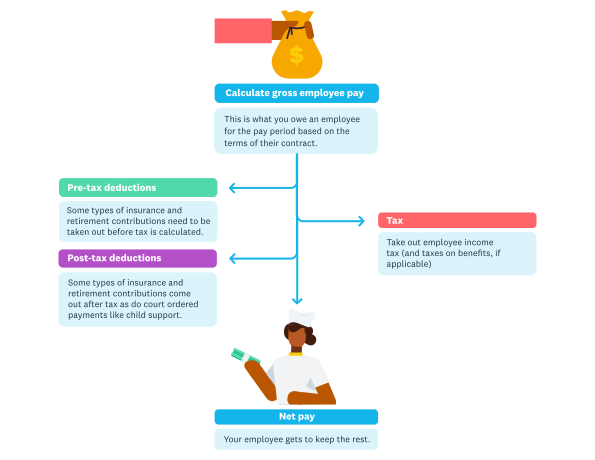
Payroll is what happens each payday and involves sending the right amounts of money to the employee, but also to a number of other locations.
Payroll is the process of calculating employee wages, withholding statutory deductions, and paying your staff. It also involves reporting those deductions to SARS each month.
For small businesses in South Africa, running payroll means more than transferring salaries. You need to calculate each employee's gross pay, deduct PAYE (income tax), UIF contributions and any other amounts, then submit the totals to SARS. Getting payroll right keeps your business compliant, your employees paid on time, and your cash flow predictable.
What is included in payroll?
Payroll covers all the amounts you pay employees and the deductions you withhold before they receive their net pay. In South Africa, a typical payroll includes:
- Basic salary or hourly wages
- Overtime pay at 1.5 times the normal rate for hours exceeding 45 per week
- Allowances such as travel, cell phone or housing
- Bonuses, including the 13th cheque many employers pay in December
- PAYE (employees' tax)
- UIF contributions (1% from the employee)
- Medical aid deductions and retirement or provident fund contributions
- Garnishee or court-ordered deductions where applicable
How does payroll work in South Africa?
Payroll in South Africa follows a monthly cycle. You calculate each employee's gross pay, deduct PAYE and UIF, and pay the net amount into their bank accounts. After the pay run, you must declare and pay PAYE, UIF and SDL to SARS via the EMP201 by the 7th of the following month.
If the 7th falls on a weekend or public holiday, the deadline moves to the last business day before it. Missing the deadline results in penalties and interest, so building a consistent payroll routine is essential.
The South African payroll process step by step
Running payroll involves a sequence of tasks each pay period. Follow these nine steps to pay your employees and stay compliant with SARS:
- Collect employee information, including ID numbers, tax reference numbers and banking details.
- Record hours worked, leave taken and any overtime.
- Calculate gross pay by adding basic salary, overtime and any allowances or bonuses.
- Calculate PAYE using the SARS tax tables for the 2027 tax year.
- Calculate UIF (1% from the employee, 1% from you) and SDL if your annual payroll exceeds R500,000.
- Calculate net pay by subtracting all deductions from gross pay.
- Approve the pay run and review totals before releasing payments.
- Pay employees by EFT into their nominated bank accounts.
- Submit the EMP201 to SARS and pay the PAYE, UIF and SDL amounts by the 7th of the following month.
What is PAYE?
PAYE stands for Pay As You Earn. It's the income tax you withhold from employees' pay and remit to SARS on their behalf each month.
As an employer, you must register with SARS for PAYE within 21 business days of becoming an employer or of your employees becoming liable for tax. For the 2027 tax year (1 March 2026 to 28 February 2027), tax rates range from 18% to 45%, with a primary rebate of R17,820. Under the Fourth Schedule to the Income Tax Act, directors of private companies are treated as employees for PAYE purposes and cannot substitute dividends for salary to avoid tax.
UIF, SDL and other statutory contributions
Beyond PAYE, you have two other statutory contributions to manage: UIF and SDL.
UIF (Unemployment Insurance Fund) totals 2% of each employee's pay, split equally between the employee (1%) and you as the employer (1%). Contributions are capped at earnings of R17,712 per month, meaning the maximum contribution is R177.12 per party.
SDL (Skills Development Levy) is 1% of your total payroll. It only applies if your expected annual payroll exceeds R500,000. SDL is an employer cost and is not deducted from employees' salaries.
Payroll deductions explained
Deductions reduce an employee's gross pay to arrive at their net pay. Understanding each type helps you calculate payroll accurately and meet your employer responsibilities.
- PAYE: income tax withheld based on SARS tax tables and the employee's earnings.
- UIF: 1% of the employee's remuneration, matched by an equal employer contribution.
- Medical aid contributions: voluntary deductions for employees who belong to a medical scheme, which may attract a medical tax credit.
- Retirement or provident fund contributions: voluntary in South Africa, though many employers offer these as a benefit.
- Garnishee or court orders: amounts deducted on instruction from a court, such as maintenance or debt repayments.
How is payroll calculated?
Payroll is calculated by starting with an employee's gross pay, subtracting each deduction, and arriving at the net pay they take home. Take an employee who earns a gross salary of R20,000 a month. The calculation looks like this:
- Gross pay: R20,000
- Less PAYE (income tax): around R2,115, based on the 18% bracket for annual earnings under R245,100, after applying the primary rebate
- Less UIF: R177.12, which is 1% of pay capped at the R17,712 monthly earnings ceiling
- Net pay: about R17,708
On top of this, you pay UIF of R177.12 and SDL of 1% as employer costs, and these are not deducted from the employee's salary. The figures here are illustrative, so use the current SARS tax tables to work out exact amounts for each employee.
How to set up payroll for the first time
Setting up payroll correctly from the start saves time and helps you avoid penalties. If you're hiring employees for the first time, follow these steps:
- Register as an employer with SARS for PAYE, UIF and SDL via eFiling. You must do this within 21 business days of becoming an employer.
- Collect employee information, including ID numbers, tax reference numbers, banking details, and any relevant allowances or benefits.
- Choose a payroll method: manual calculations, an accountant or bookkeeper, or payroll software.
- Run your first pay run and issue payslips to each employee in line with the Basic Conditions of Employment Act.
Ways to run payroll
There are several ways to manage payroll, depending on your budget, time and comfort with tax calculations. Each approach has trade-offs between cost, control and compliance risk.
Run payroll manually
Manual payroll involves calculating gross pay, PAYE, UIF and SDL yourself using SARS tax tables and a spreadsheet. It costs nothing beyond your time, but increases the risk of errors and can become time-consuming as your team grows.
Use an accountant or bookkeeper
Outsourcing payroll to an accountant or bookkeeper shifts the compliance burden to a professional. They handle calculations, submissions and payslips, freeing you to focus on running your business. You can find a certified professional in the Xero advisor directory. This option suits owners who prefer expert support or lack the time to manage payroll in-house.
Use payroll software
Online payroll software automates calculations, generates payslips and helps you submit EMP201s on time. It reduces manual errors and keeps employee records organised. For many small businesses, dedicated software strikes the right balance between cost and efficiency.
Payroll compliance and legal requirements
South African employers must meet several legal obligations when running payroll. Failing to comply can result in penalties from SARS or the Department of Employment and Labour.
- Issue a written payslip on every payday as required by section 33 of the Basic Conditions of Employment Act.
- Pay at least the national minimum wage of R30.23 per ordinary hour from 1 March 2026.
- Submit the EMP201 and pay PAYE, UIF and SDL to SARS by the 7th of the month following the pay period.
- Keep payroll and tax records for five years from the date the return was filed.
- Register with the Compensation Fund and submit an annual Return of Earnings as required by COIDA.
Key payroll documents and SARS submissions
Running payroll in South Africa involves several documents and regular submissions to SARS. Understanding each one helps you stay organised and meet your deadlines.
Payslip
A written payslip is required by the Basic Conditions of Employment Act. It must show the employer's name, the employee's name and occupation, the pay period, ordinary and overtime hours, each deduction, and the net pay.
EMP201
The EMP201 is your monthly declaration to SARS of PAYE, UIF and SDL. Submit it and pay the amounts due by the 7th of the following month.
EMP501
The EMP501 is a reconciliation return. Submit the annual EMP501 by 31 May and the interim EMP501 by 31 October.
IRP5 and IT3(a)
After each EMP501 submission, issue an IRP5 certificate to employees from whom you withheld PAYE, or an IT3(a) to those with no tax withheld. Employees use these certificates when filing their personal tax returns.
Simplify your payroll with Xero
Managing payroll, SARS submissions and employee records can take hours each month. Xero brings your accounting and payroll into one place, helping you calculate pay, generate payslips and track deductions without juggling spreadsheets. Ready to spend less time on admin and more time on your business? Get one month free and see how Xero can help.
FAQs on payroll
Here are answers to common questions about payroll in South Africa.
When is the EMP201 due?
The EMP201 is due by the 7th of the month following the pay period. If the 7th falls on a weekend or public holiday, submit by the last business day before it.
What is the difference between UIF and SDL?
UIF provides short-term relief for employees who lose their jobs, funded by a 2% contribution split between employer and employee. SDL funds skills training across industries and is a 1% employer-only cost, applicable only if your annual payroll exceeds R500,000.
Do I have to give my employees a payslip?
Yes. The Basic Conditions of Employment Act requires a written payslip on every payday, showing earnings, deductions and net pay.
What is an IRP5?
An IRP5 is an employee tax certificate issued after each EMP501 reconciliation. It summarises the employee's earnings and the PAYE you withheld during the tax year.
Is a 13th cheque compulsory in South Africa?
No, the 13th cheque is not a legal requirement. It's a bonus many employers choose to pay, usually in December, but it depends on your employment contracts and company policy.
What is the minimum wage in South Africa?
The national minimum wage is R30.23 per ordinary hour from 1 March 2026. Some sectors have different rates, so check the sectoral determinations that apply to your industry.
Related terms
Learn more about payroll
Handy resources
Advisor directory
You can search for experts in our advisor directory
Your guide to hiring
Learn tips for hiring, onboarding and paying an employee, while keeping everyone happy
Payroll with Xero
Learn how Xero can help with your payroll requirements
Disclaimer
This glossary is for small business owners. The definitions are written with their requirements in mind. More detailed definitions can be found in accounting textbooks or from an accounting professional. Xero does not provide accounting, tax, business or legal advice.