Profit
Learn what profit means and how to calculate and improve it in your business.
Published Monday 17 August 2026
Table of contents
Key takeaways
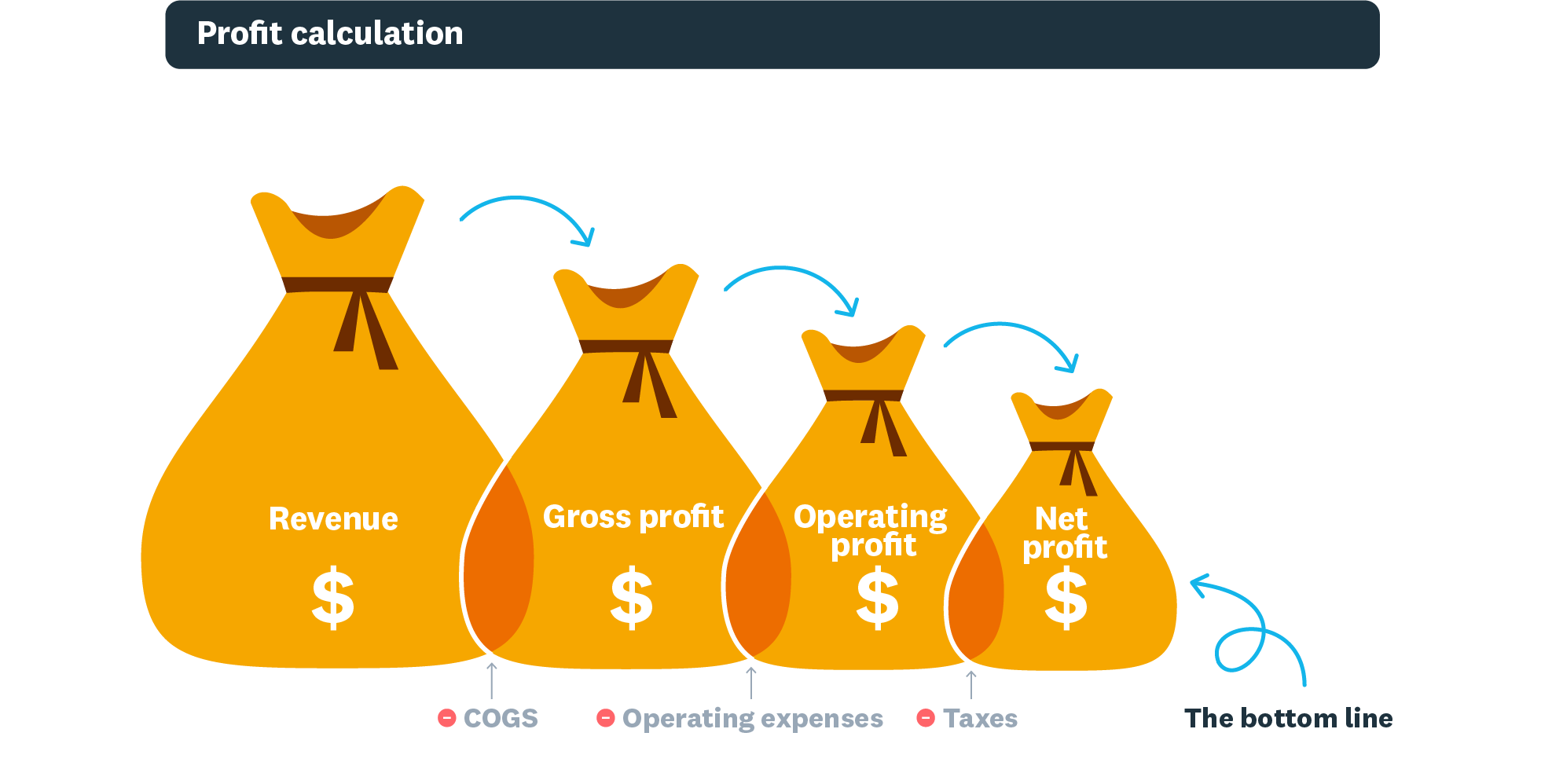
There are three types of profit. Net profit is what you get to keep.
- Profit is the money your business keeps after paying all expenses, calculated as revenue minus costs.
- The three types of profit (gross, operating, and net) each reveal different aspects of your financial health.
- Profit and cash flow are different: you can be profitable on paper yet still run short on cash if customers pay slowly.
- Improving profit comes down to two levers: increasing revenue or reducing costs.
What is profit?
Profit is the money left over after your business pays all its expenses. It’s a core measure of financial success and tells you whether your business is earning more than it spends.
The basic formula is simple: profit equals revenue minus expenses.
Profit vs revenue
Revenue is your ‘top line’, the total amount your business earns from sales before any costs are deducted. Profit is your ‘bottom line’, the amount that remains once you subtract all costs from that revenue.
For example, if your shop brings in ₱100,000 in sales but spends ₱70,000 on cost of goods sold and other expenses, your profit is ₱30,000. Revenue shows the size of your business; profit shows its financial health.
The three types of profit
Businesses track profit at three levels, each offering a clearer view of where money goes.
Gross profit
Gross profit is what remains after you subtract the direct costs of producing or purchasing your goods. The formula is gross profit equals revenue minus cost of goods sold. This figure shows how efficiently you turn sales into margin before other business expenses come into play.
Operating profit
Operating profit goes a step further by subtracting operating expenses such as rent, utilities, and salaries. The formula is operating profit equals gross profit minus operating expenses. This number reveals how well your core business activities perform day to day.
Net profit
Net profit is the final amount after interest payments and taxes are deducted. The formula is net profit equals operating profit minus interest and taxes. This is the profit you actually keep and can reinvest or distribute.
How to calculate profit
Working out your net profit follows a straightforward sequence of steps.
- Add up your total revenue for the period.
- Calculate your cost of goods sold (COGS).
- Subtract COGS from revenue to get gross profit.
- Total your operating expenses (rent, utilities, wages, and so on).
- Subtract operating expenses from gross profit to get operating profit.
- Deduct interest and taxes from operating profit to arrive at net profit.
Here’s an example for a small retailer in a single month:
- Revenue: ₱500,000
- Cost of goods sold: ₱300,000
- Gross profit: ₱500,000 − ₱300,000 = ₱200,000
- Operating expenses: ₱120,000
- Operating profit: ₱200,000 − ₱120,000 = ₱80,000
- Taxes: ₱16,000
- Net profit: ₱80,000 − ₱16,000 = ₱64,000
Profit vs profitability
Profit is a peso amount, while profitability (often called profit margin) expresses that amount as a percentage of revenue. You calculate it by dividing profit by revenue and multiplying by 100.
For instance, if your net profit is ₱64,000 on ₱500,000 in revenue, your net profit margin is 12.8%. A gross profit margin measures gross profit the same way. What counts as a ‘good’ margin varies by industry, so compare your numbers against businesses similar to yours.
Why profit matters for your business
Profit keeps your business sustainable. Without it, you can’t cover unexpected costs or ride out slow periods. It also funds growth, letting you hire staff, stock more inventory, or invest in better equipment.
Healthy profit gives you, the owner, a return for the time and risk you’ve invested. Lenders and investors look at profit to gauge whether your business can repay loans or generate returns. Tracking and learning to measure profitability helps you spot problems early and make informed decisions.
Profit vs cash flow
Profit is calculated on an accrual basis, meaning revenue and expenses are recorded when they’re earned or incurred, not when cash changes hands. Cash flow tracks actual money moving in and out of your bank account.
You can show a profit on paper yet still struggle to pay bills if customers take weeks to settle invoices. Monitoring both metrics ensures you have the funds on hand to operate while working toward long-term profitability.
How to improve your profit
Boosting profit comes down to two levers: earn more or spend less. Often the best results come from doing both at once.
- Raise prices where the market allows
- Introduce higher-margin products or services
- Negotiate better rates with suppliers
- Cut unnecessary subscriptions and overheads
- Speed up invoicing to shorten payment cycles
- Review staffing levels and automate repetitive tasks
Manage your profit with Xero
Xero’s profit and loss reports show your gross, operating, and net profit in real time, so you always know where you stand. Automated bank feeds and invoicing help you stay on top of income and expenses without the manual work. Ready to take control of your numbers? You can try Xero free for 30 days and see how it keeps your profit in clear view.
FAQs on profit
Below are common questions about profit and how it works in a small business context.
Is profit the same as revenue?
No. Revenue is total sales before any costs are deducted. Profit is what’s left after subtracting all expenses from revenue.
Is profit the same as cash flow?
No. Profit is recorded when income is earned and expenses are incurred. Cash flow tracks the actual timing of money entering and leaving your bank account.
What are the three types of profit?
Gross profit shows revenue minus cost of goods sold. Operating profit subtracts operating costs from gross profit. Net profit deducts interest and taxes from operating profit.
Where does profit come from?
Profit comes from charging more for goods or services than it costs to produce and deliver them. The wider the gap between revenue and total costs, the larger your profit.
Can a business be profitable but still fail?
Yes. If profit sits in unpaid invoices while bills come due, you can run out of cash despite showing a healthy profit on your accounts.
How often should I check my profit?
Monthly reviews help you catch trends early. More frequent checks are useful during busy seasons or when costs are changing.
Related terms
Learn more about profit
Handy resources
Advisor directory
You can search for experts in our advisor directory
How to manage your finances and cash flow
Learn about money management for your small business
Financial reporting
Keep track of your performance with accounting reports
Disclaimer
This glossary is for small business owners. The definitions are written with their requirements in mind. More detailed definitions can be found in accounting textbooks or from an accounting professional. Xero does not provide accounting, tax, business or legal advice.