Profit margin: types, formulas and how to calculate it
Learn the three types of profit margin, how to calculate each one and what a good margin looks like.
Written by Jotika Teli—Certified Public Accountant with 24 years of experience. Read Jotika's full bio
Published Tuesday 6 October 2026
Table of contents
Key takeaways
- Profit margin is the percentage of revenue you keep as profit, calculated as (profit ÷ revenue) × 100. Track gross, operating and net margins to see where your money goes at each stage.
- As a rule of thumb, a net margin of about 5% is low, 10% is healthy and 20% is high. Averages vary widely by industry, so compare yourself with similar Philippine businesses.
- You can lift your margins by spending less to deliver what you sell and by charging the right price for it. Review your supplier rates and prices at least once a year.
- Check margin trends monthly or quarterly to spot problems early. Use the results to guide your pricing and investment decisions.
What is a profit margin?
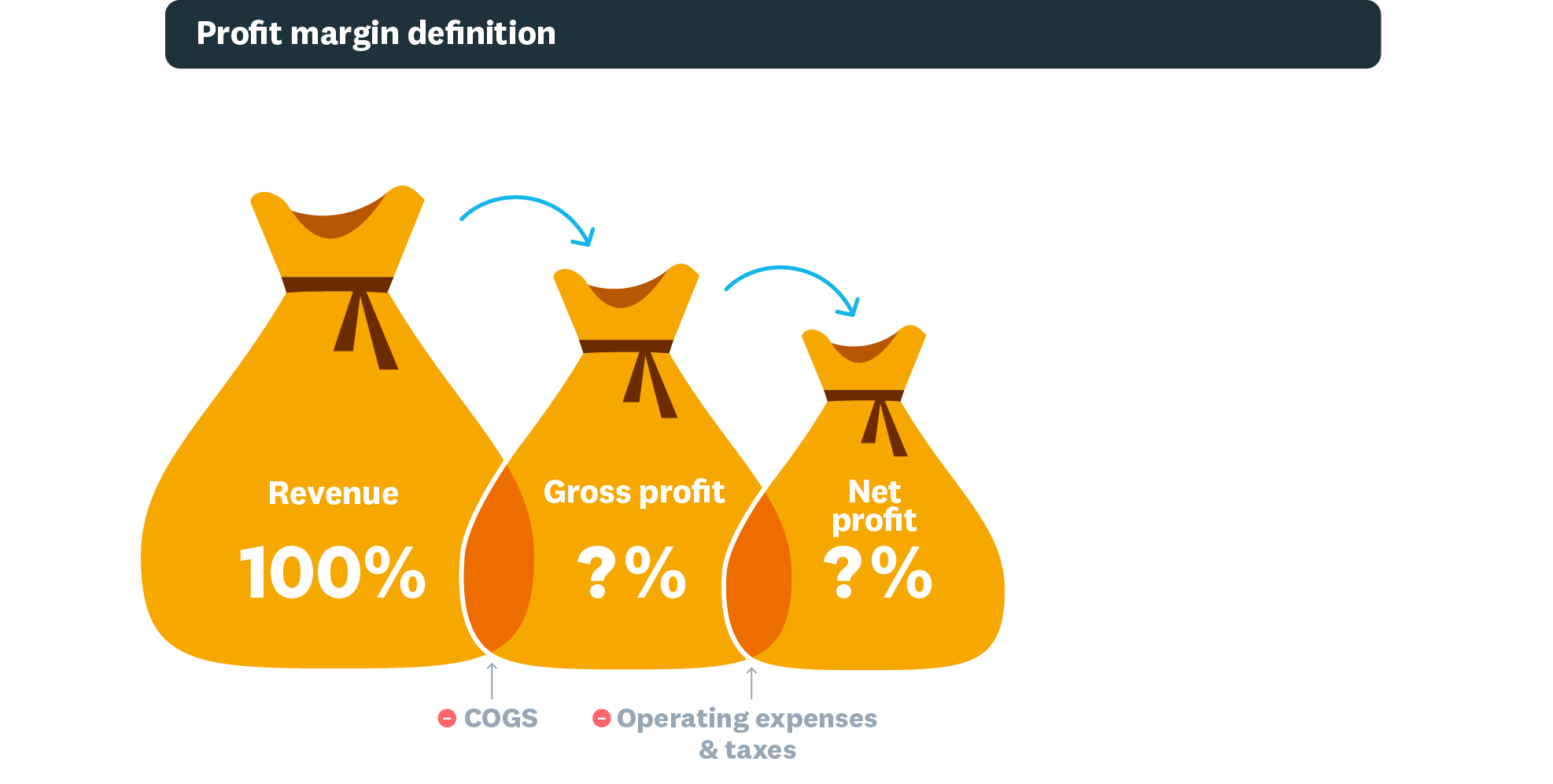
A profit margin is the percentage of revenue you keep as profit after paying business expenses. The formula is: profit margin = (profit ÷ revenue) × 100. The higher the percentage, the more of each peso in sales you keep, so a 30% margin means you keep 30 centavos of every peso.
A strong profit margin signals that your business earns enough to cover costs and reinvest in growth. It also shows which areas perform well and where you may need to cut expenses.
Profit margin vs net profit
Net profit is the peso amount left after you deduct all expenses from revenue. Profit margin expresses that profit as a percentage of revenue.
Net profit tells you how much money you made. Profit margin tells you how efficiently you made it.
What are the types of profit margin?
There are three main types of profit margin: gross, operating and net. Each one subtracts a wider set of costs from revenue, so together they show where your money goes. Gross margin covers direct costs, operating margin adds running costs such as rent, and net margin includes every expense, including interest and tax.
Each type measures profitability at a different stage of your business operations. Here’s how to work out each one.
Gross profit margin
Gross profit margin is the percentage of revenue left after you subtract the cost of goods sold (COGS). COGS covers the direct costs of producing or sourcing what you sell, such as materials and direct labor.
Gross profit margin = ((revenue − COGS) ÷ revenue) × 100
It tells you how efficiently you produce or source what you sell. Use gross profit margin to set prices and to compare performance from one period to the next.
Operating profit margin
Operating profit margin is the percentage of revenue left after you subtract COGS and operating expenses, before interest and tax. Operating expenses include fixed costs such as rent and variable costs such as sales commissions.
Operating profit margin = ((revenue − COGS − operating expenses) ÷ revenue) × 100
It tells you how well your core business operations generate profit. The exact calculation can vary: an International Accounting Standards Board (IASB) study found that companies use at least nine different ways to calculate operating profit.
Investors and lenders often review operating margins to judge whether a business is financially sound.
Net profit margin
Net profit margin is the percentage of revenue left after you pay all costs, including interest and tax.
Net profit margin = (net profit ÷ revenue) × 100
It’s the most complete measure of your business’s financial health because it accounts for every expense. Learn more about net profit margin and how to calculate it.
How do you calculate profit margin?
To calculate profit margin, divide profit by revenue, then multiply by 100 to get a percentage. Use gross, operating or net profit, depending on the margin you need. A percentage makes it easy to compare your performance across different periods, or against other businesses of any size.
Follow these three steps to work out any type of margin.
- Find your revenue and costs for the period on your profit and loss statement
- Subtract the relevant costs from revenue to get your gross, operating or net profit
- Divide that profit by revenue and multiply the result by 100
The examples below follow one cleaning business through each step in order: gross profit first, then operating profit, then net profit.
Gross profit margin calculation
Your cleaning business earns ₱200,000 in revenue. Delivering those services costs ₱80,000 in direct costs, which leaves ₱120,000 in gross profit.
Calculation: ₱120,000 ÷ ₱200,000 × 100 = 60% gross profit margin
A 60% gross profit margin means you keep 60 centavos of every peso earned after covering direct costs. Try the gross profit margin calculator to check your own numbers.
Operating profit margin calculation
From your ₱120,000 gross profit, you spend ₱30,000 on operating expenses such as rent and utilities. Your operating profit is ₱90,000.
Calculation: ₱90,000 ÷ ₱200,000 × 100 = 45% operating profit margin
A 45% operating profit margin means you keep 45 centavos of every peso from core operations, before interest and tax.
Net profit margin calculation
After you pay ₱30,000 in interest and tax, your net profit is ₱60,000.
Calculation: ₱60,000 ÷ ₱200,000 × 100 = 30% net profit margin
A 30% net profit margin means you keep 30 centavos of every peso earned after all expenses. Use the net profit margin calculator to run your own figures.
What is a good profit margin?
As a rule of thumb, a net profit margin of about 5% is low, 10% is healthy and 20% is high, according to Brex’s guide to profit margins. What counts as good still depends on your industry and business model. Compare your margins with businesses that sell similar products to similar customers.
Average net margins vary widely by industry. NYU Stern data from Aswath Damodaran, as of January 2026, shows these averages:
- Total market: 9.74%
- Retail (general): 5.61%
- Retail (grocery and food): 1.32%
- Restaurant/dining: 9.37%
- Business and consumer services: 7.03%
- Software (system and application): 25.49%
- Engineering/construction: 5.94%
These figures are averages for US publicly listed companies. Margins for Philippine small businesses may differ, so compare yours with similar local businesses and ask your accountant what’s realistic for your sector.
Your gross profit margin will naturally be higher than your net profit margin, because it leaves out operating costs, interest and tax. Focus on operating and net profit margins to judge your overall financial health.
Why do profit margins matter?
Profit margins matter because they show how much of each peso of revenue you keep after expenses. That tells you whether your business is financially healthy and whether your prices cover your costs. Margins also help you decide where to spend, and they give lenders and investors a quick read on your business.
The Institute of Chartered Accountants in England and Wales (ICAEW) lists profitability among its top five practice key performance indicators (KPIs). Profit margins sit alongside other profitability ratios that help you make smarter decisions and attract funding.
Here’s how profit margins help you run your business.
- Identify which products or services deliver healthy returns
- Spot areas where expenses eat into profits
- Put more of your budget into higher-margin activities
- Give banks and investors the figures they review before approving loans or investment
Benefits of high profit margins for growth
High profit margins give your business more flexibility and more options. Here’s what healthy margins make possible.
- Easier access to funding, because investors and lenders favor financially healthy businesses
- Room to reinvest extra profit in new equipment, staff or marketing
- Space to test new prices or products while keeping cash flow steady
- A buffer when costs rise unexpectedly
Compare your margins with industry benchmarks and competitors to see where you stand and where you can improve. Aim for sustainable growth, because rapid expansion can temporarily reduce margins if costs rise faster than revenue.
Factors affecting profit margins
Several factors influence your profit margins. You control some of them, while others come from the wider economy.
- Retail and hospitality businesses typically run tighter margins than professional services because of higher overheads
- Inflation and rising interest rates push up costs and squeeze margins
- Rent, taxes and local wages vary by location and directly affect your expenses
- Your pricing, supplier negotiations and operating choices all shape your margins
Account for these factors when you set prices and plan for growth.
How to increase your profit margins
To increase profits relative to sales, work on both sides of the equation. Spend less to deliver what you sell, and charge the right price for it.
Control your costs
Every peso you save on expenses goes straight to your profit margin. Start with these tactics.
- Review subscriptions and cancel services you no longer use
- Negotiate better rates with suppliers
- Manage labor costs by planning schedules to reduce overtime
- Switch to energy-efficient equipment to lower utility bills
Small savings across several areas add up to meaningful margin gains.
Make your operations more efficient
Efficiency gains let you earn more revenue without adding costs. Try these approaches.
- Automate repetitive tasks like invoicing, payroll and inventory tracking
- Simplify workflows to cut the time you spend on admin
- Train staff to handle tasks faster and with fewer errors
- Use accounting software to spot inefficiencies in real time
Adjust your pricing
A smart pricing strategy suited to your industry and customers helps you maximize revenue and lift margins. Consider these approaches.
- Adjust prices based on demand, seasonality or competitor activity
- Bundle products or services into premium packages to increase average order value
- Set prices based on the value you deliver as well as your costs
- Revisit prices every year to account for inflation and rising expenses
Test different approaches to find what works for your customers and market.
To keep margins healthy over time, communicate a clear value proposition and build customer loyalty through excellent service and retention programs. You can measure loyalty by tracking metrics like client retention rate and the cost of client acquisition.
Analyze your profit margins for better business decisions
Profit margin data helps you make informed decisions across your business. Here’s how to use it.
- Identify products with healthy margins and adjust prices for underperformers
- Put resources toward higher-margin products or services when you set budgets
- Focus growth efforts on the most profitable areas of your business
- Catch declining margins early, before they affect cash flow
What profit margin trends reveal
Profit margin trends show how your margins change over time, which reveals patterns in your financial health and efficiency. Following these trends is one of the simplest ways to measure profitability as your business grows.
Here’s what different trends can tell you.
- Rising margins suggest your business is becoming more efficient or commanding better prices
- Falling margins suggest costs are growing faster than revenue, or your pricing power is weakening
- Stable margins show consistent operations, with room to look for improvements
- Seasonal swings are normal for many industries, so plan cash flow around them
Calculate your margins monthly or quarterly and compare them with your own history and industry benchmarks. This matches common reporting practice: an IASB analysis found companies disclosed most alternative performance measures for interim periods. Recalculate whenever your prices or costs change.
Track your profit margins with Xero
Knowing your gross, operating and net margins helps you price with confidence and plan for growth. Xero accounting software tracks your profit margins in real time, so you can spot trends and make faster decisions.
With automated reporting and clear dashboards, you’ll spend less time on spreadsheets and more time growing your business. Start tracking your margins today and get one month free.
FAQs on profit margin
Here are answers to common questions about profit margins.
What is the formula for profit margin?
The general formula is profit margin = (profit ÷ revenue) × 100. To set a target, multiply revenue by your goal margin: ₱200,000 × 30% = ₱60,000 of net profit needed.
What does a 20% profit margin mean?
A 20% profit margin means you keep 20 centavos of every peso of revenue after expenses. If your business earns ₱100,000, a 20% margin leaves ₱20,000 in profit.
Is a 10% profit margin good?
By the Brex rule of thumb, a 10% net margin is healthy, and it’s close to the 9.74% NYU Stern average for all US-listed companies. It would be strong for a grocery business but low for a software company.
What’s the difference between gross and net profit margin?
Gross profit margin subtracts only direct costs, while net profit margin subtracts every expense, including interest and tax. A wide gap between the two shows that overheads, interest or tax take a large share of your gross profit.
What’s the difference between profit margin and markup?
Profit margin is profit as a percentage of the selling price, while markup is profit as a percentage of cost. A product that costs ₱60 and sells for ₱100 has a 40% profit margin but a 67% markup.
Can profit margins be negative?
Yes, a negative profit margin means your expenses exceed your revenue, so you’re making a loss. This can happen during start-up phases or economic downturns, or when costs rise unexpectedly.
Disclaimer
Xero does not provide accounting, tax, business or legal advice. This guide has been provided for information purposes only. You should consult your own professional advisors for advice directly relating to your business or before taking action in relation to any of the content provided.