Net profit margin (calculation)
Net profit margin shows how much of your revenue you keep as profit. Here's how to calculate it.
Published Monday 17 August 2026
Table of contents

How to calculate net profit margin
Key takeaways


- Net profit margin is your net profit divided by revenue, times 100. It shows what percentage of your sales you keep as profit.
- To find it, work out your net profit, divide it by total revenue, then multiply by 100.
- A margin of around 10% is often treated as an average benchmark, but a good result depends heavily on your industry.
- You can lift your margin by raising prices, selling more, or trimming costs that don't add value.
What is net profit margin?
Net profit margin is net profit divided by revenue, times 100. It tells you what portion of your total income you actually keep as profit once every expense is paid.
Because it accounts for all your costs, including tax and interest, net profit margin is one of the clearest signs of how efficiently your business turns sales into profit. It's shown as a percentage, so you can compare it over time or against other businesses of any size. To see where it sits alongside other measures, the guide on profitability ratios is a useful starting point.
Handy resources
Advisor directory
You can search for experts in our advisor directory
Profit & Loss template
Download Xero’s profit and loss statement template to show how much money your business is making
Financial reporting
Keep track of your performance with accounting reports
Disclaimer
This glossary is for small business owners. The definitions are written with their requirements in mind. More detailed definitions can be found in accounting textbooks or from an accounting professional. Xero does not provide accounting, tax, business or legal advice.
Net profit margin formula
The formula puts your bottom-line profit over your total sales, then converts the result to a percentage.
Net profit margin = (net profit ÷ revenue) × 100
Here's what each part means:
- Net profit: revenue minus every cost, including cost of goods sold, operating expenses, interest, and tax
- Revenue: the total money your business brings in from sales before any deductions
- × 100: the step that turns the ratio into a percentage
How to calculate net profit margin
You can work out your net profit margin in three steps using figures from your income statement.
- Work out your net profit by subtracting all expenses, including cost of goods sold, operating expenses, interest, and tax, from your total revenue.
- Divide that net profit by your total revenue.
- Multiply the result by 100 to express it as a percentage.
If you'd rather skip the maths, the net profit margin calculator works it out for you once you enter your figures.
Example of a net profit margin calculation
A quick scenario shows how the three steps fit together. Say your business makes ₱20,000 by cleaning offices. It costs you ₱8,000 to provide those services, and you spend another ₱7,000 on operating expenses and tax.
- Gross profit: ₱20,000 − ₱8,000 = ₱12,000
- Net profit: ₱12,000 − ₱7,000 = ₱5,000
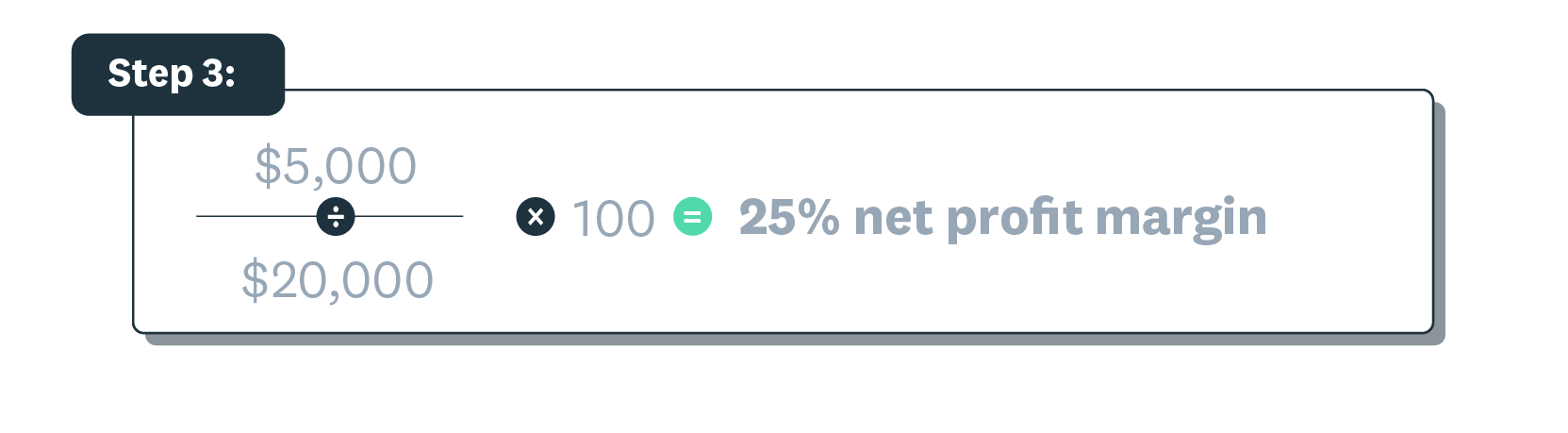
- Net profit margin: (₱5,000 ÷ ₱20,000) × 100 = 25%
A 25% net profit margin means you keep 25 centavos of profit for every peso of revenue, after all expenses are covered.
What is a good net profit margin?
There's no single number that counts as good, because margins vary widely by industry. As a general rule of thumb, Corporate Finance Institute notes that a net profit margin of around 5% is low, 10% is average, and 20% is high or "good".
Treat those figures as a guide rather than a target. A grocery store working on high volume may run a thin margin and still be healthy, while a service business might expect much more. The most useful comparison is your own margin over time, and the average for your industry.
Net profit margin vs gross profit margin
Both measures start with revenue, but they stop at different points, so it helps to keep them separate.
- Gross profit margin looks at revenue minus cost of goods sold, showing how profitable your products or services are before overheads
- Net profit margin goes further, subtracting all other operating expenses, interest, and tax to show your true bottom-line profit
Operating profit margin sits between the two, covering everyday running costs but not interest or tax. Reading them together gives you a fuller picture, and the guide on gross profit margin explains where each one fits.
How to improve your net profit margin
Improving your margin comes down to earning more from each sale or spending less to make it. A few practical levers can help.
- Review your pricing so it reflects the value you deliver and rising costs
- Increase sales volume where you can do so without adding proportionally more cost
- Trim expenses that don't add value, while protecting quality and service
- Watch cost of goods sold closely, since small savings there flow straight to the bottom line
Keeping an eye on the numbers makes these decisions easier. Being able to run financial reports and read your profit margin regularly helps you spot which changes are working.
Track your profit margin with Xero
Knowing your net profit margin is easier when your numbers are always up to date. Xero brings your income and expenses together in real-time reports, so you can see your profit and margin at a glance and act on what they're telling you. New customers can get one month free and start tracking profitability from day one.
FAQs on net profit margin
Here are quick answers to some common questions about net profit margin.
What is the difference between net profit and net profit margin?
Net profit is a peso amount left after all expenses, while net profit margin expresses that profit as a percentage of revenue. The margin makes it easier to compare performance across periods or businesses.
Is a higher net profit margin always better?
Generally a higher margin means you keep more of each sale, but it should be read against your industry and strategy. A very high margin from heavy cost-cutting can hurt quality and future sales.
How is net profit margin different from gross profit margin?
Gross profit margin only subtracts cost of goods sold, while net profit margin subtracts every expense, including operating costs, interest, and tax. Net profit margin is the more complete measure of profitability.
Can net profit margin be negative?
Yes. If your total expenses are greater than your revenue, your net profit is negative and so is your margin, which signals the business made a loss for that period.