Operating profit
Learn what operating profit is, how to calculate it, and why it matters for your small business.
Published Thursday 23 July 2026
Table of contents

How to calculate operating profit
Key takeaways
- Operating profit is what your business earns from its core operations after operating expenses, and before interest and tax.
- You calculate it by taking gross profit and subtracting operating expenses, depreciation and amortisation.
- Operating profit is the same as operating income and EBIT when your business has no non-operating revenue.
- Tracking operating profit shows whether your day-to-day trading actually makes money, separate from financing and tax.
What is operating profit?
Operating profit is what a business earns from its core operations after operating expenses, before interest and tax. It measures how well your everyday trading performs, without the effects of borrowing or tax.

Operating profit is also called operating income, and it's the same as earnings before interest and tax (EBIT) when your business has no non-operating revenue. Because it strips out financing and tax, it gives you a clean view of how your core business is doing.
Operating profit formula
The operating profit formula starts with your gross profit and takes away the costs of running the business. Here's the equation in plain terms.
Operating profit = gross profit − operating expenses − depreciation and amortisation.
Handy resources
Advisor directory
You can search for experts in our advisor directory
How to manage your finances and cash flow
Learn about money management for your small business
Financial reporting
Keep track of your performance with accounting reports
To get there, you first need your gross profit, which is revenue minus cost of goods sold. So gross profit = revenue − cost of goods sold.
How to calculate operating profit
You calculate operating profit by working down from your revenue to gross profit, then subtracting the costs of running your operations. Follow these steps.
- Start with your total revenue for the period.
- Subtract cost of goods sold to get gross profit.
- Subtract operating expenses, such as rent, wages, and utilities.
- Subtract depreciation and amortisation to reach your operating profit.
When working out operating profit, your accountant also makes two adjustments. Depreciation counts as an additional cost, and loan interest is removed from your costs.
Interest is excluded because operating profit only measures the things your business can control. Interest payments depend on the rate your lender sets, so they sit outside your core operations. That's why operating profit is also known as earnings before interest and tax (EBIT).
Example of an operating profit calculation
A simple worked example shows how the numbers flow from revenue to operating profit. Imagine your business sold $20,000 worth of products or services.
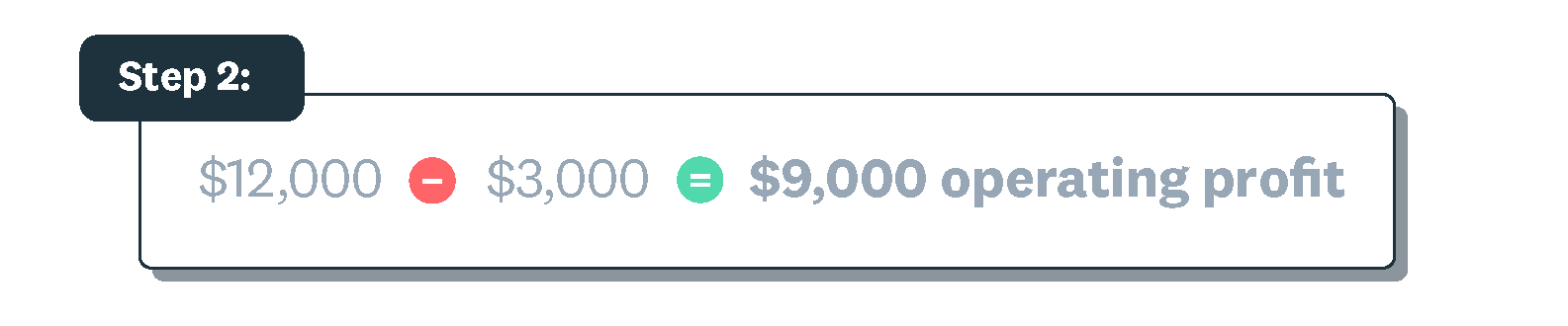
Now say it cost you $8,000 to provide those products and services, and you paid another $3,000 on things like rent, electricity, and phone charges. You work out operating profit in two steps.
- $20,000 minus $8,000 equals $12,000 gross profit.
- $12,000 minus $3,000 equals $9,000 operating profit.
What's included in and excluded from operating profit
Operating profit includes only the income and costs tied to your core trading, and it leaves out anything unrelated to daily operations. Knowing what to include keeps your figure accurate.
These items are excluded from operating profit because they sit outside your core operations:
- Non-operating income, such as asset sales, investment or dividend income, and foreign exchange gains
- Interest paid on loans and other financing costs
- One-off legal settlements
- Restructuring costs
- Income tax
Operating profit vs gross profit and net profit
These three profit measures each show a different stage of your earnings. Reading them together gives you the full picture of your business performance.
Gross profit is revenue minus cost of goods sold, so it shows what's left after the direct costs of making your product or delivering your service. Operating profit then takes gross profit and subtracts operating expenses, depreciation and amortisation, which shows how your core business performs. Net profit is what remains after all operating expenses, interest and tax, so it's your true bottom line.
Operating profit margin
Operating profit margin turns your operating profit into a percentage of revenue. It shows how much of each dollar you keep from core operations before interest and tax.
You work it out with a simple calculation: operating profit margin = operating profit / revenue, shown as a percentage. A higher margin means your core operations are more efficient, and tracking your profit margin over time helps you spot changes early.
Why operating profit matters for your business
Operating profit matters because it shows whether your core operations make money before financing and tax get involved. It's one of the clearest signals of day-to-day business health.
When you track operating profit, you can see if price rises or cost cuts are working, compare performance across periods, and decide where to invest. It gives you an honest read on your trading, separate from one-off events or the way you fund the business.
Track your operating profit with Xero
Keeping an eye on operating profit is easier when your numbers update in real time. With clear reporting, you can see how your core operations perform without digging through spreadsheets.
Xero brings your revenue, costs, and profit measures together in one place, so you always know where your business stands. To try it for yourself, get one month free.
FAQs on operating profit
Here are answers to some frequently asked questions about operating profit to help you use the measure with confidence.
Is operating profit the same as EBIT?
Yes, operating profit equals earnings before interest and tax (EBIT) when your business has no non-operating revenue. If you earn income outside your core operations, the two figures can differ.
What is the difference between operating profit and net profit?
Operating profit stops before interest and tax, while net profit is what remains after those are taken out. Net profit is your final bottom line.
What is a good operating profit margin?
A good margin varies by industry, so compare yours against similar businesses rather than a fixed number. A steady or rising margin over time is usually a healthy sign.
Is operating profit the same as operating income?
Yes, operating profit and operating income refer to the same figure. Both describe the earnings from your core operations before interest and tax.
Related Terms
Learn more about operating profit
Handy resources
Advisor directory
You can search for experts in our advisor directory
Profit & Loss template
Download Xero’s profit and loss statement template to show how much money you business is making
Financial reporting
Keep track of your performance with accounting reports
Disclaimer
This glossary is for small business owners. The definitions are written with their requirements in mind. More detailed definitions can be found in accounting textbooks or from an accounting professional. Xero does not provide accounting, tax, business or legal advice.