Bookkeeping vs accounting
Bookkeeping records your daily transactions; accounting turns them into business insight.
Published Thursday 23 July 2026
Table of contents
Key takeaways
- Bookkeepers record and organise your day-to-day transactions, while accountants analyse that data to give you strategic insight.
- Hire a bookkeeper when routine admin eats into your week, and add an accountant when you need tax, compliance and planning support.
- In New Zealand, accountants handle Inland Revenue Department (IRD) filing, provisional tax and statutory returns, so your records meet IRD rules.
- Many small businesses use both, and an indicative guide is to add an accountant as revenue approaches NZ$500,000.
Bookkeeping vs accounting
Bookkeeping is the day-to-day recording and organising of your financial transactions. Accounting is the analysis, interpretation and reporting of that data to guide business decisions.
The difference in bookkeeping vs accounting comes down to purpose: bookkeepers capture the numbers, accountants make sense of them. Both roles matter, and many small businesses use them at different stages of growth.
What bookkeepers do
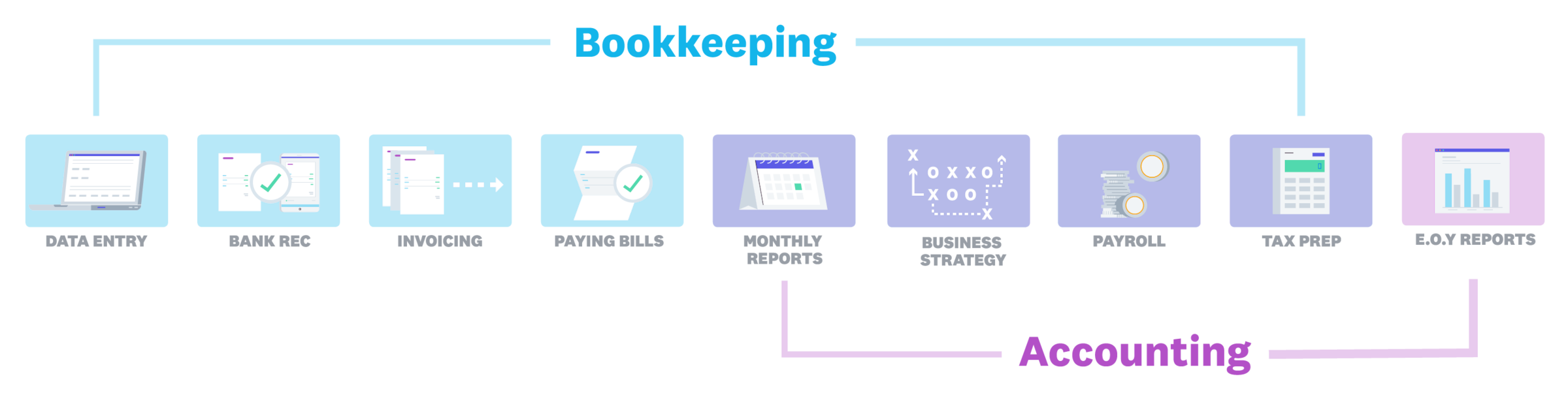
Bookkeepers handle the day-to-day record-keeping that keeps your business organised and compliant. Their typical tasks include:
- Recording and categorising your business transactions
- Managing accounts payable and accounts receivable
- Processing invoices and payments
- Completing bank reconciliations to keep records accurate
- Running payroll and preparing monthly financial reports
Some bookkeepers also spot trends in your numbers and flag issues before they grow. If you want the basics first, this guide on what bookkeeping is is a good place to start.
What accountants do
Accountants interpret your financial data to give strategic advice and keep you compliant. In New Zealand, they also handle IRD filing and tax returns. Their core services include:
- Preparing financial statements such as the balance sheet and cash flow statement
- Filing tax returns and managing IRD compliance
- Forecasting and analysing your business performance
- Advising on budgets, growth and investment
- Preparing for audits and representing you if one arises
Some accounting firms also offer bookkeeping, so you can manage your records and reporting in one place.
Difference between accountants and bookkeepers
The traditional line between the two roles has blurred, but the core difference holds. Bookkeepers keep your records accurate day to day, and accountants turn those records into insight.
Think of it as a handover. A bookkeeper builds a clean, up-to-date set of books, and an accountant uses them for tax, financial reporting, and forward planning. Using a bookkeeper for daily management and an accountant for strategy gives you full support without paying for services you do not need.
Bookkeeping, accounting and IRD compliance in New Zealand
If you run a business in New Zealand, your books also need to meet IRD rules. Accurate record-keeping sits at the centre of staying compliant.
You must keep records that support your GST and income tax returns for at least 7 years, as set out by IRD. Clean bookkeeping makes this straightforward, because every transaction is captured and easy to find.
Provisional tax is usually an accountant-level task. It spreads your income tax across the year in instalments, and an accountant can calculate what you owe and keep you on schedule. Accountants also handle statutory filing, from annual income tax returns to GST returns lodged through IRD.
When to hire a bookkeeper vs accountant
The right choice depends on your business stage and how much of your time admin is taking. Here is how to decide between a bookkeeper, an accountant, or both.
When to hire a bookkeeper
A bookkeeper suits you when routine financial admin starts to slow you down. Consider hiring one when you:
- Have regular transactions that need organising
- Spend more than 5 hours a week on financial record-keeping
- Need help with invoicing and paying bills
- Want monthly reports to track how the business is performing
When to hire an accountant
An accountant suits you when decisions get bigger and tax gets more complex. Consider hiring one when you:
- Need strategic advice for major business decisions
- Face complex tax situations or multiple revenue streams
- Are planning growth, investment or a loan application
- Want detailed financial analysis and forecasting
When to hire both
Growing businesses often benefit from both roles working together. As an indicative guide, consider using both when you:
- Approach annual revenue of NZ$500,000
- Operate across multiple locations
- Need daily financial management and strategic planning
- Want to focus on running the business rather than managing the books
Most small businesses start with a bookkeeper and add an accountant as they grow.
Education and qualifications required
Understanding the qualifications behind each role helps you choose the right support and set a realistic budget. The paths differ in length and depth.
Bookkeepers often train through industry-recognised certificates and diplomas, backed by hands-on experience. Common routes include:
- Completing an industry-recognised certificate or diploma in bookkeeping or accounting
- Learning accounting software on the job
- Building 1 to 3 years of practical experience
- Joining a professional bookkeeping body for ongoing training
Accountants usually hold a degree and a professional designation. In New Zealand, the main credential is Chartered Accountant (CA), awarded through Chartered Accountants Australia and New Zealand (CA ANZ), while CPA refers to CPA Australia. Typical steps include:
- Earning a bachelor's degree in accounting or a related field
- Gaining a CA designation through CA ANZ, or a CPA through CPA Australia
- Building 2 to 5 years of professional experience
- Adding specialist training in tax, forensic accounting or business valuation
Higher qualifications usually mean higher fees, alongside a broader range of services. Choose the level that matches your business needs and budget.
Manage your bookkeeping and accounting with Xero
Whether you work with a bookkeeper, an accountant or both, the right software keeps everyone on the same page. Xero brings your records, reports and GST details together in one place, so your day-to-day admin takes less time.
You get a clear view of your numbers, and your advisor gets books that are ready for tax and planning. See how Xero can support your bookkeeping and accounting, and get one month free when you start today.
FAQs on bookkeeping vs accounting
Here are answers to frequently asked questions about bookkeeping vs accounting.
What is the difference between bookkeeping and accounting?
Bookkeeping records and organises your daily transactions, while accounting analyses that data for reporting and advice. Bookkeepers keep the books accurate, and accountants turn them into insight.
Can a bookkeeper do accounting?
A bookkeeper can handle basic record-keeping and simple reporting, but usually not strategic analysis, tax planning or complex advice. Those tasks generally call for an accountant.
Do I need both a bookkeeper and an accountant?
Many small businesses use both, with a bookkeeper for daily records and an accountant for tax and strategy. The two roles work well together as you grow.
Which is more cost-effective for a small business?
Bookkeepers usually charge less per hour than accountants, so a bookkeeper is cost-effective for routine work. Add an accountant when you need strategic advice to grow.
When should I upgrade from a bookkeeper to an accountant?
Bring in an accountant when you face complex tax, major decisions or the need for financial planning. Revenue approaching NZ$500,000 is a common indicative trigger.
Related terms
Learn more about bookkeeping and accounting
Handy resources
Advisor directory
You can search for experts in our advisor directory
Margin calculator
Calculate your gross profit margin with this simple calculator to check you’re hitting your targets.
Xero dashboard
See your key information on the business dashboard
Disclaimer
This glossary is for small business owners. The definitions are written with their requirements in mind. More detailed definitions can be found in accounting textbooks or from an accounting professional. Xero does not provide accounting, tax, business or legal advice.