Break-even point formula
Learn the break-even point formula, with worked examples in RM, to find the sales you need to cover your costs.
November 2023 | Published by Xero
Published Wednesday 30 September 2026
Table of contents
Key takeaways
- The break-even point is the level of sales where your revenue covers all your costs. Every sale beyond it adds to your profit.
- The break-even point formula comes in two versions. One gives the sales revenue you need, and the other gives the number of units or hours you need to sell.
- Contribution margin is your selling price minus your variable cost per unit. Divide your fixed costs by it to find your break-even volume.
- Raising prices and trimming costs both lower your break-even point. Recalculate whenever your prices or costs change.
What is the break-even point?
The break-even point is the level of sales at which your total revenue equals your total costs, so you make zero profit and zero loss. Every sale after that point adds to your profit.
As Corporate Finance Institute’s guide to break-even analysis explains, the calculation shows the sales volume a business needs to cover its fixed and variable costs. It’s a big milestone, because it’s the moment your business starts to turn a profit.
Picture a bucket you need to fill before it overflows. Your costs are the bucket, and each sale pours in a little more water; once it’s full, everything extra is profit. You can use the figure to set baseline sales targets and to test whether a new price or product will pay its way.
Fixed costs, variable costs and contribution margin
Both break-even formulas draw on the same building blocks, so it helps to define them first. Here’s what each term means.
- Fixed costs stay the same whatever your sales volume, such as rent and insurance
- Variable costs rise and fall with how much you produce, such as raw materials and hourly wages
- Selling price is the amount you charge for each unit or hour
- Contribution margin is the selling price minus the variable cost per unit
- Contribution margin ratio is the contribution margin divided by the selling price
Contribution margin is the amount each sale leaves over to pay your fixed costs. OpenStax’s Principles of Managerial Accounting shows how this one figure drives break-even in both units and sales value.
In a simple break-even model, your variable cost per unit is the same as your marginal cost, the extra cost of making one more unit. If a bottle sells for RM7 and costs RM2 to make, it contributes RM5 towards fixed costs. The contribution margin ratio is RM5 ÷ RM7, or about 71%.
Break-even point formulas
There are two break-even point formulas: one works out the sales revenue you need, and the other works out the number of units. Revenue break-even gives you a ringgit figure to beat, while volume break-even tells you how much work you need to do.
Break-even point in sales (RM)
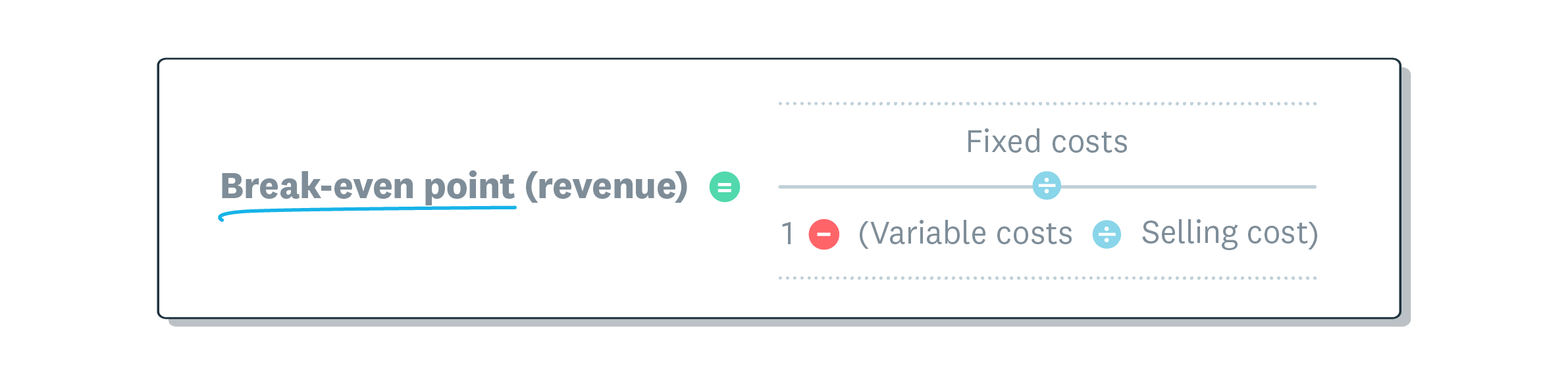
This version tells you how much revenue you need to cover your costs. Break-even point (revenue) = Fixed costs ÷ (1 − (Variable cost per unit ÷ Selling price)).
The part in brackets, 1 − (variable cost ÷ selling price), is your contribution margin ratio. That means you can also write it as Break-even point (revenue) = Fixed costs ÷ Contribution margin ratio.
Break-even point in units
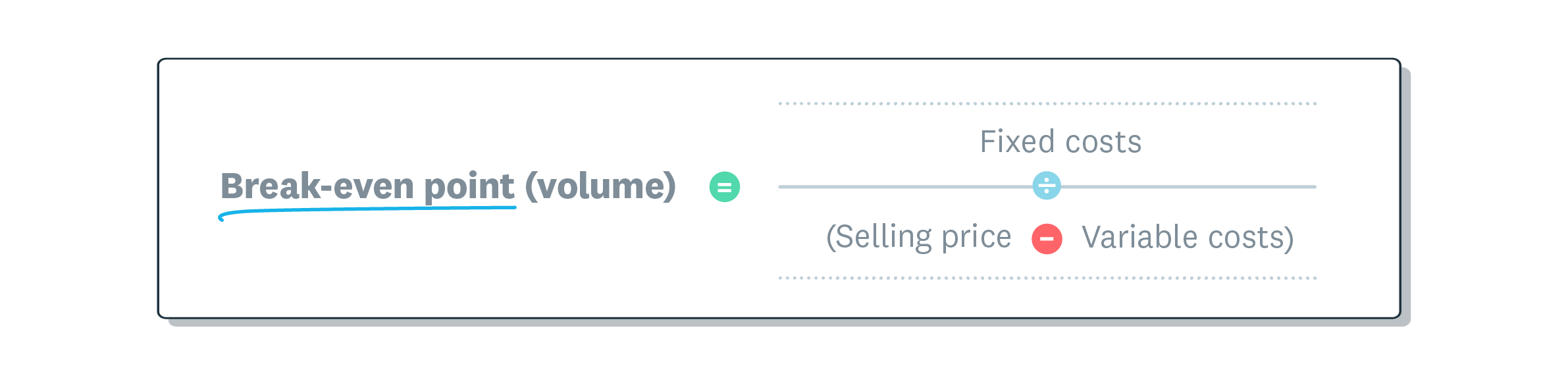
This version tells you how many units or hours you need to sell. Break-even point (units) = Fixed costs ÷ (Selling price − Variable cost per unit).
It’s simple to use if you sell one product or charge a single hourly rate. If you sell many products at different prices, use an average contribution margin based on your usual sales mix.
How to calculate the break-even point in 4 steps
Work through these four steps using your latest monthly figures. Each step builds on the one before, so the final division gives you your answer.
1. Add up your fixed costs
List every cost you pay regardless of how much you sell, such as rent, insurance, equipment leases and software subscriptions. Add them up for one period, usually a month.
2. Work out your variable cost per unit
Add up the costs that rise with each sale, such as ingredients, packaging and sales commissions. Divide the total by the number of units sold. Your cost of sales figure is a good starting point for this number.
3. Calculate your contribution margin
Subtract your variable cost per unit from your selling price. For the revenue version, divide that contribution margin by your selling price to get the contribution margin ratio.
4. Divide your fixed costs by the contribution margin
Divide your fixed costs by the contribution margin to get break-even in units. Divide them by the contribution margin ratio instead to get break-even in sales revenue.
Break-even point examples
These two examples show both formulas at work, one for a product business and one for a service business. All figures are monthly and in Malaysian ringgit.
Example 1: a kombucha brewery
A kombucha brewery has fixed monthly costs of RM6,000 for rent, utilities, insurance and advertising. Each bottle costs RM2 in packaging, ingredients and labour, and sells for RM7.
In units, the brewery needs RM6,000 ÷ (RM7 − RM2) = RM6,000 ÷ RM5 = 1,200 bottles a month.
In revenue, start with 2 ÷ 7 ≈ 0.2857, then 1 − 0.2857 = 0.7143. Finally, RM6,000 ÷ 0.7143 ≈ RM8,400, and using the exact fraction (5/7) gives RM8,400 exactly.
You can check the answer by multiplying the units by the price: 1,200 bottles × RM7 = RM8,400. Both formulas land on the same point, measured in different ways.
Example 2: a graphic designer
A graphic designer has fixed monthly costs of RM2,700 for utilities, hardware leases, software subscriptions and advertising. They pay a contractor RM35 an hour and charge clients RM75 an hour.
In hours, the designer needs RM2,700 ÷ (RM75 − RM35) = RM2,700 ÷ RM40 = 67.5 billable hours a month.
In revenue, start with 35 ÷ 75 ≈ 0.4667, then 1 − 0.4667 = 0.5333. Finally, RM2,700 ÷ 0.5333 = RM5,062.50 when you use the exact fraction (8/15), which matches 67.5 hours × RM75.
Break-even point for a target profit
The same formula can tell you how much to sell to hit a profit goal. Add your target profit to your fixed costs before you divide.
Units for target profit = (Fixed costs + Target profit) ÷ Contribution margin per unit.
Say the kombucha brewery wants RM2,000 profit each month. It needs (RM6,000 + RM2,000) ÷ RM5 = 1,600 bottles, which is RM11,200 in sales at RM7 a bottle.
How to calculate the break-even point in Excel or Google Sheets
Excel has no single built-in break-even function, so you build your own with a short formula that works the same way in Google Sheets. Set up your inputs once, and the result updates whenever a cost or price changes.
- Enter your fixed costs (6000) in cell B1
- Enter your selling price (7) in cell B2
- Enter your variable cost per unit (2) in cell B3
- Add labels in column A so each figure is easy to identify
For break-even in units, type =B1/(B2-B3) in another cell, and it returns 1,200. For break-even in revenue, type =B1/(1-B3/B2), and it returns 8,400.
To work backwards from a goal, try Excel’s Goal Seek tool. Microsoft’s Goal Seek guide shows how it adjusts one input until a formula hits your target. For example, it can find the price that brings break-even down to 1,000 bottles.
Margin of safety and break-even
Once you know your break-even point, you can measure how much buffer your current sales give you. That buffer is your margin of safety.
Margin of safety = (Current sales − Break-even sales) ÷ Current sales.
If the brewery sells 1,500 bottles a month, its buffer is (1,500 − 1,200) ÷ 1,500 = 20%. Xero’s guide explains how to track your margin of safety over time.
How to lower your break-even point
A lower break-even point means you start making a profit sooner. Each of these levers changes one input in the formula.
- Raise your prices to lift the contribution margin on every sale
- Negotiate with suppliers or buy in bulk to cut variable costs
- Review rent, subscriptions and other overheads to keep fixed costs in check
- Promote products with a higher contribution margin so each sale covers more
Before you change prices, check how the move affects your profit margin and customer demand. For more ideas, explore practical ways to increase profits.
Limitations of break-even analysis
Break-even analysis works best as a planning guide, because it rests on a few simplifying assumptions. Keep these in mind when you read your result.
- It assumes your selling price stays the same at every sales level
- It treats costs as moving in a straight line with volume
- It suits a single product or a fixed sales mix
- It needs semi-variable costs, such as a phone bill with a base fee, split into fixed and variable parts
- It leaves out customer demand and the timing of cash coming in and going out
Pair your break-even figure with a cash flow forecast to see when money will actually reach your account.
Track your break-even point with Xero
Knowing your break-even point gives you a clear sales target and a solid base for pricing decisions. Xero brings your costs and sales into easy-to-read reports, so the numbers behind your formula stay current. Try Xero today and get one month free.
FAQs on break-even point formula
Here are quick answers to common questions about the break-even point formula.
What are the three ways to calculate the break-even point?
The equation method sets revenue equal to fixed plus variable costs, and the contribution margin method divides fixed costs by the margin, as shown above. The graphical method plots revenue and total cost lines on a chart, and break-even is where they cross.
How do fixed and variable costs affect the break-even point?
Higher fixed costs raise your break-even point, because you need more sales to cover them. Higher variable costs shrink your contribution margin, so each sale covers less and break-even rises too.
What happens after you pass the break-even point?
Every sale after break-even adds its full contribution margin to your profit. For the brewery, bottle number 1,201 adds RM5 of profit.
How often should a small business recalculate its break-even point?
Recalculate whenever your prices, supplier costs or overheads change, and before you launch a product or sign a new lease. A quarterly check also keeps your sales targets realistic.
Can a service business use the break-even formula?
Yes. Treat each billable hour as a unit, your hourly rate as the selling price and direct hourly costs like contractor pay as the variable cost.
Related terms
Learn more about break-even point formula
Handy resources
Advisor directory
You can search for experts in our advisor directory
How to increase revenue
Find out how businesses grow their sales income.
Stay on top of your numbers with Xero
Accounting software tracks your performance while you sleep.
Disclaimer
This glossary is for small business owners. The definitions are written with their requirements in mind. More detailed definitions can be found in accounting textbooks or from an accounting professional. Xero does not provide accounting, tax, business or legal advice.