Cash flow projection: what it is and how to create one
Discover how cash flow projection gives your small business clarity to time bills, smooth cash flow, and plan growth.
Written by Jotika Teli—Certified Public Accountant with 24 years of experience. Read Jotika's full bio
Published Thursday 2 April 2026
Table of contents
Key takeaways
- Create cash flow projections by listing your starting balance, expected cash inflows with dates, expected outflows with dates, then calculate your running cash position to spot potential shortfalls before they happen.
- Update your cash flow projection at least monthly to maintain accuracy, as projections become less reliable the further into the future you forecast.
- Analyse your projections by comparing predicted results against actual outcomes to identify patterns like late customer payments or seasonal trends that affect your business.
- Use cash flow projections to make confident spending decisions by showing exactly how purchases or investments will affect your available cash position over time.
What is a cash flow projection?
A cash flow projection is a forecast of your expected cash inflows and outflows over a set period. It shows how much money you'll have available at any point in the future, helping you plan spending and spot potential shortfalls before they happen.
Unlike a cash flow statement, which records past transactions, a projection looks ahead. This forward-looking view gives you time to adjust your plans and make confident financial decisions.
Cash flow projection vs cash flow forecast vs cash flow statement
These three terms are often used in the same conversation, but they each have a specific job. Understanding the difference helps you use the right tool for the right task.
- Cash flow projection: an estimate of future cash inflows and outflows over a specific period, used for planning and decision-making.
- Cash flow forecast: often used interchangeably with projection, though some businesses use 'forecast' for shorter-term estimates and 'projection' for longer-term planning.
- Cash flow statement: a formal financial report showing actual cash movements that have already occurred, typically prepared monthly, quarterly, or annually.
For most small businesses, the terms projection and forecast mean the same thing. The key distinction is between looking forward (projection or forecast) and looking back (statement).
A cash flow statement records what happened. A cash flow projection helps you plan what's coming next.
Why cash flow projections matter for small businesses
Cash flow projections help you avoid cash shortages by showing when money will be tight. This is more important than ever. With financing costs more than doubling since 2021, forecasting helps you pay bills on time, ensure you can pay yourself, and plan for rising costs before they become a problem.
When expenses climb unexpectedly, a projection gives you advance warning. That visibility helps you take action early rather than scrambling to cover gaps.
Benefits of cash flow projections
Cash flow projection is a good financial habit to get into. It offers several operational and financial benefits:
- Spot cash shortages early: identify gaps before they happen so you can delay spending, request supplier credit, or secure a business loan.
- Assess growth affordability: determine whether you have enough cash to buy new equipment or hire staff.
- Protect your own pay: confirm you'll have enough to pay yourself each period.
- Track expense trends: catch rising costs or falling income before they become serious.
- Fix cash flow problems: identify issues like slow-paying customers, impractical payment terms, or seasonal dips, and manage cash proactively to overcome major challenges. 'Access to funding' is considered one of the top five barriers for small and medium-sized enterprises (SMEs).
Key components of a cash flow projection
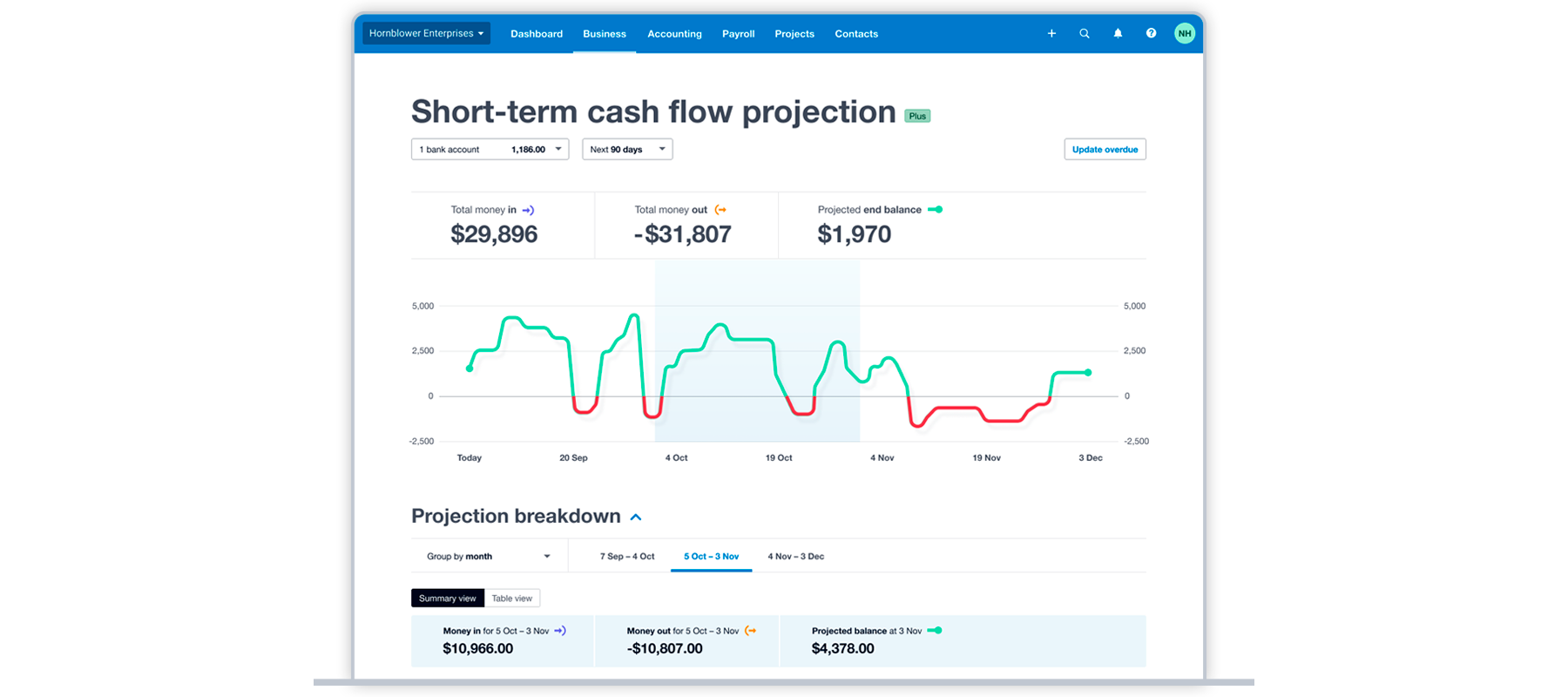
A cash flow dashboard shows how cash balances will rise and fall in response to expected transactions.
Your cash flow projection includes five key components:
- Starting balance: the cash you have in the bank at the beginning of the period.
- Cash inflows: money coming in from sales, loans, asset sales, or other sources.
- Cash outflows: money going out for expenses, payments, and purchases.
- Net cash flow: the difference between inflows and outflows, showing whether your cash position grew or shrank.
- Closing balance: the cash you expect to have at the end of the period.
How to create a cash flow projection
Creating a cash flow projection shows you how much cash you'll have at any point in the future. You can do it yourself using a spreadsheet or accounting software. Many small business owners also work with a bookkeeper or accountant who can prepare projections quickly based on their experience with small business finances.
Follow these steps to build one using a spreadsheet or software.
1. Choose your forecasting period and starting balance
Select a time frame for your projection, such as one month, one quarter, or 12 months. Note how much cash you have in the bank at the start of this period.
2. List all expected cash income
Record every source of incoming cash during the forecast period. Include sales receipts, grants, tax refunds, loan proceeds, and any other money that will hit your bank account. Add the expected date for each payment.
3. List all expected cash outflows
Record all payments you expect to make. Include regular business costs plus less frequent expenses like annual fees, tax payments, or scheduled repairs. Add the expected date for each payment.
4. Calculate your running cash flow
Start with your opening balance. Add each incoming amount and subtract each outgoing amount as they occur. The result shows your expected cash position at any point during the forecast period.
Cash flow projection methods
Accounting software speeds up the projection process by pulling data directly from your books. Xero, for example, tracks your incomings and outgoings automatically, so you can generate a projection in a few clicks.
A cash flow dashboard shows how cash balances will rise and fall in response to expected transactions.
For longer-term forecasting, accounting software integrates with dedicated apps like Spotlight, Fathom, and Calxa. These tools provide more detailed projections and scenario planning.
You can also create cash flow projections using your balance sheet and income statement. These methods, sometimes called indirect projections, work better for longer-term planning rather than day-to-day or week-to-week tracking.
Preparing an indirect projection requires accounting knowledge. If you want to explore this approach, ask your accountant or bookkeeper for guidance.
Example of a cash flow projection
Here's how a cash flow projection works in practice.
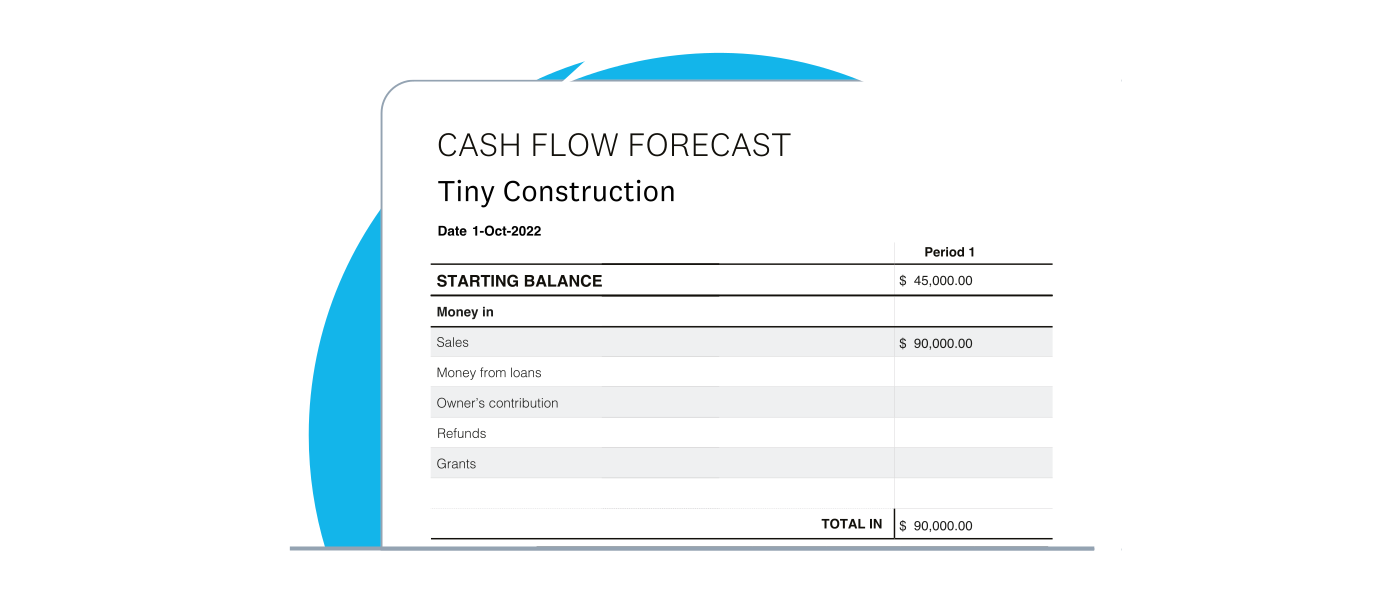
The finance manager of Tiny Construction wants to assess whether the business can afford a new piece of equipment costing $20,000 next month.
Based on current bank balances, Tiny Construction has a starting balance of $45,000. Outstanding invoices and sales forecasts estimate incoming payments of $90,000 within the next 30 days. There are no other incoming payments for the month.
So the "money in" part of the cash flow projection will look like this:
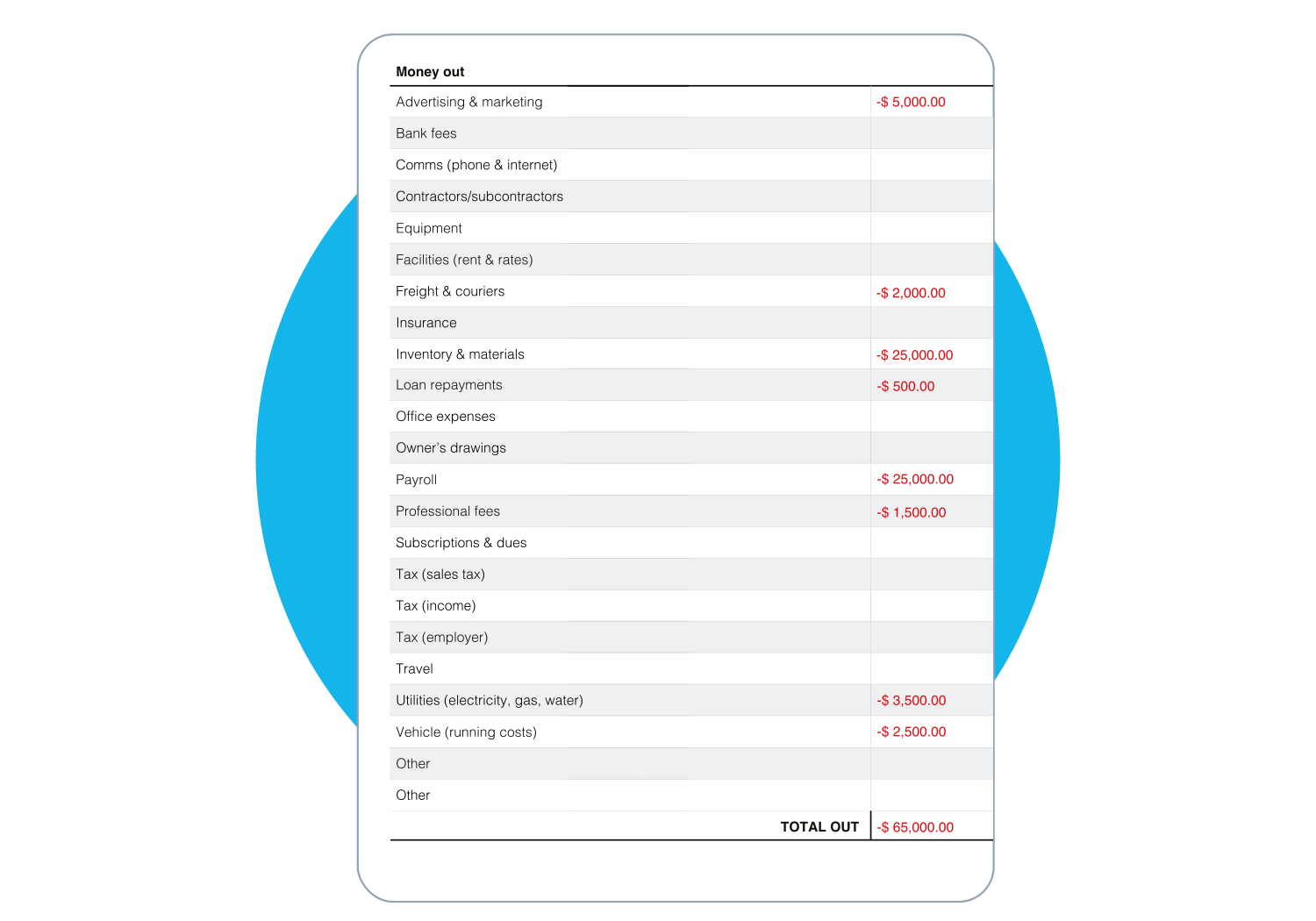
The "money out" part of the cash flow projection will look like this:
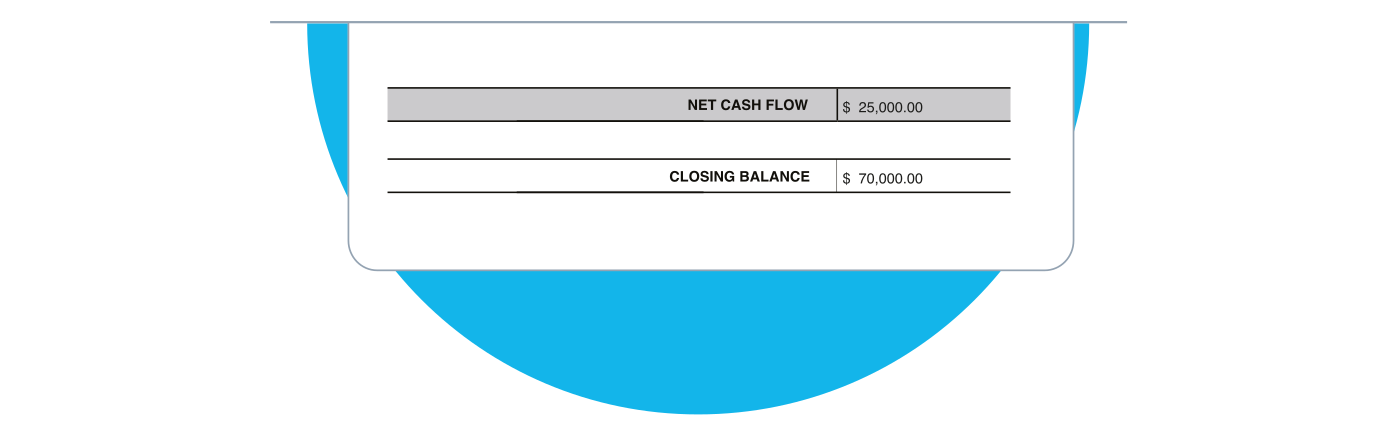
The net cash flow for the period is $25,000. Adding this to the starting balance of $45,000 gives a closing balance of $70,000.
If Tiny Construction buys the equipment for $20,000, the starting balance for the next month drops to $50,000. That's still a healthy position, so the projection confirms the purchase is affordable.
This example shows how cash flow projections help you make investment decisions with confidence by showing exactly how a purchase affects your cash position.
How to analyse your cash flow projection
Analysing your cash flow projection means comparing what you predicted against what actually happened. This review is critical because forecasting is notoriously difficult; one Ernst & Young (EY) analysis found that only 28% of companies' cash forecasts were within 10% of their annual targets. This review helps you improve future projections and spot patterns in your business finances.
Focus on these three areas:
- Closing balance: check whether you'll have enough cash in reserve at the end of each period to cover unexpected expenses or opportunities.
- Net cash flow: review whether your cash position grew or shrank during the period, and by how much.
- Accuracy: compare your projection to actual results once the period ends, then identify what you overestimated or underestimated.
If your projection was significantly off, investigate the cause. Common issues include customers paying later than expected, unexpected expenses, or seasonal patterns you didn't account for. Research identifies four phases of seasonality: busy, slow, and the 'shoulder' periods in between. These can last from one to three and a half months. Use these insights to make your next projection more accurate.
How often should you update your cash flow projection?
Update your cash flow projection at least monthly to keep it accurate and useful. The further you project into the future, the less reliable your estimates become, so regular updates help you stay on track.
If you use a 12-month rolling projection, refresh it at the end of each month. Drop the completed month, add a new one at the end, and review the entire forecast for any changes to expected income or expenses.
For businesses with tight cash flow or rapid changes, weekly updates may be more appropriate. The goal is to catch problems early enough to take action.
Simplify cash flow projections with Xero
Xero makes cash flow projections faster and more accurate by automating the data collection. Instead of manually entering transactions, Xero pulls information directly from your bank feeds and invoices to show your projected cash position.
You can view your cash flow forecast in a few clicks, spot potential shortfalls early, and make confident decisions about spending and growth. If you're just getting started, download a free cash flow projection template to see how the process works.
Ready to automate your cash flow management? Get one month free and see how Xero simplifies projections for your business.
FAQs on cash flow projections
Here are answers to common questions about cash flow projections.
What's the difference between a cash flow projection and a projected cash flow statement?
A cash flow projection estimates future cash inflows and outflows to show your expected cash position. A projected cash flow statement is a more formal financial document that follows accounting standards and is often required for loan applications or investor presentations.
How do you calculate projected net cash flow?
Subtract your total expected cash outflows from your total expected cash inflows for the period. The result is your projected net cash flow, which shows whether your cash position will increase or decrease.
What are the most common mistakes in cash flow projections?
The most common mistakes include overestimating how quickly customers will pay, underestimating expenses, and forgetting irregular costs like annual fees or tax payments. Comparing projections to actual results helps you identify and correct these errors over time.
Should I use spreadsheets or software for cash flow projections?
Spreadsheets work well for simple projections, but accounting software saves time by pulling data automatically from your bank feeds and invoices. Software also reduces manual entry errors and makes it easier to update projections regularly.
What should I do if my cash flow projection shows a shortfall?
Act early to close the gap. Options include delaying non-essential purchases, following up on overdue invoices, and negotiating extended payment terms. When seeking external funding to pay existing fixed costs, small business owners often use savings or credit cards for smaller amounts, while larger needs may require loans or investors.
Disclaimer
Xero does not provide accounting, tax, business or legal advice. This guide has been provided for information purposes only. You should consult your own professional advisors for advice directly relating to your business or before taking action in relation to any of the content provided.
Start using Xero for free
Access Xero features for 30 days, then decide which plan best suits your business.