Margin vs markup
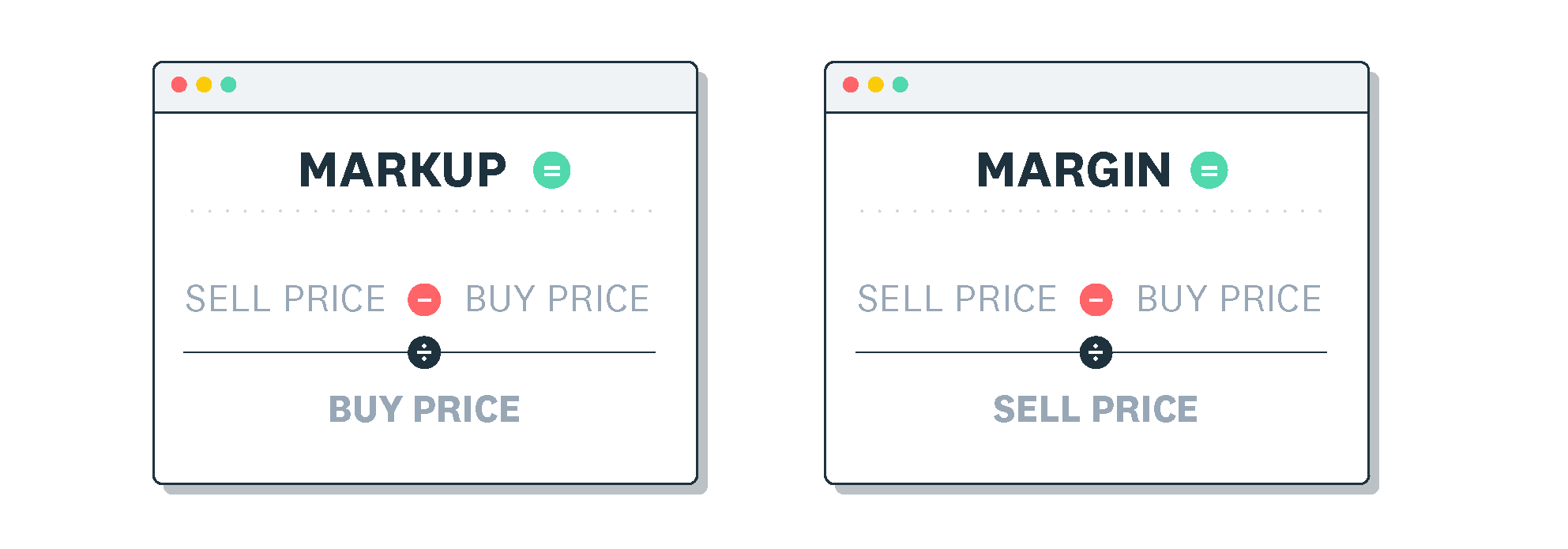
Margin measures profit as a percentage of the selling price; markup measures it as a percentage of cost.
Published Thursday 6 August 2026
Table of contents
Key takeaways
- Margin shows your profit as a percentage of the selling price, while markup shows the same profit as a percentage of cost.
- Markup is always a larger percentage than margin for the same sale, because it divides profit by the smaller cost figure.
- Use margin to measure profitability and financial health, and use markup to set prices from a known cost.
- You can convert between the two: markup equals margin divided by (1 minus margin), and margin equals markup divided by (1 plus markup).
What is margin?
Margin is your profit on a sale shown as a percentage of the selling price. It tells you what portion of each dollar of income you keep after paying for the goods you sold.
The profit here is your gross profit, which is the selling price minus the cost of the item. To turn it into a margin percentage, divide gross profit by the selling price and multiply by 100.
Say you buy a product for HK$60 and sell it for HK$100. Your gross profit is HK$40, so your margin is 40 ÷ 100 × 100, which equals 40%. In other words, 40% of your income from that sale is profit.
What is markup?
Markup is the same profit shown as a percentage of cost. It tells you how much you add to what you paid to arrive at your selling price.
To work out markup, divide gross profit by the cost and multiply by 100. This starts from what the item cost you rather than what you sold it for, so it suits pricing decisions where you already know your cost of goods sold.
Using the same figures, a HK$60 cost and a HK$40 profit give a markup of 40 ÷ 60 × 100, which equals 66.7%. So you added 66.7% to the cost to set the HK$100 price. This cost-based approach matches how the Corporate Finance Institute defines markup percentage.
Margin vs markup: the key difference
Margin and markup describe the same profit in dollars, but they measure it against different starting points. That single difference is what sets them apart, as AccountingTools explains.
- Margin is a percentage of the selling price, so it shows how much of your income is profit.
- Markup is a percentage of cost, so it shows how much you added to your costs to set the price.
Because the selling price is always higher than the cost, dividing by the selling price gives a smaller percentage than dividing by the cost. That is why your markup is always bigger than your margin, even though both point to the same HK$40 of profit. In the example above, a 40% margin and a 66.7% markup come from exactly the same sale.
Mixing up the two is a common pricing mistake. If you aim for a 40% profit margin but apply a 40% markup instead, you end up charging less than you intended and keep less profit.
How to calculate margin and markup
Both calculations start from the same two numbers: your cost and your selling price. Work out your gross profit first, then divide it by a different base for each figure. Xero's guide to gross profit margin walks through the wider picture if you want more context.
- Subtract the cost from the selling price to find your gross profit.
- For margin, divide gross profit by the selling price, then multiply by 100.
- For markup, divide gross profit by the cost, then multiply by 100.
With a HK$60 cost and a HK$100 price, gross profit is HK$40. That gives a 40% margin (40 ÷ 100) and a 66.7% markup (40 ÷ 60).
How to convert between margin and markup
You do not need to recalculate from cost and price every time. If you know one figure, you can convert it to the other with two short formulas.
- To find markup from margin, divide the margin by (1 minus the margin). A 40% margin becomes 0.40 ÷ 0.60, which equals 66.7% markup.
- To find margin from markup, divide the markup by (1 plus the markup). A 66.7% markup becomes 0.667 ÷ 1.667, which equals 40% margin.
Keeping both figures on hand helps when different parts of your business speak different languages. A supplier might quote you a markup, while your reports track margin.
When to use margin vs markup
Each figure answers a different question, so most businesses use both. The choice depends on whether you are setting a price or measuring performance.
- Use markup when you set prices from a known cost, since it builds your profit directly on top of what you paid.
- Use margin when you check profitability, because it shows how much of your revenue you actually keep.
Margin is the figure to watch as you measure your profitability over time, since it lets you compare products and periods on the same basis. Markup is the quicker tool at the point of pricing a single item.
Track your margins and markups with Xero
Knowing your margin and markup only helps if your cost and sales figures are accurate and up to date. Xero brings your income and costs together and turns them into clear reports, so you can see your gross profit and margins without manual spreadsheets. Start with confidence and get one month free when you choose a Xero plan.
FAQs on margin vs markup
Here are quick answers to common questions about how margin and markup compare.
Is a higher margin or a higher markup better?
Neither is better on its own, because they measure the same profit against different bases. A higher margin means you keep more of each dollar of revenue, which is the clearer sign of profitability.
How do you convert a markup to a margin?
Divide the markup by (1 plus the markup). For example, a 66.7% markup divided by 1.667 gives a 40% margin.
Can margin and markup ever be the same?
Only when there is no profit, which means the cost and selling price are equal and both figures are zero. For any profitable sale, markup is the larger percentage.
Which do retailers usually use to set prices?
Retailers often use markup because they price up from a known cost of stock. They then check margin to confirm the price meets their profit targets.
Related terms
Learn more about margin vs markup
Handy resources
Advisor directory
You can search for experts in our advisor directory
Xero Small Business Guides
Discover resources to help you do better business
Financial reporting
Keep track of your performance with accounting reports
Disclaimer
This glossary is for small business owners. The definitions are written with their requirements in mind. More detailed definitions can be found in accounting textbooks or from an accounting professional. Xero does not provide accounting, tax, business or legal advice.