How to measure profitability: profit margin formulas
Learn to measure profitability, choose key metrics, and make faster decisions on your pricing and costs.

Written by Jotika Teli—Certified Public Accountant with 24 years of experience. Read Jotika's full bio
Published Friday 17 April 2026
Table of contents
Key takeaways
- Calculate your gross profit margin by subtracting cost of goods sold from revenue, then dividing by revenue and multiplying by 100 to track how much money covers direct production costs.
- Track your net profit margin monthly or quarterly by dividing total profit (after all expenses) by revenue to spot problems early and maintain healthy cash flow.
- Use your profit and loss statement to find the numbers you need, with revenue at the top, cost of goods sold below that, operating expenses in the middle, and net profit at the bottom.
- Improve low profit margins by raising prices to reflect true costs, negotiating better supplier terms, cutting operating expenses, or increasing sales volume without proportionally raising costs.
What profitability means in small business
Understanding profitability is essential for any small business owner.
Profitability measures how effectively your business turns sales into profit. The main profitability metrics are gross profit margin and net profit margin, which show what percentage of revenue you keep after paying costs.
High profitability means you retain a large share of sales as profit. This is generally positive, though it may signal room to lower prices and boost sales volume.
Low profitability means most of your revenue covers expenses. This could indicate high costs, underpriced products or services, or a competitive market where price pressure is constant.
Profit versus profitability and their significant differences
- Profit: the amount of money your business keeps after paying expenses
- Profitability: the percentage of revenue you retain versus the percentage spent on operations
This distinction matters. High profitability only improves your bottom line when paired with strong revenue. You need both healthy margins and solid sales to grow.
Profitability metrics
Profitability metrics are key performance indicators (KPIs) that show how efficiently your business converts revenue into profit. The two most common are gross profit margin and net profit margin, sometimes called profitability ratios.
Gross profit margin
Gross profit margin measures the percentage of revenue remaining after you pay direct costs, known as the cost of goods sold (COGS). These include materials, labour, and other expenses directly tied to delivering your product or service.
- What it shows: how much revenue covers direct production costs
- Why it matters: gross profit funds your operating expenses like rent, marketing, and administration
Net profit margin
Net profit margin measures the percentage of revenue remaining after paying all business costs, including operating expenses, interest, and depreciation.
- What it shows: your true bottom-line profitability
- Why it matters: net profit is what you reinvest in growth or distribute to owners
Net profit can be quoted before or after taxes. The calculations below use pre-tax net profit.
Operating profit margin
Operating profit margin measures the percentage of revenue remaining after paying both direct costs and operating expenses, but before interest and taxes. It shows how efficiently you run day-to-day operations, though its calculation can vary; one study found that companies used at least nine different ways to calculate operating profit.
- Formula: (Revenue − COGS − Operating expenses) ÷ Revenue × 100
- When to use it: if you want to assess operational efficiency separately from financing costs
For most small businesses, gross and net profit margins provide sufficient insight. Operating margin is useful when you want a more detailed view of how well you manage overhead costs.
How to measure profitability
To measure profitability, divide your profit by revenue and multiply by 100 to get a percentage. The calculation differs slightly depending on whether you're measuring gross or net profit margin.
First, calculate your profit figure. Then apply the formula for the margin you want to track.
How to calculate gross profit margin

Follow these steps to calculate gross profit margin:
- Find your total revenue for the period.
- Subtract your cost of goods sold (COGS) from revenue to get gross profit.
- Divide gross profit by revenue.
- Multiply by 100 to get a percentage.
Use the gross margin calculator to run the numbers automatically.
How to calculate net profit margin

*Net profit can be quoted before or after taxes. If quoting after-tax net profit then you need to also subtract taxes.
- Find your total revenue for the period.
- Subtract all expenses (COGS, operating costs, interest, depreciation) from revenue to get net profit.
- Divide net profit by revenue.
- Multiply by 100 to get a percentage.
Use the net profit margin calculator to run the numbers automatically.
Here's a practical example showing how these calculations work.
Example: Measuring profitability for a small business
Here's how to calculate profitability for a business with $100,000 in sales, $60,000 in inventory costs (COGS), and $20,000 in general expenses.
- Gross profit: $100,000 revenue − $60,000 COGS = $40,000
- Gross profit margin: $40,000 ÷ $100,000 × 100 = 40%
- Net profit: $100,000 revenue − $80,000 total costs = $20,000
- Net profit margin: $20,000 ÷ $100,000 × 100 = 20%
This business keeps 40 cents of every dollar after direct costs and 20 cents after all expenses.
Now that you understand the calculations, you need to know where to find the data.
Where to find the numbers you need
You'll find the numbers you need on your profit and loss (P&L) statement, also called an income statement. Here's where to look:
- Revenue: the top line of your P&L, showing total sales for the period
- Cost of goods sold (COGS): the section below revenue, covering direct costs like materials and production labour
- Operating expenses: the section including rent, utilities, marketing, salaries, and administrative costs
- Net profit: the bottom line after all expenses are subtracted
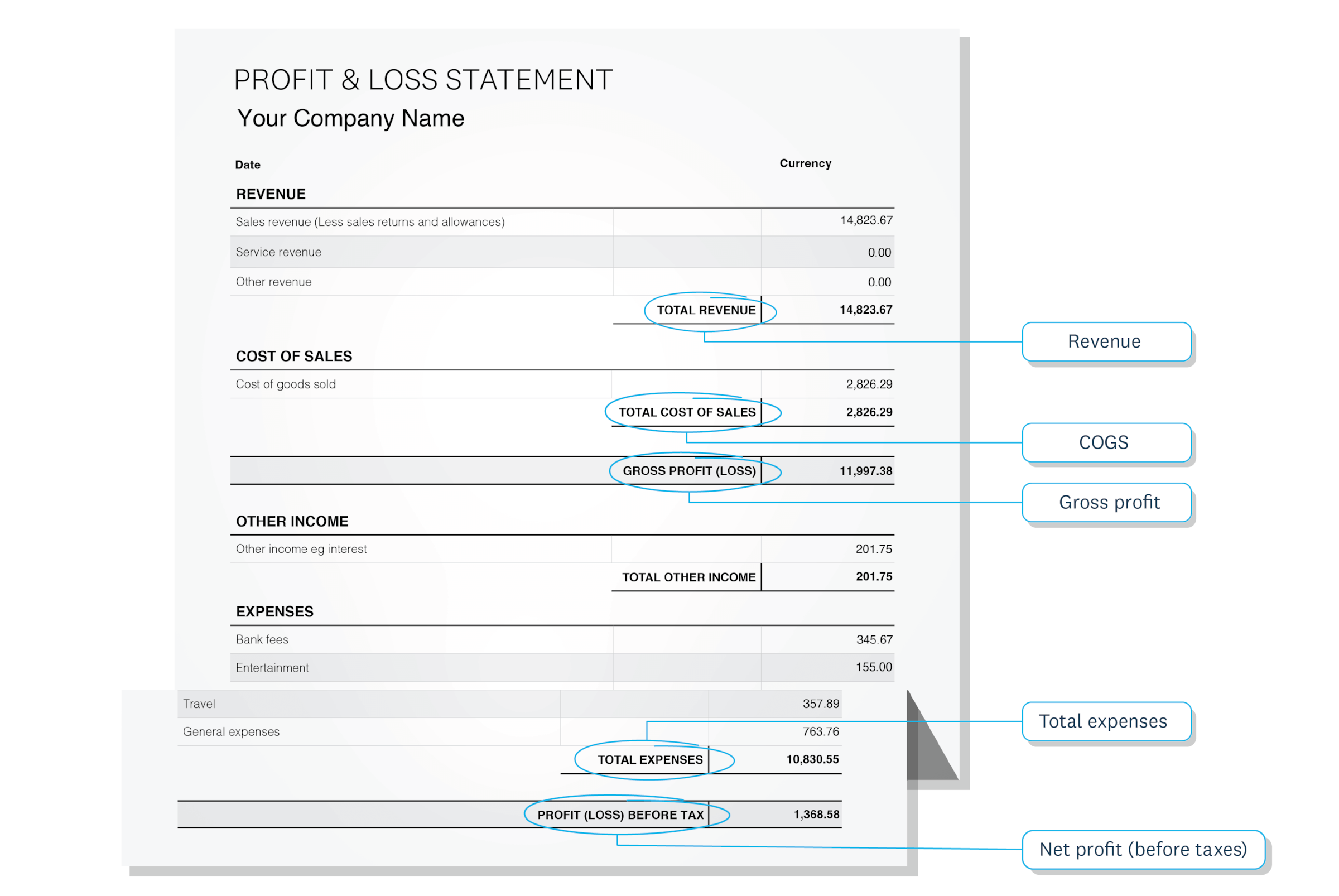
If you use accounting software like Xero, these figures are calculated automatically. You can pull a P&L report for any date range and see your margins at a glance.
Why measuring profitability regularly matters
Regular profitability tracking helps you spot problems early and make adjustments before margins erode. When profitability drops, cash flow often follows, making it harder to cover expenses and invest in growth.
Your margins can shift due to factors outside your control:
- rising costs for materials, energy, or transport
- changes in interest rates or rent
- currency fluctuations affecting import costs
- increased competition driving prices down
Measuring profitability monthly or quarterly helps you respond quickly to these changes and maintain healthy margins.
How Xero helps you measure profitability
You can automate profitability tracking so you don't have to calculate margins manually. While many businesses are embracing this type of automation, broader tech adoption has room to grow, with 83% of small businesses not using advanced tools like artificial intelligence. Xero calculates your gross and net profit margins automatically based on your transactions.
Here's how to access your profitability data in Xero:
- Xero Analytics: select any date range to see margin trends over time
- Profit and loss reports: generate a P&L statement to view revenue, costs, and profit figures
- Dashboard insights: check real-time profitability from your main dashboard
Automated tracking means you always have current data without manual spreadsheet work.
Once you understand your current margins, you can take steps to improve them.
How to improve profitability
Track your profitability regularly, especially when costs change or competition intensifies. Set a target margin for your business and use it as a benchmark. An accountant or bookkeeper familiar with your industry can help you understand typical margins and set realistic goals.
If your margins are lower than expected, you have several options:
- Raise prices: adjust pricing to reflect your true costs and value. This is a common strategy, with many small business owners resorting to measures like raising prices (47%) to stay afloat.
- Reduce direct costs: negotiate with suppliers or find more efficient production methods.
- Cut operating expenses: review overheads like rent, subscriptions, and utilities for savings.
- Increase sales volume: higher revenue can improve margins if your costs stay stable.
Learn more in how to increase profits.
With the right tools and knowledge, you can take control of your business finances.
Measure profitability with confidence
Knowing how to measure profitability gives you clearer insight into your business performance. Track your gross and net profit margins regularly, and use those numbers to guide pricing, cost management, and growth decisions.
Xero calculates your profitability automatically, so you can focus on running your business instead of crunching numbers. Get one month free and see your margins in real time.
FAQs on measuring profitability
Still have questions about measuring profitability? Here are answers to common concerns.
What's a healthy profit margin for a small business?
A healthy net profit margin typically ranges from 5% to 20%, depending on your industry. For example, some of the top profitable industries for small businesses by net margin include entertainment software (27.43%) and retail real estate investment trusts (REITs) (25.47%). Service businesses often have higher margins than retail or manufacturing due to lower direct costs.
How often should I measure profitability?
Review your profit margins monthly or quarterly to spot trends and respond to changes quickly. Measure more frequently during periods of rapid growth or cost fluctuations.
What profitability KPIs should I track?
Focus on gross profit margin and net profit margin as your core KPIs. These show how efficiently you convert revenue into profit at different stages of your cost structure.
What are the five main profitability ratios?
The five main profitability ratios are gross profit margin, operating profit margin, net profit margin, return on assets (ROA), and return on equity (ROE). For most small businesses, gross and net margins are the most practical to track.
What should I do if my profit margins are lower than expected?
Review your pricing, negotiate better terms with suppliers, reduce operating expenses, or look for ways to increase sales volume without proportionally raising costs.
Disclaimer
Xero does not provide accounting, tax, business or legal advice. This guide has been provided for information purposes only. You should consult your own professional advisors for advice directly relating to your business or before taking action in relation to any of the content provided.
Start using Xero for free
Access Xero features for 30 days, then decide which plan best suits your business.