Marginal cost: what it is, how to calculate it, and why it matters
Learn the marginal cost formula, see worked examples, and make smarter pricing and production decisions.

Published Tuesday 19 May 2026
Table of contents
Key takeaways
- Marginal cost is the expense of producing one additional unit of a product or service. It helps you decide whether increasing production will be profitable.
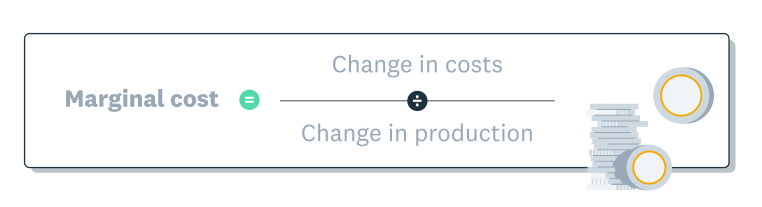
- You calculate marginal cost by dividing the change in total cost by the change in quantity. This straightforward formula can guide pricing, budgeting, and production decisions.
- Marginal cost typically follows a U-shaped curve: it decreases at first as you spread fixed costs over more units, then rises when production pushes past your efficient capacity.
- Comparing marginal cost to marginal revenue shows you the point where producing more units stops adding to your profit. This is one of the most practical tools for setting production levels.
What is marginal cost?
Understanding your costs at every level of production is essential for making smart business decisions. Marginal cost is one of the clearest ways to measure how your expenses change as output grows.
Marginal cost is the additional expense you incur when you produce one more unit of a product or service. It captures how your total costs shift when you increase output by a single unit. For example, if you run a bakery and baking 100 loaves costs $500, but baking 101 loaves costs $506, your marginal cost for that extra loaf is $6.
This metric is key for pricing, production planning, and resource allocation. It tells you whether making one more item will add to your profit or eat into it. When marginal cost stays below the price you charge, each additional unit contributes to your bottom line.
Variable costs vs fixed costs
Before you can calculate marginal cost, you need to understand the two main types of business expenses. Each one behaves differently as your production volume changes.
Variable costs rise and fall in proportion to how much you produce. These include raw materials, hourly wages, packaging, shipping, and energy consumption. For a Toronto-based furniture maker, variable costs might include lumber, fabric, glue, and the hourly pay for assembly workers. The more chairs you build, the more you spend on these items.
Fixed costs stay the same regardless of how many units you produce. Rent, salaried employees, insurance, and equipment leases are common examples. A Vancouver coffee roaster pays the same monthly lease on their roasting equipment whether they roast 500 kg or 5,000 kg of beans that month.
Marginal cost is driven primarily by variable costs, since fixed costs stay the same regardless of output. However, understanding both types helps you see the full picture of your cost of goods sold and how efficiently your business operates at different production levels.
How to calculate marginal cost
Calculating marginal cost is a straightforward process once you have your production and cost data in front of you. Follow these steps to find the marginal cost for any change in output.
- Determine your current production quantity and total cost. Start by identifying how many units you're currently producing and what it costs in total. Include both fixed and variable costs in this figure.
- Calculate the new total cost after increasing production. Estimate or record the total cost of producing a higher quantity. This should reflect any additional materials, labour, or other variable expenses.
- Find the change in total cost. Subtract the original total cost from the new total cost. This gives you the additional expense tied to your increased output.
- Divide the change in total cost by the change in quantity. Take the cost difference from step 3 and divide it by the number of additional units produced. The result is your marginal cost per unit.
Marginal cost formula
Here's the formula in its simplest form so you can apply it to your own numbers.
Marginal Cost = Change in Total Cost / Change in Quantity
If producing 10 extra units adds $80 to your total costs, your marginal cost is $80 / 10 = $8 per unit. You can use this formula to evaluate any production increase, whether it's one unit or 1,000.
Marginal cost examples
Seeing marginal cost in action makes the concept easier to apply to your own business. Here are two worked examples using different types of Canadian businesses.
Example 1: a bakery
Mohammed runs a bakery in Calgary and produces 100 cakes per week at a total cost of $1,000. He receives a special order for one additional cake. To fill it, he spends $5 more on ingredients and a bit of extra oven time, bringing his new total cost to $1,005.
- Change in total cost: $1,005 – $1,000 = $5
- Change in quantity: 101 – 100 = 1
- Marginal cost: $5 / 1 = $5 per cake
Since Mohammed sells each cake for $15, that extra cake adds $10 to his profit. Producing it is a clear win.
Example 2: a SaaS company
A software company in Waterloo currently serves 500 subscribers at a total monthly cost of $25,000. Adding 50 new subscribers requires extra server capacity and support staff time, pushing total costs to $26,500.
- Change in total cost: $26,500 – $25,000 = $1,500
- Change in quantity: 550 – 500 = 50
- Marginal cost: $1,500 / 50 = $30 per subscriber
If each subscriber pays $60 per month, the company earns $30 in additional profit per new subscriber. That margin gives room for growth before costs start climbing further.
The marginal cost curve and economies of scale
Marginal cost shifts as production grows. It tends to follow a predictable pattern that's useful for planning how far to scale your operations.
When you plot marginal cost against production volume, you typically get a U-shaped curve. At low production levels, marginal cost decreases as you produce more. This happens because you're spreading fixed costs like rent, equipment, and management salaries across a larger number of units. Each additional unit absorbs a smaller share of those overheads. Economists call this economies of scale.
At a certain point, the curve bottoms out. This is your most efficient production level, where each unit costs the least to produce.
Beyond that point, marginal cost starts rising again. You might need to pay overtime wages, source more expensive materials, run equipment past its optimal capacity, or deal with higher error rates. These are diseconomies of scale. Understanding your cost of sales at different volumes helps you spot where this tipping point falls for your business.
Why marginal cost matters for your business
Marginal cost isn't just an academic concept. It directly influences some of the most important decisions you make as a business owner.
Pricing decisions: knowing your marginal cost helps you set prices that cover expenses and protect your margins. If your marginal cost for a product is $12, pricing it at $10 means you're losing money on every additional unit. Pairing marginal cost data with a solid pricing strategy keeps your business profitable as you grow.
Production planning: marginal cost shows you exactly when scaling up makes financial sense and when it doesn't. If producing an extra 200 units drops your marginal cost, it's worth expanding. If marginal cost spikes, you may need to invest in capacity before ramping up further.
Resource allocation: when you understand how costs shift with output, you can direct labour, materials, and capital where they'll generate the best return. This is especially valuable when you're looking to reduce costs without sacrificing quality.
Ultimately, marginal cost analysis helps you grow your revenue by making sure each production decision is backed by real numbers, not guesswork.
Marginal cost vs average cost
These two metrics are related but measure different things. Knowing when to use each one gives you a more complete picture of your cost structure.
Average cost is your total cost divided by the total number of units produced. It tells you, on average, how much each unit costs. Marginal cost tells you how much one additional unit costs. The difference matters because average cost smooths out all your expenses, while marginal cost zooms in on incremental changes.
Here's a quick example. Say you produce 100 units at a total cost of $2,000. Your average cost is $2,000 / 100 = $20 per unit. Now you produce one more unit, and your total cost rises to $2,012. Your marginal cost is $12, which is below the average.
When marginal cost is below average cost, producing more units pulls your average cost down. When marginal cost rises above average cost, each new unit pushes the average up. This relationship helps you understand whether increasing production is making your business more or less efficient overall.
Marginal revenue vs marginal cost
Pairing marginal cost with marginal revenue is one of the most practical ways to figure out the right production level for your business.
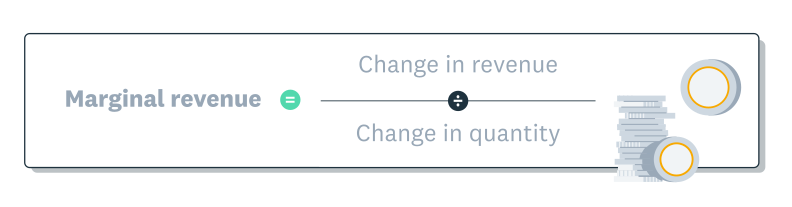
Marginal revenue is the additional income you earn from selling one more unit. You calculate it the same way: change in total revenue divided by change in quantity. The goal is to keep producing as long as marginal revenue exceeds marginal cost, because each of those units adds to your profit.
Profit maximization happens at the point where marginal cost equals marginal revenue. Beyond that point, producing more units costs more than they bring in.
Consider Alison, who makes handcrafted wallets in Montreal. She sells them for $40 each. Her marginal cost for the first 50 wallets is $22, so each one earns her $18 in profit. But as she pushes past 80 wallets per month, overtime labour and material shortages push her marginal cost to $45. At that point, every extra wallet she makes actually loses money.
By tracking both figures, Alison can find the sweet spot where she maximizes her profit and avoid overproducing. You can use a margin calculator to check how your margins hold up at different production levels.
Limitations of using marginal cost
While marginal cost is a valuable tool, it has boundaries you should be aware of before relying on it as your only decision-making metric.
- It assumes linear cost changes. In practice, costs often jump in steps rather than rising smoothly. You might operate at one cost level until you hit a threshold, then need a significant new investment to continue growing.
- It focuses on internal production costs. Market shifts, supply chain disruptions, seasonal demand swings, and regulatory changes can all affect your expenses, so pair marginal cost analysis with external market research.
- It captures short-term incremental changes. For bigger decisions like expanding your warehouse or hiring permanent staff, use marginal cost alongside long-term financial planning tools.
- It works best alongside other metrics. Marginal cost is most useful when you combine it with financial ratios, cash flow analysis, and break-even calculations to get a well-rounded view of your business performance.
Simplify your cost calculations with Xero
Understanding marginal cost puts you in a stronger position to price products, plan production, and allocate resources with confidence. The clearer your cost data, the better your decisions.
Xero's accounting software helps you track expenses, monitor costs in real time, and generate reports that make it easier to spot trends in your spending. When your financial data is organized and up to date, calculating metrics like marginal cost becomes a straightforward part of running your business. Get one month free.
FAQs on marginal cost
Here are answers to frequently asked questions about marginal cost.
What causes marginal cost to increase?
Marginal cost rises when your production pushes past its most efficient point. Common causes include overtime wages, the need for more expensive raw materials, equipment running beyond its optimal capacity, and higher error or waste rates. These factors mean each additional unit costs more to produce than the one before it.
How does marginal cost relate to supply and demand?
Marginal cost directly influences supply. When marginal cost is low, businesses can afford to supply more units. As marginal cost rises, it becomes harder to justify increasing production unless demand (and prices) rise to match. In competitive markets, price tends to settle around marginal cost over time.
What is the relationship between marginal cost and contribution margin?
Contribution margin is the difference between sales revenue per unit and the variable cost per unit. Marginal cost is closely tied to variable cost, so when marginal cost is low relative to your selling price, your contribution margin is higher. A healthy contribution margin means each unit sold contributes more toward covering fixed costs and generating profit.
When should you use marginal cost analysis?
Marginal cost analysis is most useful when you're deciding whether to accept a new order, adjust your pricing, or scale production up or down. It's also helpful for comparing the cost efficiency of different products or services so you can focus resources on the most profitable ones.
Can marginal cost be zero or negative?
Marginal cost can be very close to zero for digital products where adding one more user costs almost nothing, such as a software download. Truly negative marginal cost is rare but can occur when producing more of something generates a by-product you can sell, effectively reducing your net cost for the additional unit.
Disclaimer
Xero does not provide accounting, tax, business or legal advice. This guide has been provided for information purposes only. You should consult your own professional advisors for advice directly relating to your business or before taking action in relation to any of the content provided.
Start using Xero for free
Access Xero features for 30 days, then decide which plan best suits your business.