How to calculate net profit margin
Learn what net profit margin is, the formula, and how to calculate yours with a simple worked example.
Published Thursday 23 July 2026
Table of contents

How to calculate net profit margin
Key takeaways


- Net profit margin is the percentage of revenue you keep as profit once every expense is paid, so it shows how much of each sale turns into real earnings.
- You work it out with a simple formula: divide net profit by revenue, then multiply by 100.
- A good margin depends on your industry, so it helps to compare your figure against similar businesses rather than a single benchmark.
- You can lift your margin by pricing well, trimming costs that don't earn their keep, and running your day-to-day work more efficiently.
Net profit margin tells you how profitable your business really is, not just how much you sell. It's one of the clearest ways to see whether your revenue is turning into money you get to keep.
What is net profit margin?
Net profit margin is the percentage of revenue left as profit after you've paid all your expenses. Those expenses include the cost of goods sold, operating costs, interest, and taxes, so the margin reflects what's truly left over.
Handy resources
Advisor directory
You can search for experts in our advisor directory
Income statement template
Download Xero’s income statement template to show how much money your business is making
Financial reporting
Keep track of your performance with accounting reports
Disclaimer
This glossary is for small business owners. The definitions are written with their requirements in mind. More detailed definitions can be found in accounting textbooks or from an accounting professional. Xero does not provide accounting, tax, business or legal advice.
Because it accounts for every cost, net profit margin gives you a fuller picture than sales figures alone. A higher margin means more of each dollar you earn stays in the business, which you can reinvest or take as profit.
The formula behind net profit margin is short, and you only need two numbers to use it: your net profit and your revenue.
Net profit margin formula
You calculate net profit margin with this formula: net profit margin = (net profit ÷ revenue) x 100. Net profit is what remains after every expense, and revenue is your total sales before any deductions.
Multiplying by 100 turns the result into a percentage, which makes it easy to compare across time periods or against other businesses. If you're unsure what counts as net profit for your business, it's the figure at the very bottom of your income statement.
Working out your margin takes three quick steps once you have your numbers. Here's how to do it, followed by a worked example you can follow along with.
How to calculate net profit margin
Follow these steps to calculate your net profit margin.
- Find your net profit by subtracting all expenses, including cost of goods sold, operating costs, interest, and taxes, from your revenue.
- Divide your net profit by your total revenue.
- Multiply the result by 100 to get your margin as a percentage.
Say you run a business cleaning offices and bring in $20,000 in revenue. The cost of delivering those services is $8,000, which leaves you with $12,000 in gross profit.
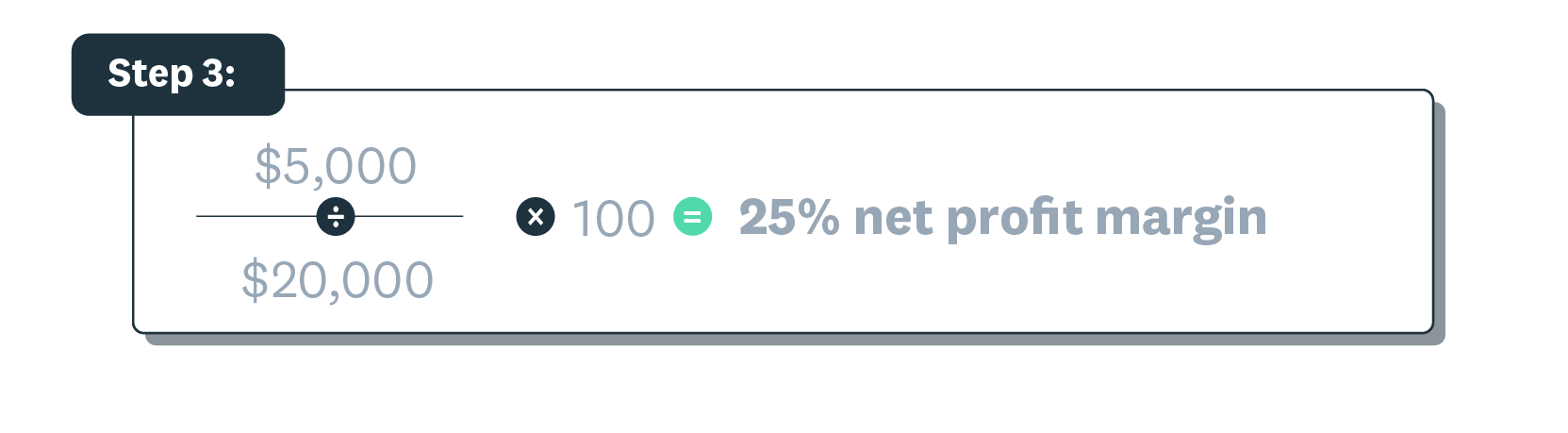
From that $12,000, you then pay $3,000 in operating expenses and $4,000 in taxes, leaving a net profit of $5,000. To find your margin, you divide $5,000 by $20,000 and multiply by 100, which gives you a 25% net profit margin.
Net profit margin is one of three profitability measures, and each strips out a different set of costs. Knowing how they differ helps you read your numbers correctly.
Net profit margin vs gross profit margin vs operating profit margin
The three margins build on each other by adding more costs at each stage. Understanding what each one includes stops you from reading too much into a single figure.
- Gross profit margin uses gross profit, which is revenue minus the cost of goods sold
- Operating profit margin uses operating profit, which is gross profit minus operating expenses
- Net profit margin uses net profit, which is operating profit minus interest and taxes
Gross profit shows how efficiently you produce or deliver what you sell. Operating profit shows how well you run the business day to day, and net profit shows what's left after every cost, including financing and tax.
There's no single number that counts as a good net profit margin. What's healthy for one business can be low for another, so context matters.
What is a good net profit margin?
A good net profit margin depends heavily on your industry. According to NYU Stern professor Aswath Damodaran's margin dataset, the average net profit margin across all industries sits around 8.5%.
Low-margin sectors like retail and grocery often run in the low single digits, while software and financial services tend to run much higher. Compare your margin against businesses like yours rather than the overall average.
If your margin is thinner than you'd like, small changes across pricing and costs can add up. These practical steps can help you keep more of what you earn.
How to improve your net profit margin
Improving your margin usually comes down to earning more or spending less on each sale. Focus on the levers below to make steady gains.
- Raise your prices strategically, testing small increases on products or services where customers see clear value
- Cut unnecessary costs by reviewing subscriptions, suppliers, and overheads you no longer need
- Improve efficiency by automating repetitive admin so you spend less time and money on manual work
Tracking your income and outgoings in one place makes these changes easier to spot. A regularly updated profit and loss statement shows you exactly where your money is going.
Net profit margin is useful, but it doesn't tell the whole story on its own. Keep these limitations in mind when you interpret your figure.
Limitations of net profit margin
The margin can be shaped by factors that have little to do with how well you run your business day to day. Read it alongside your other numbers for a balanced view.
- Industry differences make cross-sector comparisons misleading, since typical margins vary widely by type of business
- Debt and interest costs can drag down net profit even when your core operations are healthy
- Depreciation and one-off events can distort the figure in any given period, so a single result rarely tells the full story
Seeing your margins clearly starts with having your numbers in one organized place. Xero brings your income, costs, and reporting together so profitability is easy to track.
See your profit margins clearly with Xero
With real-time reporting, you can watch how each sale and cost affects your bottom line without wading through spreadsheets. That means less time on manual admin and more confidence in the decisions you make.
Give it a try and start a plan today to get one month free.
Here are some frequently asked questions about net profit margin to help you put the figure to work in your business.
FAQs on net profit margin
What counts as a strong net profit margin for a small business?
There's no universal target, because a strong margin in retail can look weak in software. Benchmark against similar businesses in your sector, then aim to improve on your own past results over time.
What is the difference between net profit margin and gross profit margin?
Gross profit margin only subtracts the cost of goods sold, so it measures production efficiency. Net profit margin subtracts every cost, including operating expenses, interest, and taxes, so it reflects overall profitability.
What is net profit?
Net profit is the amount left once you subtract all expenses from your revenue, including costs, interest, and taxes. It's the figure that flows through to the bottom of your income statement.
Why is net profit margin important?
It shows how much of your revenue actually becomes profit, which sales figures alone can hide. Tracking it over time helps you catch rising costs or shrinking profitability early.
How often should I check my net profit margin?
Reviewing it monthly or quarterly helps you spot trends before they become problems. More frequent checks are worth it during busy seasons or when you've made pricing or cost changes.