How to calculate net profit margin
Learn the net profit margin formula and how to calculate it step by step for your small business.
Published Thursday 23 July 2026
Table of contents
Key takeaways
- Net profit margin shows what percentage of your revenue remains as profit after all expenses, giving you a clear picture of your overall business health.
- You can calculate it by dividing your net profit by total revenue and multiplying by 100, using figures straight from your income statement.
- A typical net profit margin for Australian small businesses ranges from 5% to 20%, though this varies widely by industry.
- Tracking your net profit margin over time helps you spot trends, control costs, and make smarter decisions about pricing and spending.
What is net profit margin?

How to calculate net profit margin
Net profit margin is the percentage of revenue your business keeps as profit after deducting every expense. It's one of the most useful profitability metrics because it accounts for all costs; not just the direct ones, but also overheads, interest, and taxes.
The result is expressed as a percentage. A net profit margin of 15% means your business retains $0.15 from every dollar of revenue. The higher the percentage, the more efficiently your business converts sales into actual profit.
For small business owners, net profit margin provides a bottom-line snapshot. It tells you whether your pricing, cost management, and overall strategy are working together to generate sustainable returns.
Net profit margin formula
The formula for net profit margin is straightforward. Once you have your revenue and expense figures, you can calculate it in seconds. You can also use the net profit margin calculator for a quick result.
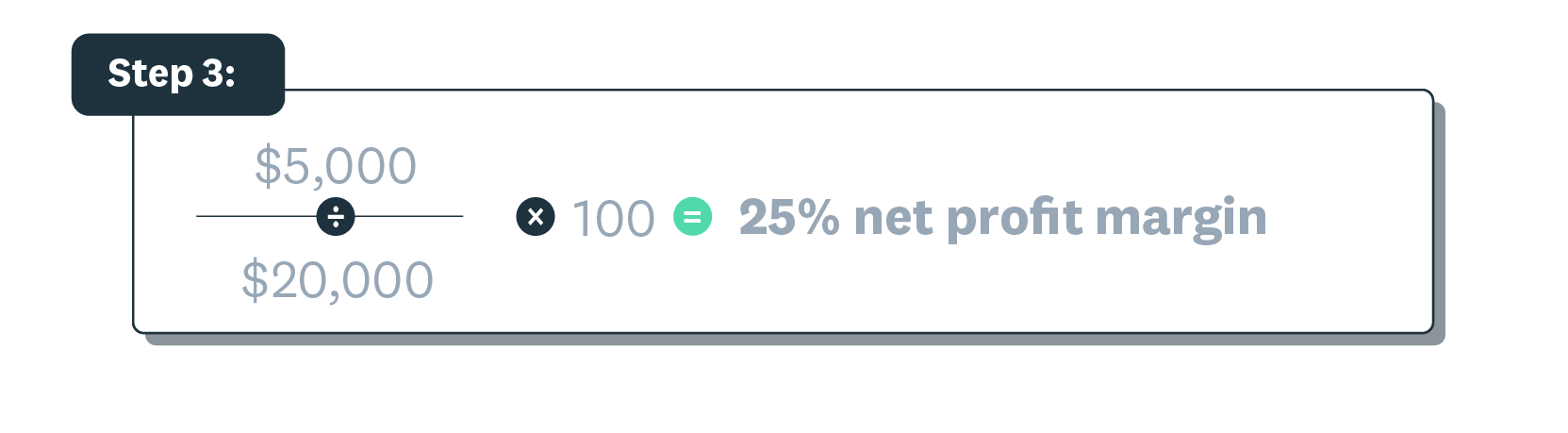
Net profit margin = (net profit / revenue) x 100
Here's what each variable means:
- Revenue: the total income your business earns from sales before any deductions
- Cost of goods sold (COGS): the direct costs of producing or delivering your product or service, such as materials and labour
- Operating expenses: the day-to-day costs of running your business, including rent, utilities, wages, marketing, and insurance
- Interest: any payments on business loans or credit facilities
- Taxes: income tax and other taxes your business owes
- Net profit: the amount left after subtracting COGS, operating expenses, interest, and taxes from revenue
How to calculate net profit margin
Calculating your net profit margin takes just a few steps. You'll need your income statement (also called a profit and loss statement), which lists your revenue and all your expenses.


1. Add up your total revenue
Start with the total income your business earned over a specific period. This includes all sales revenue before any deductions.
2. Calculate your total expenses
Add together your COGS, operating expenses, interest, and taxes. This gives you the full cost of running your business during that period.
3. Subtract total expenses from revenue to get net profit
Take your total revenue and subtract your total expenses. The result is your net profit; the actual money your business kept.
4. Divide net profit by revenue and multiply by 100
This final step converts your net profit into a percentage, giving you your net profit margin.
Example 1: cleaning business
Say you run a cleaning business that earns $20,000 in revenue over a quarter. Your total expenses, including supplies, wages, vehicle costs, insurance, and taxes, come to $16,000. Your net profit is $20,000 - $16,000 = $4,000.
Net profit margin = ($4,000 / $20,000) x 100 = 20%
That means you're keeping 20 cents from every dollar earned.
Example 2: freelance graphic designer
Imagine you're a freelance graphic designer who earned $50,000 in revenue over the financial year. Your expenses include software subscriptions ($3,000), home office costs ($2,000), professional development ($1,000), accounting fees ($1,500), and taxes ($6,500). Your total expenses are $14,000, leaving a net profit of $36,000.
Net profit margin = ($36,000 / $50,000) x 100 = 72%
This high margin reflects the low overhead typical of service-based businesses with minimal material costs.
What is a good net profit margin?
What counts as a "good" net profit margin depends heavily on your industry, business model, and growth stage. There's no single number that works for every business.
As a general guide, many Australian small businesses aim for a net profit margin between 5% and 20%. Service-based businesses often sit at the higher end because they have lower material costs. Retail and hospitality businesses typically operate on thinner margins, sometimes between 2% and 10%, due to higher overheads and stock costs.
Rather than comparing your margin to a universal benchmark, focus on how your margin changes over time. A steady or rising margin signals that your costs are under control and your pricing strategy is working. A declining margin may point to rising expenses, pricing pressure, or inefficiencies that need attention.
Consulting your accountant or bookkeeper about industry-specific benchmarks can help you set realistic targets for your business.
Net profit margin vs gross profit margin
Net profit margin and gross profit margin both measure profitability, but they tell you different things about your business. Understanding the types of profit margins gives you a more complete financial picture.
Gross profit margin only accounts for the direct costs of producing your goods or services (COGS). It shows how efficiently you turn raw materials or direct labour into revenue. You calculate it as: (revenue - COGS) / revenue x 100. See the full formula in the gross profit margin calculation guide.
Net profit margin goes further by also subtracting operating expenses, interest, and taxes. It reflects your true bottom-line profitability after every cost is covered.
Use gross profit margin to evaluate your pricing and production efficiency. Use net profit margin to assess the overall financial health of your business. If your gross margin is strong but your net margin is low, your overheads or financing costs may need attention.
Why net profit margin matters for your business
Your net profit margin is more than a number on a report. It's a practical tool for running your business with confidence and making informed decisions about your future. Understanding profitability ratios like this one helps you benchmark performance and plan ahead.
- It shows whether your business is genuinely profitable after all costs, not just generating revenue.
- It helps you spot trends early; a shrinking margin can flag rising costs or pricing issues before they become critical.
- It gives you a basis for comparing your performance across different periods, so you can measure the impact of changes you've made.
- Lenders and investors often look at net profit margin when assessing your business, so a healthy margin can support applications for funding or credit.
- It helps you make better decisions about pricing, hiring, and spending by showing how those choices affect your bottom line.
How to improve your net profit margin
Improving your net profit margin comes down to 2 levers: increasing revenue or reducing costs. For a deeper look at strategies, see the guide on how to measure profitability. Here are practical strategies that work for small businesses.
- Review your pricing: make sure your prices reflect your true costs and the value you deliver. Even small price adjustments can have a meaningful impact on your margin.
- Cut unnecessary expenses: audit your regular outgoings and cancel subscriptions, services, or suppliers that aren't adding value.
- Negotiate with suppliers: ask for better rates, bulk discounts, or longer payment terms to reduce your COGS.
- Automate repetitive tasks: use software to handle invoicing, bank reconciliation, and expense tracking, freeing up time and reducing errors.
- Focus on high-margin products or services: identify which parts of your business generate the strongest margins and put more effort there.
- Monitor your finances regularly: checking your profit and loss statement monthly, rather than quarterly or yearly, helps you catch problems early and act quickly.
Simplify your financial tracking with Xero
Keeping a close eye on your net profit margin is much easier when your financial data is accurate and up to date. Xero brings your income, expenses, and reporting together in one place, so you can see your profitability at a glance.
With automatic bank feeds and real-time reconciliation, your books stay current with less manual data entry. Xero's reporting tools let you generate profit and loss statements in a few clicks, helping you track your net profit margin over time and spot trends as they happen.
Whether you're reviewing margins with your accountant or making day-to-day decisions about spending, having reliable numbers makes all the difference. Get one month free.
FAQs on net profit margin
Here are some frequently asked questions about net profit margin.
Can net profit margin be negative?
Yes. A negative net profit margin means your total expenses exceed your revenue, resulting in a net loss. This can happen during early growth phases or periods of heavy investment, but sustained negative margins need attention.
How often should you calculate your net profit margin?
Aim to review it at least monthly. Regular tracking helps you identify trends and respond to cost increases or revenue dips before they compound.
Is net profit margin the same as net profit?
No. Net profit is a dollar amount showing how much money you kept after expenses. Net profit margin is that figure expressed as a percentage of revenue, making it easier to compare across periods or against other businesses.
What expenses are included in net profit margin?
Net profit margin accounts for all business expenses: COGS, operating costs like rent and wages, interest on loans, and taxes. It captures your complete cost picture, unlike gross profit margin which only covers COGS.
Does net profit margin vary by business size?
It can. Larger businesses may benefit from economies of scale that lower their per-unit costs. Smaller businesses, particularly in services, can achieve strong margins through low overheads and lean operations.
Handy resources
Advisor directory
You can search for experts in our advisor directory
Profit & Loss template
Download Xero’s profit and loss statement template to show how much money your business is making
Financial reporting
Keep track of your performance with accounting reports
Disclaimer
This glossary is for small business owners. The definitions are written with their requirements in mind. More detailed definitions can be found in accounting textbooks or from an accounting professional. Xero does not provide accounting, tax, business or legal advice.