New Zealand Small Business Insights
This analysis focuses on core performance metrics of sales growth, jobs growth, wages growth, late payments and time to be paid.

Agriculture delivers best sales result in nearly 4 years
Published: 30 July 2026
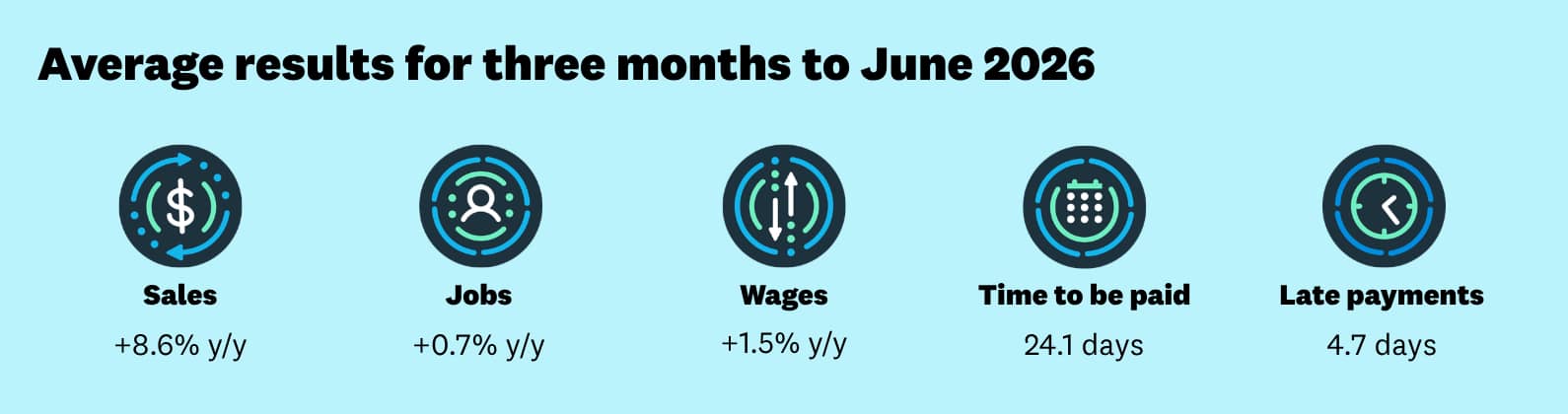
The latest Xero Small Business Insights (XSBI) data for New Zealand show small businesses recorded the best sales result since the September quarter 2022, up 8.6% year-on-year (y/y). This national result was heavily influenced by agriculture, with other industries not performing as strongly. The uneven nature of the sales recovery means the labour market didn't see strong gains, with jobs up only 0.7% y/y and wages up just 1.5% y/y. Both payment times metrics were little changed and held on to recent gains.
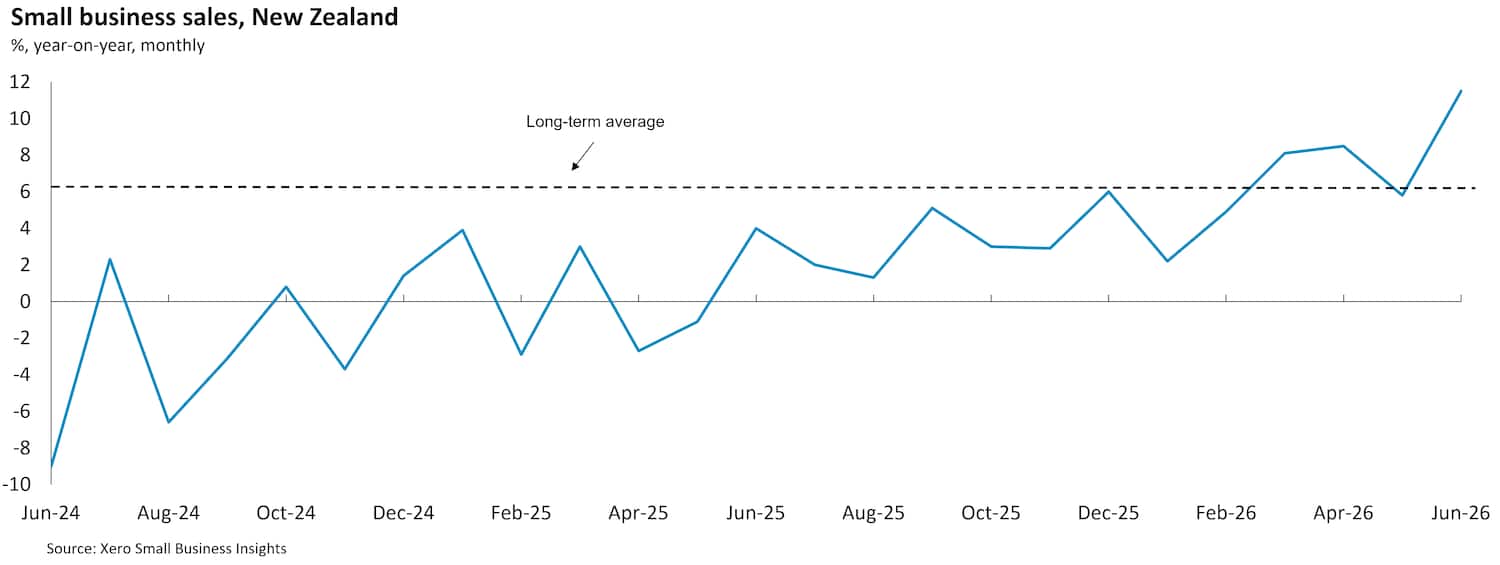
Small business sales rose 8.6% (y/y) in the June quarter, after a 5.1% y/y rise in the March quarter. This is the best result in almost four years and the first quarter of sales growing faster than their historical average (6.2% y/y) since the December quarter 2022.
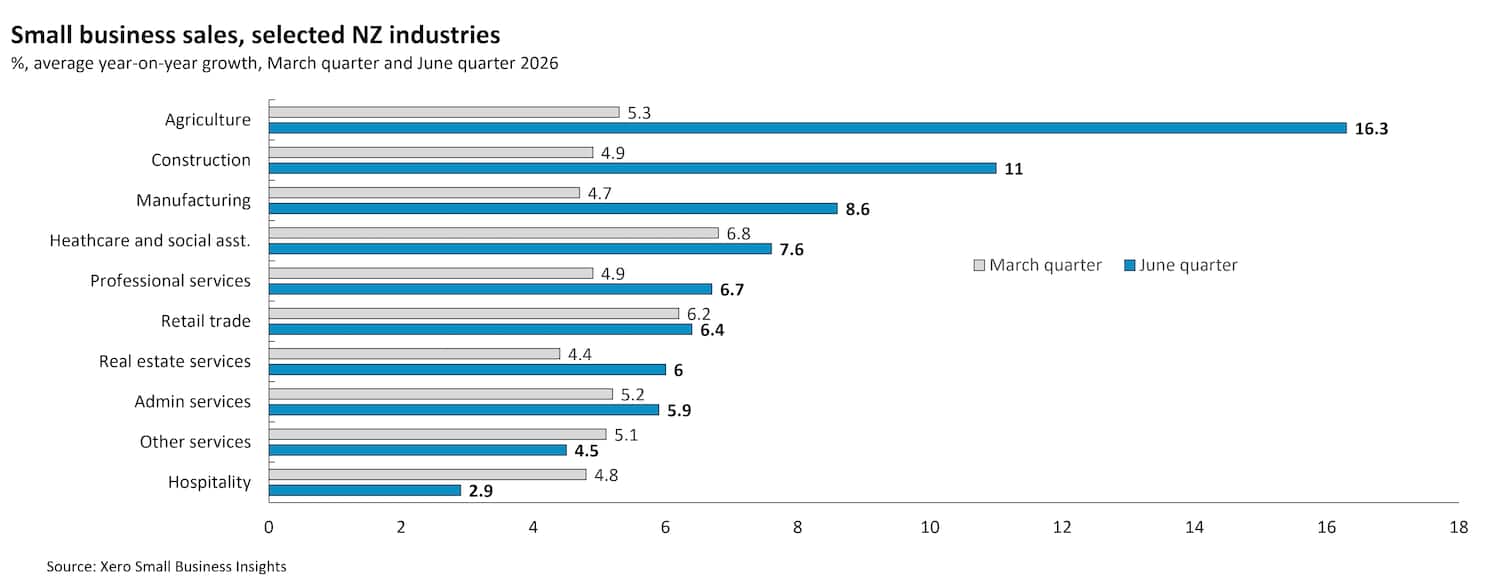
However, this sales performance was not evenly distributed across industries. This is a shift from earlier quarters when the recovery in sales was more broad-based. The gains were underpinned by a 16.3% y/y rise in agriculture sales, which is consistent with recent NZ government reports of solid agricultural exports over the past year. Other industries are continuing to gradually improve sales performance, but not at the accelerated pace of agriculture (see chart). Other strong performers were construction (+11.0% y/y) and manufacturing (+8.6% y/y) although both these results were, in part, due to weak outcomes in the June quarter 2025. Retail trade (+6.4% y/y) held up despite concerns about the impact of ongoing elevated fuel prices on discretionary spending. Hospitality was the softest sector tracked by XSBI, with sales up just 2.9% y/y.
These industry differences were also reflected in regional results, with agricultural areas performing better than urban areas. Canterbury (+12.3% y/y), Manawatū-Whanganui (+11.9% y/y), Waikato (+10.0% y/y) and Southland (+9.6% y/y) - a new XSBI region - all recorded exceptional sales growth. Meanwhile, Auckland (7.2% y/y) and Wellington (7.1% y/y) were not as strong. The wine growing and tourism hub of Marlborough, Nelson & Tasman (+4.4% y/y) - another new region for XSBI - also missed out on the agriculture-led recovery.
Small businesses recorded the best sales result since the September quarter 2022 …. heavily influenced by agriculture
XSBI NZ April 2026 - June 2026 data
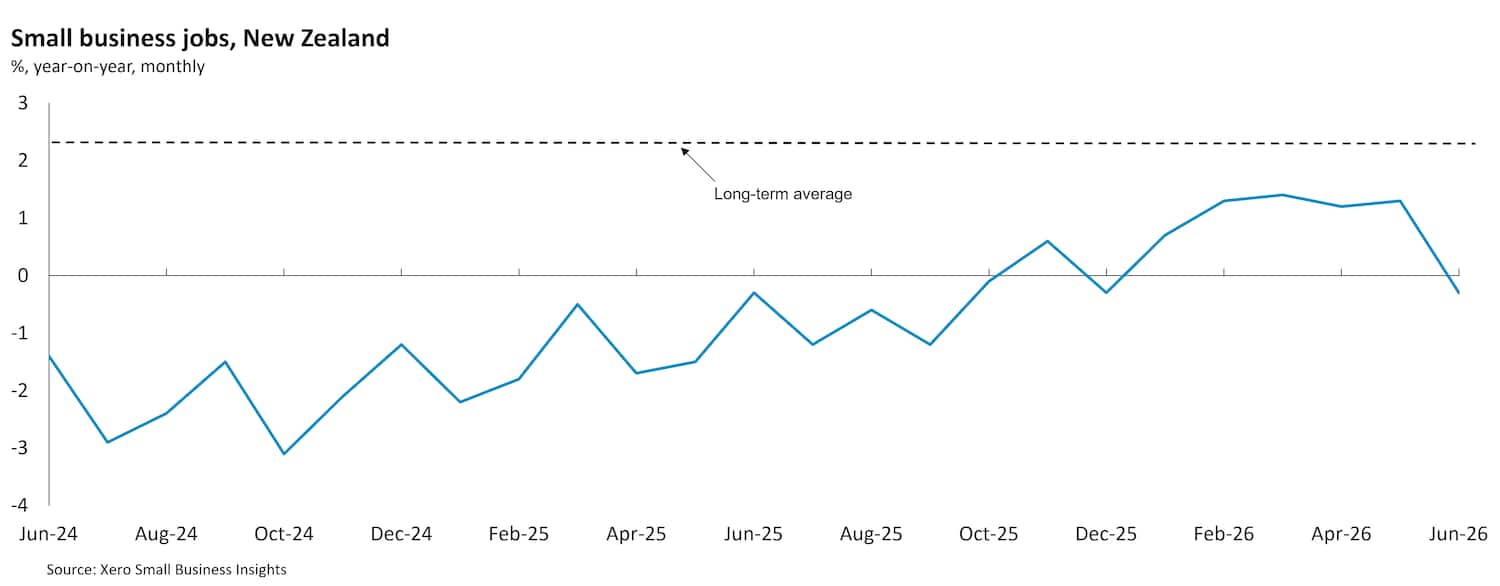
The uneven nature of the sales performance means it hasn't translated into jobs growth this quarter. Jobs grew only 0.7% y/y, dragged lower by a 0.3% y/y decline in the month of June. More data is needed to understand if this is the start of another downturn, or just a temporary pause in an ongoing recovery. Despite strong sales, agricultural jobs are only 0.6% higher than a year ago. Three sectors recorded lower jobs than a year ago - retail trade (-1.3% y/y), hospitality (-5.6% y/y) and other services (-0.3% y/y). The best jobs performers were real estate services (+6.1% y/y) and admin services (+5.1% y/y) - both of which had weak jobs results in the June quarter 2025. In terms of the regions, Canterbury (+4.5% y/y) was by far the strongest jobs performer. Auckland (-0.2% y/y), Northland (-1.9% y/y), Bay of Plenty (-0.9% y/y) and Wellington (-0.1% y/y) all have fewer jobs in small businesses than a year ago.
This soft jobs outcome was also reflected in wages, which rose just 1.5% y/y in the June quarter. This is the smallest quarterly rise in the history of the series (back to March quarter 2017) and well below the historical average (+3.6% y/y).
Both measures of payment times were little changed this quarter. Small businesses waited, on average, 24.1 days to be paid after issuing an invoice - similar to the 24.0 days of the March quarter and better than the 24.9 day average for 2025. Late payments were 4.7 days, higher than the 4.3 days of the March quarter but still better than the 2025 average of 5.3 days. It is disappointing that, on average, small businesses are still paid late. Nevertheless, NZ small businesses are paid a lot less late than their counterparts in other countries tracked by XSBI - Australia (6.0 days), UK (8.3 days), US (8.5 days) and Canada (11.3 days).
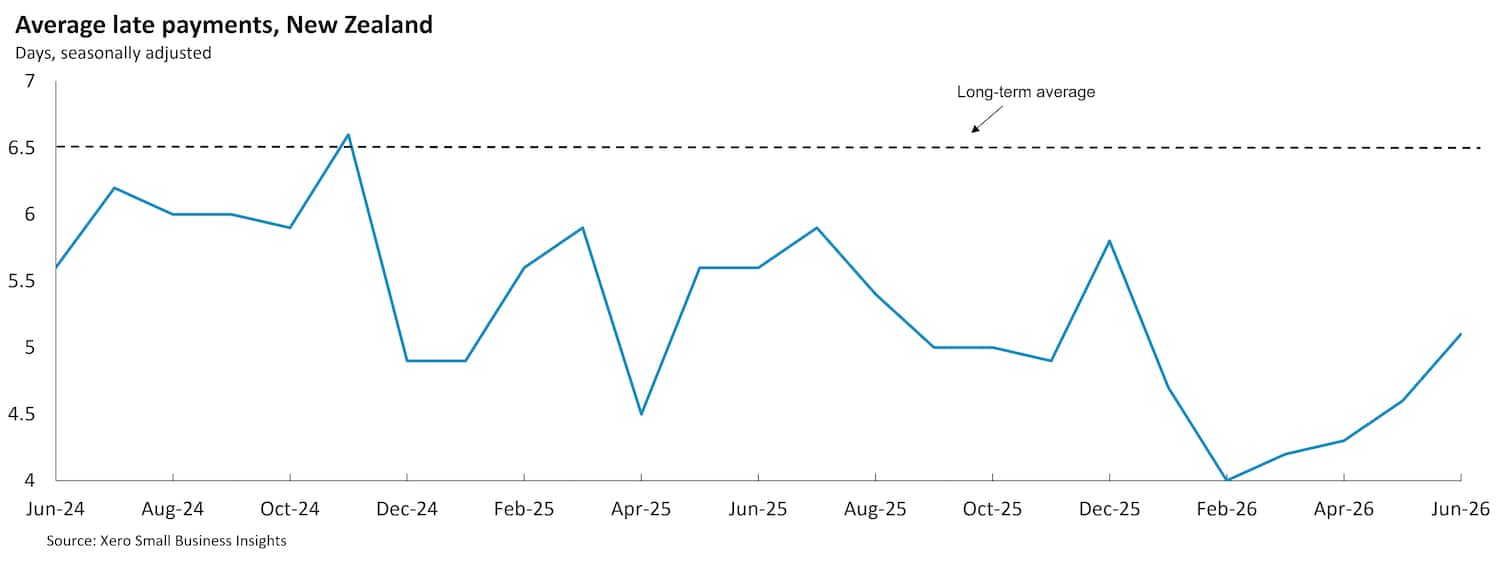
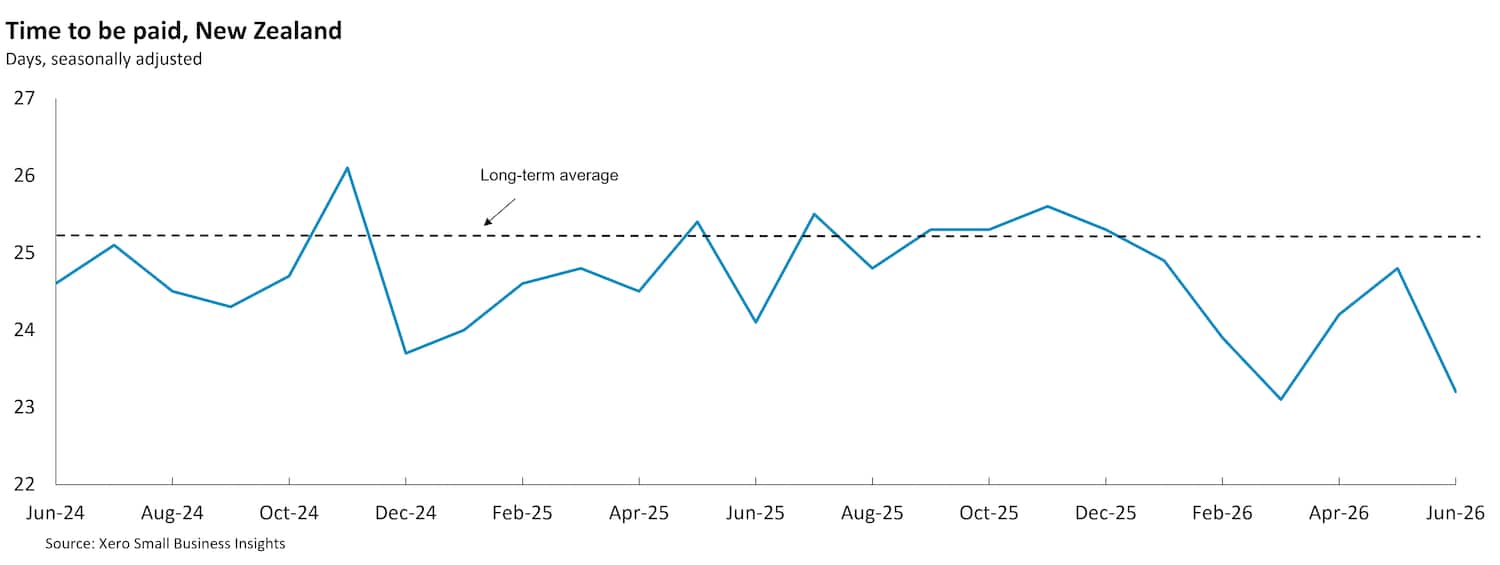
Overall, the latest XSBI data confirms that the NZ economy is continuing to recover, albeit not uniformly and not as quickly as the headline national sales result suggests.
Looking ahead, in its latest forecast the OECD expects NZ GDP to grow 1.4% in 2026 and 2.2% in 2027, supported by earlier monetary easing and resilient exports. The think-tank also warned, however, that the recovery was still fragile and is at risk due to the impact of prolonged higher-than-normal fuel prices on consumer spending.
This narrative is consistent with the Reserve Bank of New Zealand's (RBNZ) decision, in early July, to raise interest rates by 25bps to 2.5% as it became more confident in the overall economic recovery. The RBNZ noted that the economic recovery was underway before the Middle East conflict, but lost momentum in the June quarter as the oil shock weighed on economic activity. Growth is expected to resume in the September quarter as these effects fade and confidence improves. The return of hostilities between the US and Iran in July introduces renewed uncertainty about the return to a recovery path in the second half of the year. A sustainable economic upswing and improved hiring will require broader-based sales growth and improved confidence amongst small business owners that the impact of higher fuel prices will be temporary.

Disclaimer
This report was prepared using Xero Small Business Insights data and publicly available data for the purpose of informing and developing policies to support small businesses.
This report includes and is in parts based on assumptions or estimates. It contains general information only and should not be taken as taxation, financial, investment or legal advice. Xero recommends that readers always obtain specific and detailed professional advice about any business decision.
The insights in this report were created from the data that was available as at the date it was extracted. Data used was anonymised and aggregated to ensure individual businesses can not be identified.
Find out more about XSBI
If you have any questions about Xero Small Business Insights, reach out to us.