Canada Small Business Insights
This analysis focuses on core performance metrics of sales growth, late payments and time to be paid.

.1777291645805.png)
Conditions remain dire for small business
Published: 30 April 2026
The latest Xero Small Business Insights (XSBI) data shows 2026 started as badly as 2025 finished. A rare bright spot was a 1% year-over-year rise in small business sales in the month of March - coming after five consecutive months of declines. Ongoing poor sales results are also impacting the ability to pay bills and manage cash flow. Small businesses were paid, on average, 11.6 days late in the March quarter - that's over two weeks late. The sharp rise in gasoline prices in March, due to conflict in the Middle East, is another blow that could hit both costs and sales in future months as customers have less to spend on non-fuel purchases.
Small business sales fell 4.0% year-over-year (y/y) in the March quarter. This was a larger decline than in the December quarter (-1.8% y/y, revised up from -4.1% y/y). The toughest month of the quarter was January, where sales fell 10.1% y/y, followed by a 2.9% y/y decline in February. There was some relief in March, when sales rose 1.0% y/y, but this comes after five months of declines and is well below the 4.3% average rise for the series. In fact, in the past three years monthly sales growth has only been above this historical average for four months, which highlights just how prolonged this tough trading period has been.
The monthly March data is an early insight into how small businesses are being impacted by the fuel price spike caused by the conflict in the Middle East. XSBI sales are measured in nominal terms, which includes changes in both sales volumes and prices. CPI data helps to understand how much of the March sales rise is due to prices and how much is due to higher sales volumes. Is the CPI showing broad based price increases or isolated spikes in fuel prices? The latest CPI data shows prices paid by consumers rose an average of 2.4% y/y in March, up from 1.8% y/y in February. However, this was almost entirely due to gasoline prices (+21.2% m/m) rather than reflecting broad based inflation. This suggests the latest month of XSBI sales growth is most likely reflecting a genuine improvement in activity rather than being due to higher prices.
.1777045185867.png)
This data is an early insight into how small businesses are being impacted by the Middle East conflict
XSBI Canada January 2026 - March 2026 data
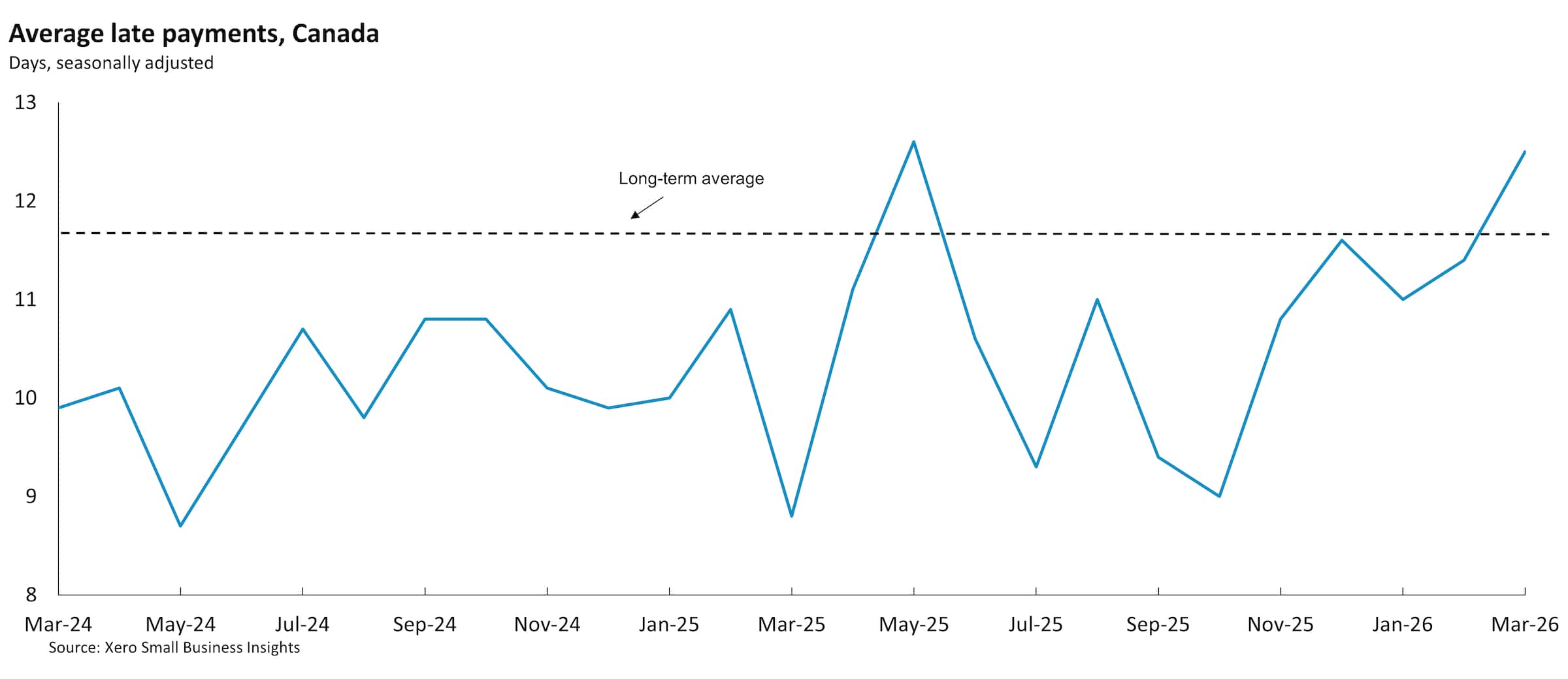
Small businesses were also paid increasingly late in the quarter, suggesting cash flow pressure increased over the early months of the year. This is disappointing as it reverses a period where payment times and late payments had been quicker than historical averages. Small businesses had to wait, on average, 29.8 days for their invoices to be paid, up from 27.2 days in the December quarter. Invoices issued by small businesses were paid, on average, 11.6 days late during the March quarter, up from 10.5 days in the December quarter.
.1777045186558.png)
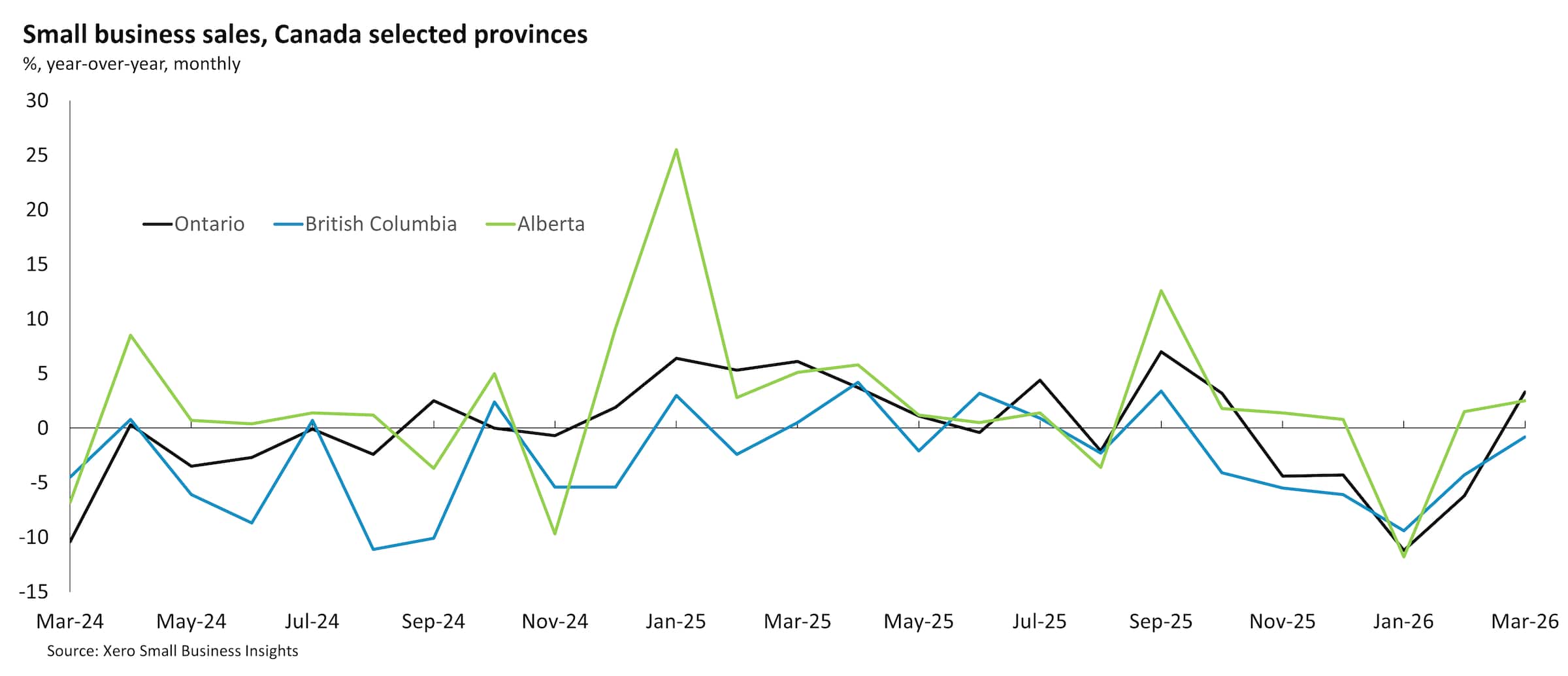
The three provinces tracked by XSBI (Alberta, British Columbia and Ontario) all recorded declines in sales in the March quarter. The best performing province was Alberta (-2.6% y/y), helped by two months of positive sales growth in February (+1.5% y/y) and March (+2.5% y/y). This was followed by Ontario (-4.7% y/y), which reversed a four month run of sales declines with a 3.3% y/y rise in the month of March. British Columbia had a 4.8% decline in sales in the quarter and recorded lower sales in all three months, although the 0.8% fall in March was the smallest decline in a 6 month run of falls.
In terms of time to be paid, the best performing province this quarter was British Columbia, at 26.5 days, which was 2.6 days quicker than in the December quarter. Alberta (26.9 days) and Ontario (30.7 days) both had longer payment wait times than in the December quarter.
Overall, these latest XSBI results confirm that there was no significant improvement in the performance for small businesses in the early months of 2026. The combination of ongoing declines in sales, especially in January, and longer payment times have likely increased cash flow pressures. These results are consistent with a recent Canadian Federation of Independent Business (CFIB) member survey which noted that insufficient demand remains the top constraint to business …. cited by 57% of SMEs - almost 20 percentage points above its historical average and worsening compared to the recent months.
Looking ahead, the impact of higher fuel prices is the main risk to the outlook. This sudden price spike hurts small businesses both directly, through rising costs of fuel (and eventually many other inputs), and indirectly, as customers are left with less to spend on non-fuel goods and services. Importantly, it is still early days in this crisis and the fuel price impacts have not yet worked through the economy. To date much of the price impacts are in fuel-exposed industries, such as transport and logistics. However, business profit margins can't absorb these dramatically higher fuel prices indefinitely. These rising transport costs are likely to increasingly flow through to the price of goods and services across many industries in the coming months, spreading the economic damage and further squeezing household budgets.
Fuel prices are unlikely to come down meaningfully any time soon, given it will take many months for the world oil market to return to 'normal', even after the Strait of Hormuz is reopened. In addition, the longer fuel prices remain high the greater the risk that the Reserve Bank of Canada will respond with an increase in the policy interest rate to combat the inflation shock. The one positive for Canadian small businesses is that, as a major oil producer, securing future supply is not a concern - which is not the case in many other countries.
During periods of major geopolitical upheaval that are outside their control, small business owners need to continue to focus on the aspects of their business they can influence - such as managing cash flow, using prompt payment practices and delivering great customer service.
For more information on the XSBI metrics, see our methodology page.
Disclaimer
This report was prepared using Xero Small Business Insights data and publicly available data for the purpose of informing and developing policies to support small businesses.
This report includes and is in parts based on assumptions or estimates. It contains general information only and should not be taken as taxation, financial, investment or legal advice. Xero recommends that readers always obtain specific and detailed professional advice about any business decision.
The insights in this report were created from the data that was available as at the date it was extracted. Data used was anonymised and aggregated to ensure individual businesses can not be identified.
Find out more about XSBI
If you have any questions about Xero Small Business Insights, reach out to us.