Online business ideas you can start with low costs
Discover online business ideas that fit your skills, save time, and grow your income.

Written by Lena Hanna—Trusted CPA Guidance on Accounting and Tax. Read Lena's full bio
Published Wednesday 1 April 2026
Table of contents
Key takeaways
- Focus on service-based businesses if you want to start quickly with minimal investment, as you can monetise existing skills through virtual assistance, tutoring, or consulting using your current network.
- Target niche markets rather than competing with large retailers on price, since specialised products that have limited local appeal can find dedicated global audiences through online channels.
- Prioritise business models with recurring revenue streams like subscriptions or memberships, as these create predictable income..
- Build authentic connections and personal touches in your branding and customer experience, since small businesses can differentiate from large competitors through genuine stories and memorable interactions that big brands cannot replicate.
Why start an online business?
Online businesses offer advantages traditional businesses can't match. Lower startup costs, location flexibility, and global reach make online models accessible to more entrepreneurs than ever.
Key benefits include:
- Lower startup costs: Launch with minimal investment compared to physical storefronts.
- Location flexibility: Work from anywhere with an internet connection.
- Scalability: Grow revenue without proportional increases in overhead.
- Part-time potential: Start while keeping your current job.
- Global customer reach: Sell to customers worldwide from day one.
- Automation opportunities: Use software to handle repetitive tasks.
These advantages help explain why online business creation continues to accelerate, with 2023 being the highest year on record for new business applications in the United States. The barrier to entry has never been lower.
Understanding profitability factors helps you choose the right business model.
What makes an online business profitable?
Profitable online businesses share common characteristics that drive sustainable margins. Understanding these factors helps you choose ideas with stronger earning potential.
Key profitability drivers include:
- Low overhead costs: Digital products and services avoid spending on inventory, shipping, and physical space.
- Scalability: Revenue grows faster than costs as you add customers.
- Recurring revenue models: Subscriptions and memberships create predictable income streams, and the subscription economy is projected to grow to US$1.5 trillion by 2025.
- High-margin products: Digital goods and specialised services typically yield better margins than commodity products.
- Strong market demand: Profitable businesses solve real problems people actively search for solutions to. In fact, research shows that having no market need for a product or service is the top reason startups fail.
- Automation potential: Businesses that automate delivery and operations free up time for growth.
The most profitable models combine several of these factors. A subscription-based digital product with low overhead and strong demand, for example, checks multiple boxes.
Once you understand what drives profitability, you need to find the right idea.
Where to find online business ideas and inspiration
Finding the right online business idea starts with knowing where to look. Trending products, social platforms, and crowdfunding sites reveal what customers want right now. Here are the best sources of inspiration:
- Browse online marketplaces: Check trending items on Amazon, Etsy, eBay, Google Shopping, Facebook Marketplace, and AliExpress to spot demand patterns.
- Search social media platforms: Use hashtags on Instagram, Facebook, and Pinterest to explore your areas of interest and see what's gaining traction.
- Explore crowdfunding sites: Review Indiegogo and Kickstarter campaigns to discover what ideas attract funding and how you could improve on them.
- Scan app stores: Look at top sellers and new releases to identify problems people are willing to pay to solve.
- Watch content creators: Follow YouTube channels and podcasts in your niche to learn what topics resonate with audiences.
With inspiration in hand, consider which business model suits you best.
What type of online business could you set up?
Online businesses fall into four main categories based on what you sell and how you deliver it. Understanding these models helps you choose the right fit for your skills and goals.
- Retail: Sell physical or digital products through an online shop or marketplace.
- Services: Provide remote services such as training, teaching, consulting, or creative work.
- Apps and SaaS: Build software or apps sold as one-time purchases or subscriptions.
- Content and media: Create podcasts, videos, blogs, or digital content that generates revenue through sales, subscriptions, or sponsorships.
Here are specific ideas within each category.
Online retail business ideas
The most popular online retail categories include:
- Fashion and clothing
- Electronics and tech accessories
- Hair and beauty products
- Groceries and food
- Toys, hobbies, and crafts
- Health and wellness products
These categories consistently attract strong customer demand, though success depends more on your niche positioning than the category itself.
You have several options for sourcing products to sell.
Make something yourself
Turn a hobby or skill into a product line. Photographers can sell prints, calendars, or merchandise featuring their images. Crafters can create handmade goods for niche markets. The key is finding an audience willing to pay for your unique creations.
If making products yourself isn't practical, consider outsourcing production.
Get something made
If making products isn't your strength, partner with manufacturers to bring your ideas to life. You can customise existing products or design something entirely new.
Contract manufacturers often accept small batch orders at reasonable costs. This approach lets you test product ideas without large upfront investments.
Another option is to sell existing products from other manufacturers.
Resell products
Buy products wholesale and sell them at a markup through your own store. To stand out from competitors selling similar items, focus on how you differentiate yourself.
Build a strong brand identity, target a specific customer segment, or offer superior customer service. Your competitive advantage comes from how you position and market the products, not just the products themselves.
If you want to avoid handling inventory entirely, consider dropshipping.
Try dropshipping
Dropshipping lets you sell products without holding inventory. When customers order from your store, you forward the order to a supplier who ships directly to them.
This model works well if you prefer marketing over logistics. You'll need strong skills in product selection, store design, and customer acquisition. Margins are typically lower than traditional retail, as fulfilment costs alone can account for 12 to 20 percent of e-commerce revenues, so volume and efficiency matter.
Standing out in a crowded market requires a different approach.
How to compete with big brands
Small businesses can't compete with big retailers on price or marketing spend. Instead, focus on what large companies can't replicate: authenticity and personal connection.
Ecommerce consultant Marc McKeown recommends building how you differentiate through your unique story:
- Lead with authenticity: Put your personal story into your product and branding. Customers often pay more for genuine connections.
- Improve the experience: Use thoughtful packaging and handwritten notes to create memorable unboxing moments.
- Build social proof: Personal touches can inspire customers to share their experience on social media.
"Amazon can't compete with that," McKeown says.
Another way to differentiate is to focus on a specific market segment.
Niche down
Niche markets thrive online. Products too specialised for local shops can find global audiences through ecommerce.
"Niche shopping has been enabled by the internet," says McKeown. "It's much easier to find out-of-the-ordinary products online, so that's what people do."
Consider hyper-specific ideas. A product with limited local appeal might attract dedicated buyers worldwide.
If selling products isn't for you, consider offering services instead.
Online services business ideas
Service businesses let you monetise skills you already have. Many online service businesses grow directly from existing expertise or job experience, a trend supported by research projecting that the number of global digital jobs that can be performed remotely will rise by roughly 25% to 92 million by 2030.
Common service business paths include:
- Administrative skills: Virtual assistant services
- Teaching experience: Online tutoring or course creation
- Creative abilities: Freelance design, writing, or video production
- Technical knowledge: Web development or IT consulting
- Industry expertise: Coaching or consulting services
Many successful service businesses grow organically from existing work.
Growing an online service business out of your day-to-day
Most service businesses start with one or two foundation clients and expand from there. Your existing network and expertise provide the launchpad.
Olivia Park moved her personal training business online after relocating from Taiwan to South Korea. She continued working virtually with existing clients while building her social media presence around health and wellness content.
As her audience grew, she launched online group programmes through Olivia Park Coaching. "It's allowed me to create more products with different tiers of service," she says. "Some people are happy to do the online courses on their own. Others ask for customised routines. And others want one-to-one time."
She now delivers twice as much service online as she could with in-person training alone.
Growing your client base online follows familiar principles.
Building your reputation is just the same online
Word of mouth drives growth for online businesses just as it does for traditional ones. Referrals remain one of the most reliable sources of new clients.
Michael Yared built his fully online app development agency, Echobind, primarily through referrals. "We spun off with one anchor client and built up from there," he says. "It was tough for the first couple of years because we never knew if the projects would keep coming."
The team focused on delivering quality work and consistently asking for referrals. That approach remains their biggest source of new business. Echobind has since grown to 40 fully remote staff.
Beyond services, you can create and sell digital products or content.
Digital products and content business ideas
Apps and software automate tasks for consumers or businesses. Successful apps can reach millions of users, creating significant revenue potential.
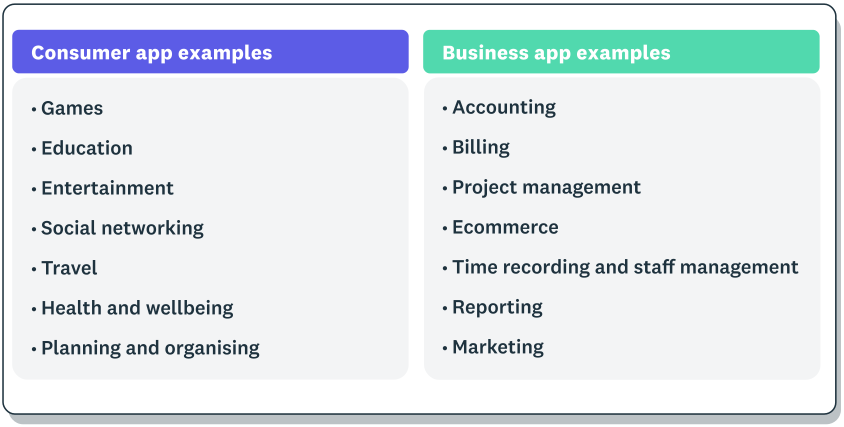
App categories span both consumer and business markets:
- Consumer apps: Fitness tracking, personal finance, entertainment, productivity, and lifestyle tools
- Business apps: Invoicing, inventory management, customer relationship management, project tracking, and industry-specific solutions
Your accounting software can integrate with hundreds of business apps serving diverse industries. Competition is intense across all categories, so you need to market effectively and differentiate from the start.
Content businesses generate revenue through advertising, sponsorships, subscriptions, or affiliate marketing. Building a profitable audience takes time, but the potential scales significantly once you establish traction.
Common content monetisation paths include:
- YouTube: Ad revenue and sponsorships, particularly strong in gaming, tutorials, and how-to content
- Podcasting: Sponsorships, premium subscriptions, and listener support
- Blogging: Display advertising, affiliate marketing, and sponsored content
- Affiliate marketing: Earn commissions when your content drives sales for partner retailers
FAQs on online business ideas
Here are answers to common questions about starting an online business.
What's the easiest online business to start?
Service businesses are often the easiest to start because you can monetise skills you already have. Virtual assistant services, online tutoring, or freelance writing require minimal upfront investment and can begin with your existing network.
How much does it cost to start an online business?
Costs vary widely by business type. Service businesses can start for under £100, covering basic website hosting and tools. Retail businesses need more capital for inventory or supplier costs. Digital products and content businesses fall in between, requiring time investment more than money.
Can you start an online business with no money?
Yes. Service-based businesses require minimal financial investment. You can offer consulting, coaching, or freelance services using free tools and platforms. Build your initial client base through your network and referrals, then reinvest earnings to grow.
How long does it take to make money from an online business?
Service businesses can generate income within weeks if you have an existing network. Retail and content businesses typically take longer, often three to six months to see meaningful revenue. Success depends on your marketing efforts, product-market fit, and time investment.
Do I need a business plan to start an online business?
A formal business plan isn't required to start, but clarity about your target market, revenue model, and basic financials helps. Start with a simple one-page plan outlining what you sell, who buys it, and how you'll reach them. You can develop a detailed plan as your business grows.
Disclaimer
Xero does not provide accounting, tax, business or legal advice. This guide has been provided for information purposes only. You should consult your own professional advisors for advice directly relating to your business or before taking action in relation to any of the content provided.
Start using Xero for free
Access Xero features for 30 days, then decide which plan best suits your business.