Gearing ratio: definition, types and how to calculate
Learn how the gearing ratio guides funding, balances risk and growth, and protects cash flow.

Written by Shaun Quarton—Accounting & Finance Content Writer and Growth Marketer. Read Shaun's full bio
Published Tuesday 24 February 2026
Table of contents
Key takeaways
- Calculate your gearing ratio regularly using the debt-to-equity formula (Total Debt ÷ Total Equity × 100) to monitor your business's financial health and make informed borrowing decisions.
- Maintain a gearing ratio between 25% and 50% for optimal balance, as this range provides growth opportunities while keeping financial risk manageable for most small businesses.
- Improve a high gearing ratio by paying down existing debt, retaining more earnings instead of distributing profits, and avoiding unnecessary borrowing to strengthen your equity position.
- Use your gearing ratio strategically when seeking funding, as lenders and investors view businesses with debt-to-equity ratios under 1.5 as 25% more likely to secure loan approvals.
Gearing ratio definition
A gearing ratio is a financial metric that compares your business's debt to its equity, showing how reliant you are on borrowed funds versus your own capital. This ratio provides insight into your financial health and risk exposure.
In finance, gearing refers to the balance between debt and equity a company uses to fund its operations:
- Debt: borrowed money, such as loans and lines of credit, that must be repaid with interest
- Equity: the owner's investment in the business, including retained earnings and share capital
Lenders, investors, and stakeholders use gearing ratios to assess financial stability:
- Higher ratio: signals greater reliance on debt, increasing financial risk but offering potential for higher returns
- Lower ratio: suggests a stronger equity position, reducing risk but potentially limiting growth opportunities
Why does your gearing ratio matter?
Your gearing ratio is a key indicator of your business's financial health. Tracking and managing it effectively helps you make smarter financial decisions and plan for sustainable growth.
- Borrowing decisions: Judge whether you can take on more debt without straining cash flow or increasing financial risk
- Attracting investors and lenders: signal financial stability to make your business more appealing to potential funders, as companies with debt-to-equity ratios under 1.5 are 25% more likely to secure loan approvals than those with higher ratios
- Strategic planning: Align your debt-to-equity structure with growth goals, whether aiming for rapid expansion or steady, low-risk growth
- Cash flow stability: Free up more cash for reinvestment with a lower ratio, or allocate more funds towards debt repayments with a higher ratio
- Risk management: spot financial vulnerabilities early by reviewing your ratio regularly, as research shows companies with debt-to-equity ratios over 2.0 are 35% more likely to face financial distress within five years
Types of gearing ratios
Small businesses and their advisors use several gearing ratios to measure financial leverage and risk. Each ratio examines different aspects of your financial stability.
- Debt-to-equity ratio: Compares total debt to total equity, showing how much of the business is funded by creditors versus owners
- Debt-to-capital ratio: Measures the proportion of total capital (debt + equity) funded by debt, with higher ratios suggesting greater reliance on borrowing
- Equity ratio: Represents the share of total assets financed by equity, with higher ratios indicating stronger financial stability
- Times interest earned (TIE) ratio: Assesses your ability to cover interest payments with pre-tax earnings, reassuring lenders you can meet debt obligations
Debt-to-equity ratio vs gearing ratio
The debt-to-equity ratio and gearing ratio both measure financial leverage, but they serve slightly different purposes:
- Debt-to-equity ratio: compares long-term debt specifically to shareholders' equity
- Gearing ratio: uses various formulas to consider different types of debt relative to capital structure
Both ratios help you evaluate financial risk. Use the debt-to-equity ratio for quick financial assessments and the gearing ratio for deeper insights into long-term planning.
How to calculate the gearing ratio
Calculate your gearing ratio in four steps to understand your business's debt-to-equity balance.
Step 1: Calculate total debt
Include all financial liabilities, such as loans, bonds, and credit lines.
Step 2: Determine total equity
Add retained earnings and share capital to find the owner's total investment in the business.
Step 3: Apply a gearing ratio formula
Use one of these common formulas:
- Debt-to-equity formula: Gearing ratio = (Total Debt / Total Equity) × 100
- Debt-to-capital formula: Gearing ratio = (Total Debt / (Total Debt + Total Equity)) × 100
Step 4: Interpret the result
A higher percentage indicates greater reliance on debt, while a lower percentage shows a stronger equity position.
Example gearing ratio calculations
These practical examples show how to calculate a gearing ratio:
- Total debt: $50,000
- Total equity: $100,000
Using the debt-to-equity formula
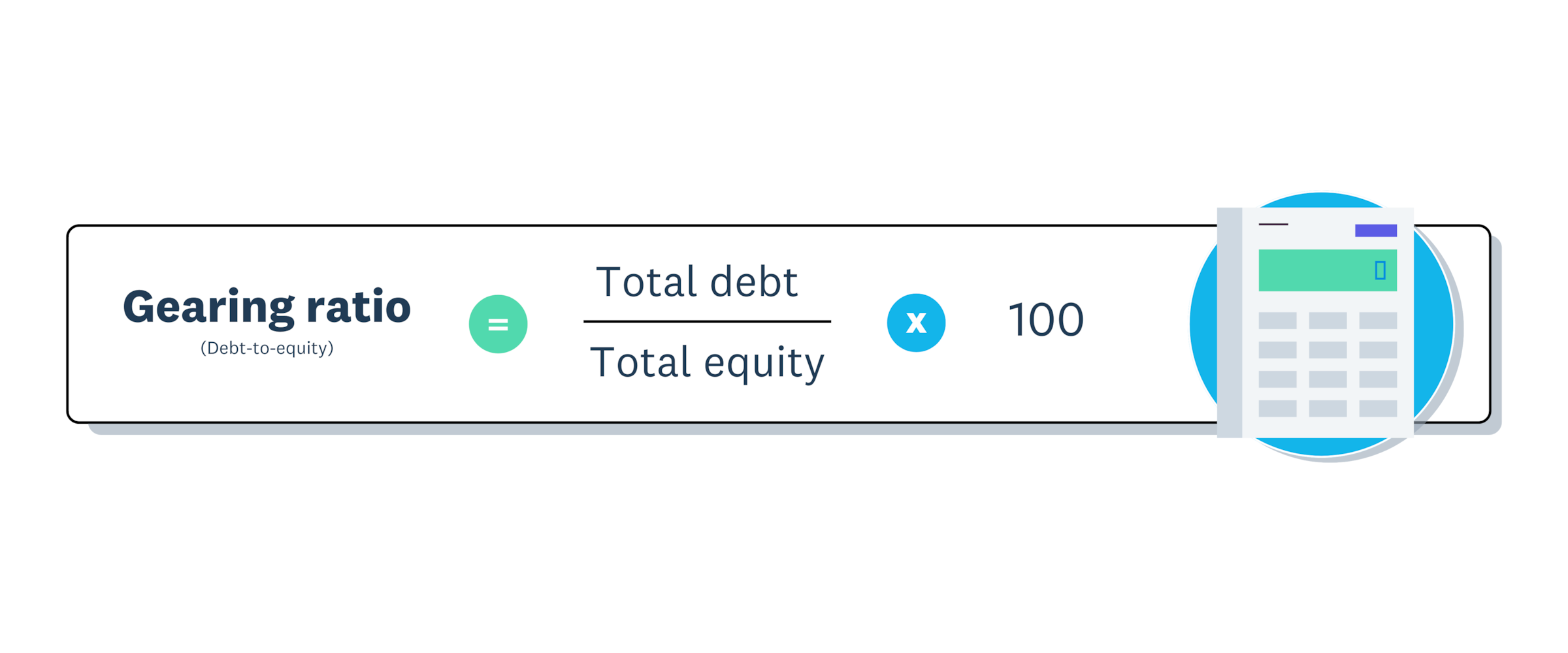
- Gearing ratio = (Total debt / Total equity) × 100
- Gearing ratio = ($50,000 / $100,000) × 100
- Gearing ratio = 50%
Using the debt-to-capital formula
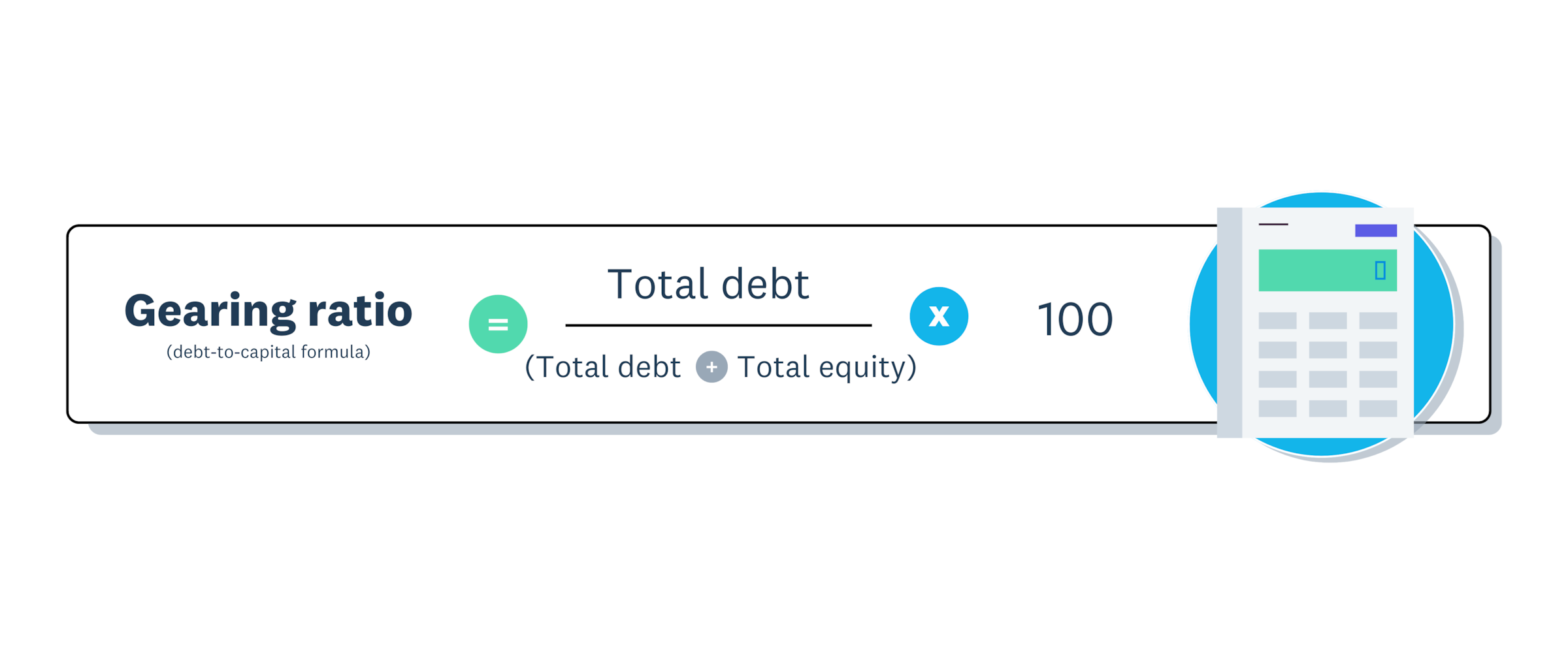
- Gearing Ratio = (Total Debt / (Total Debt + Total Equity)) × 100
- Gearing Ratio = ($50,000 / ($50,000 + $100,000)) × 100
- Gearing Ratio = ($50,000 / $150,000) × 100
- Gearing Ratio = 33.3%
When to use the debt-to-equity ratio vs the gearing ratio
When deciding which metric to use, consider your business's needs:
- Debt-to-equity ratio: use for quick financial assessments, standardised comparisons, and snapshots of your debt relative to equity
- Gearing ratio: use for strategic planning, long-term financial management, and a comprehensive view of leverage across different debt types
Gearing ratio analysis
Understanding your gearing ratio helps you assess your business's financial health and risk exposure. General benchmarks for small businesses:
- Low gearing (below 30%): suggests a strong equity position with lower risk exposure and greater stability
- Moderate gearing (30–50%): represents a balanced financial approach for most small and medium-sized businesses
- High gearing (above 70%): indicates heavier reliance on debt and increased financial risk
Typical gearing ratios vary by industry, growth stage, and risk tolerance. Many small and medium-sized businesses (SMBs) maintain a 30% to 50% debt mix, balancing borrowed funds for growth with equity for stability.
High vs low gearing: what's the difference?
The difference between high and low gearing comes down to how you balance debt and equity to fund your business.
High gearing means relying more on debt than equity. A retail store taking out a large loan to buy inventory and renovate would have a high gearing ratio. This approach works well if sales thrive but becomes risky if revenues drop or interest rates rise.
High gearing can suit your business if you:
- have stable cash flow that can service debt repayments
- operate in a high-growth industry where revenues are increasing
- see opportunities that require borrowing to scale quickly
Low gearing means using more equity and less debt. A family-owned cafe expanding with saved profits may grow more slowly, but keeps financial risk to a minimum.
Low gearing is the "safety first" choice when you're:
- prioritising long-term security over rapid expansion
- operating in unstable market conditions
- protecting your credit rating by minimising debt
Finding the right balance helps you manage financial risk so your business can seize growth opportunities.
What is a good gearing ratio for small businesses?
A good gearing ratio for most small businesses falls between 25% and 50%. This range balances growth potential with manageable financial risk.
Common thresholds to interpret:
- Below 25%: very low risk, but may indicate underutilised debt financing opportunities
- 25–50%: optimal range for most SMBs, balancing leverage for growth with financial stability
- 50–70%: moderate to high risk, acceptable for businesses with strong, predictable cash flows
- Above 70%: high risk, typically only sustainable for capital-intensive industries or businesses with very stable revenue
Ideal ratios vary by industry; for example, research shows that average debt-to-equity ratios can be around 0.48 for technology companies but closer to 0.90 for e-commerce and retail businesses.
Service businesses often operate comfortably at lower ratios, while manufacturing or retail businesses may carry higher debt to fund inventory and equipment.
How to improve your gearing ratio
If your gearing ratio is higher than you'd like, take these steps to bring it into a healthier range:
- Pay down existing debt: Prioritise high-interest loans and credit lines to reduce your total debt burden
- Retain more earnings: Reinvest profits into the business rather than distributing them to build your equity base, as companies that retain at least 50% of their earnings have been shown to improve their debt-to-equity ratio by 20% over five years
- Avoid unnecessary borrowing: Evaluate whether new debt is essential before taking on additional loans
- Increase revenue: Higher profits boost retained earnings, which strengthens your equity position over time
- Restructure existing debt: Negotiate better terms or consolidate loans to reduce interest costs and improve cash flow
A low ratio may signal room for strategic borrowing to accelerate growth. Consider whether strategic borrowing could help you expand faster while maintaining manageable risk.
Manage your finances with Xero
Monitor your debt levels, equity changes, and overall financial health in one place with automated calculations and customisable reports. Track your gearing ratio with real-time visibility into your financial position.
With Xero, you can:
- Track financial ratios: access real-time data to calculate and monitor your gearing ratio
- Streamline reporting: generate clear reports for lenders, investors, and stakeholders
- Stay organised: keep all your financial records in one secure, cloud-based platform
Ready to take control of your business finances? Get one month free and see how Xero simplifies financial management for small businesses.
FAQs on gearing ratio
Common questions about gearing ratios and how they apply to your business.
What is the gearing ratio formula?
The most common gearing ratio formula is: Gearing ratio = (Total Debt / Total Equity) × 100.
You can also use the debt-to-capital formula: Gearing ratio = (Total Debt / (Total Debt + Total Equity)) × 100.
What is a good gearing ratio?
A good gearing ratio for most small businesses falls between 25% and 50%, balancing growth potential with manageable financial risk. Ratios above 50% are considered high, while below 25% may indicate underutilised financing.
What does a gearing ratio of 60% mean?
A gearing ratio of 60% means your business has $60 of debt for every $100 of equity. This indicates moderate to high leverage, which may be acceptable if you have strong, predictable cash flows.
Should I aim for high or low gearing?
Your goals and risk tolerance determine the answer. High gearing suits businesses seeking rapid growth with stable cash flows, while low gearing prioritises financial security and protects your credit rating.
How often should I calculate my gearing ratio?
Calculate your gearing ratio at least quarterly, or whenever you're considering major financial decisions like taking on new debt or seeking investment. Monitor regularly to spot changes in your financial position early.
Start using Xero for free
Access Xero features for 30 days, then decide which plan best suits your business.