Marginal cost: formula, examples for your business
Learn how marginal cost sharpens your pricing and production plans, so you cut waste and boost profit.

Written by Lena Hanna—Trusted CPA Guidance on Accounting and Tax. Read Lena's full bio
Published Wednesday 1 April 2026
Table of contents
Key takeaways
- Calculate your marginal cost using the formula (Change in Total Cost ÷ Change in Quantity) to determine whether producing additional units will increase or decrease your profits.
- Compare your marginal cost to your average cost per unit - if marginal cost is lower, you can profitably increase production, but if it's higher, maintain current levels to protect your margins.
- Find your optimal production level by identifying the point where marginal cost equals marginal revenue, as producing beyond this point costs more than it earns.
- Use marginal cost data to make informed decisions about pricing strategies, expansion timing, and whether to accept large orders or new clients.
What is marginal cost?
Marginal cost is the additional expense of producing one more unit of a product or service. For example, if your total cost increases by $80 when producing 50 more units, the marginal cost per unit is $1.60. Understanding this figure helps you decide whether expanding production will increase your profits or eat into them.
Expanding production affects both your immediate cash flow and your long-term pricing strategy. Calculating your marginal cost is the first step in deciding whether growth makes financial sense.
Why marginal cost matters
Marginal cost helps you make smarter decisions about production levels, pricing, and growth timing. Here's how understanding this metric benefits your business:
- Optimise production volume: Produce enough to spread fixed costs without overextending.
- Set competitive prices: Base pricing on actual cost data rather than guesswork.
- Plan profitable growth: Know when expansion will boost profits versus drain resources.
- Avoid costly mistakes: Identify the tipping point where additional production stops being worthwhile.
Compare your marginal cost to your average cost of production to guide your next move:
- Marginal cost lower than average cost: You have room to increase production profitably. This is common in industries with high fixed costs; for example, research on road and rail networks shows that marginal costs are generally below average cost.
- Marginal cost higher than average cost: Maintain current production levels to protect your margins.
What are the main components of marginal cost?
To calculate marginal cost, you need to understand the two main cost categories involved in production.
- Variable costs: These change with your output level. Examples include materials, hourly wages, and energy bills. When you produce more, these costs rise.
- Fixed costs: These stay the same regardless of output. Examples include machinery, rent, and salaries. Producing more units spreads these costs across a larger volume, lowering your cost per unit.
How to calculate marginal cost
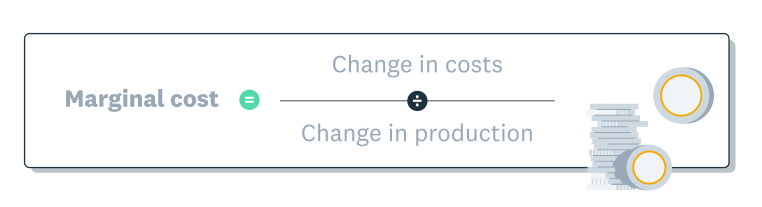
Marginal cost measures how your total costs change when you produce one additional unit. Use this formula:
Marginal Cost = Change in Total Cost ÷ Change in Quantity
To calculate it, identify how much your total costs increase when you add one unit of production, then divide by the number of additional units (typically one). This works for both products and services.
Marginal cost examples
Here are examples for both product and service businesses.
Marginal cost example: product business
Mohammed runs a bakery and wants to know if making one more cake is worth it. Here's his situation:
- Current production: 100 cakes at $1,000 total ($10 per cake)
- New production cost: 101 cakes at $1,005 total
Step 1: Calculate the change in total cost: $1,005 – $1,000 = $5
Step 2: Calculate marginal cost: $5 ÷ 1 = $5
The result: Mohammed's marginal cost of $5 is lower than his average cost of $10 per cake. Expanding production makes financial sense.
Marginal cost example: service business

Sarah runs a consulting firm and charges $150 per hour. She's considering whether to take on an additional client that requires 10 hours per week.
- Current costs: $5,000 monthly for 100 billable hours
- Additional costs for new client: $200 (software licence, admin time)
Marginal cost calculation: $200 ÷ 10 hours = $20 per hour
The result: Sarah's marginal cost of $20 per hour is well below her $150 hourly rate. Taking on the new client would add $1,300 in profit ($150 × 10 – $200).
How to use marginal cost in your business
Follow these steps to put your marginal cost calculations to work.
- Calculate your current marginal cost for your main products or services using the formula above.
- Compare it to your average cost to see whether you have room to grow production profitably.
- Evaluate your production capacity to determine if you can realistically increase output.
- Adjust your pricing strategy based on what your marginal cost reveals about your true expenses.
- Monitor changes over time as your costs shift with supplier prices, wages, or efficiency gains.
- Use the data for expansion decisions to avoid growing faster than your margins can support.
Marginal revenue vs marginal cost
Marginal revenue is the additional income you earn from selling one more unit. While marginal cost tracks your expenses, marginal revenue tracks your earnings.
Marginal Revenue = Change in Revenue ÷ Change in Quantity Sold
To maximise profits, aim for the point where marginal cost equals marginal revenue. Beyond this point, each additional unit costs more to produce than it earns. This reflects the law of diminishing returns; for instance, adding a fifth worker to a pizza shop might increase the marginal cost per pizza from an initial low of $1.14 to $8.00.
This happens because increased supply can reduce demand and lower the price customers are willing to pay. Knowing both figures helps you find your optimal production level.
FAQs on marginal cost
Here are answers to common questions about marginal cost and how to use it in your business.
What is marginal cost in simple terms?
Marginal cost is the extra expense of making one more unit. It helps you decide whether increasing production will boost or hurt your profits.
How is marginal cost different from average cost?
Average cost is your total costs divided by total units produced. Marginal cost only measures the cost of the next unit, making it more useful for production decisions.
When should I calculate marginal cost?
Calculate marginal cost when considering expansion, setting prices for new products, evaluating whether to take on a large order, or reviewing your production efficiency.
Can marginal cost decrease as I produce more?
Yes. When you benefit from economies of scale, your marginal cost can drop as fixed costs spread across more units and you gain efficiency through volume. In fact, a survey of businesses found that while only 11% saw marginal costs increase with production, 41% answered that they were decreasing.
Disclaimer
Xero does not provide accounting, tax, business or legal advice. This guide has been provided for information purposes only. You should consult your own professional advisors for advice directly relating to your business or before taking action in relation to any of the content provided.
Start using Xero for free
Access Xero features for 30 days, then decide which plan best suits your business.