Trial balance: what it is, types and how to prepare one
Learn how to prepare a trial balance step by step, spot common errors and fix them before your reports.

Written by Ebony-Storm Halladay — Freelance accounting copywriter, 10 years. Read Ebony's full bio
Published Tuesday 6 October 2026
Table of contents
Key takeaways
- Prepare a trial balance at the end of each accounting period to confirm your total debits equal your total credits before you build financial statements
- Build one in six steps, finishing with totalling the debit and credit columns and checking they agree
- Trace an imbalance through the difference: a gap divisible by 9 often means a transposition, and half the gap can reveal a wrong-side entry
- Recognise that a balanced trial balance can still hide errors of omission, commission, principle and duplication, so check your bank accounts and source documents too
What is a trial balance?
A trial balance is a financial report showing the closing balances of all accounts in the general ledger at a specific point in time. It tests your books for basic errors before you prepare financial statements or complete a financial audit.
Many businesses create a trial balance as the first step in closing their books at the end of an accounting period.
Components of a trial balance
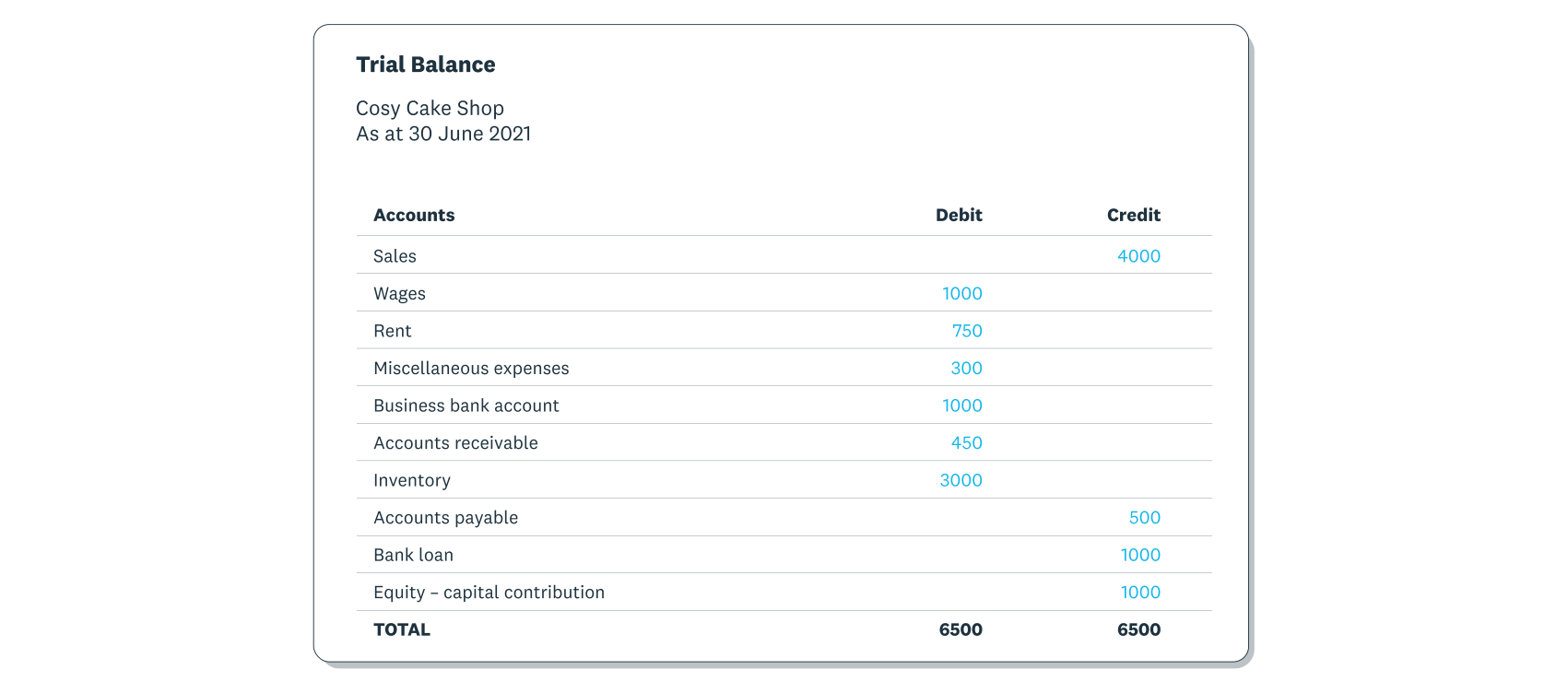
A trial balance has a simple three-column layout. Each column holds one type of information.
- Account names: every ledger account from your chart of accounts, listed in the left column
- Debit balances: asset, expense and drawings account balances in the middle column
- Credit balances: liability, equity and income account balances in the right column
You can leave out accounts you haven’t used during the period. The debit and credit totals must match; if they don’t, there’s likely an error in your bookkeeping.
The worked example in the how-to section below shows this layout with real peso figures.
Why trial balances matter for your business
A trial balance is a checkpoint that helps keep your financial statements accurate. A balanced report gives you confidence that your numbers reflect your business’s financial health, so you can meet compliance requirements and make better-informed decisions.
The 3 main purposes of a trial balance
A trial balance does three main jobs in the accounting cycle. Each one supports the reports you’ll rely on later.
- Checks for mathematical errors: it confirms total debits in the general ledger equal total credits. A mismatch points to an error to fix.
- Starts your financial statements: once it balances, it gives you the figures for reports like the balance sheet and income statement.
- Helps with internal audits: it summarises every account balance, so you or your accountant can review activity and spot issues early.
When to prepare a trial balance
Unlike formal financial statements, you can prepare a trial balance as often as you like. Most businesses run one at the end of each accounting period, such as monthly, quarterly or annually, as part of closing the books.
Making it a regular part of your small business bookkeeping helps you catch errors while they’re still small.
Types of trial balances
There are three types of trial balances. Each follows the same format but appears at a different stage of the accounting process.
- Unadjusted trial balance: captures initial data from your general ledger to check for obvious errors and identify entries needing adjustment
- Adjusted trial balance: includes corrected entries and is the basis for preparing your financial statements
- Post-closing trial balance: confirms all temporary accounts are closed and your ledger is ready for the next accounting period
Here’s more detail on each type.
Unadjusted trial balance
An unadjusted trial balance captures all initial data from your general ledger, recording day-to-day transactions before any adjustments. You or your accountant then review it and make the adjustments it needs.
- Accruals: adding unpaid bills
- Deferrals: recognising income only when earned
- Depreciation: spreading asset costs over several years
These adjustments apply when you keep your books on an accrual basis, and they give you a clearer view of your financial position.
Adjusted trial balance
An adjusted trial balance summarises the final balances in all accounts after you’ve made the adjustments. You use it to prepare your financial reports, including your income statement and balance sheet.
Post-closing trial balance
A post-closing trial balance checks that all debit and credit balances are equal after you’ve closed temporary accounts. You prepare it after finalising your financial statements.
During the closing process, balances from temporary accounts (revenue, expenses and dividends) move into retained earnings. The post-closing trial balance confirms your general ledger is ready for the next accounting period.
How to prepare a trial balance
To prepare a trial balance, list every ledger account’s closing balance as a debit or credit, then check both columns total the same. Follow these six steps.
1. Record and post all transactions to the general ledger
Record every sale, bill, payment and adjustment for the period as a journal entry, then post it to the right ledger account. Under double-entry bookkeeping, each entry has equal debits and credits, which is what makes the final check work.
2. Calculate each account’s closing balance
For each account, add up the debits and the credits, then subtract the smaller total from the larger one. For example, if your cash account has ₱320,000 in debits and ₱135,000 in credits, its closing balance is a ₱185,000 debit.
3. List accounts in chart-of-accounts order
Write the account names down the left column in chart-of-accounts order: assets, liabilities, equity, income, then expenses. Leave out any account with a zero balance.
4. Put each balance in the debit or credit column
Each account type has a normal balance that tells you which column it goes in. Assets, expenses and drawings normally carry debit balances, while liabilities, equity and income normally carry credit balances.
An account sitting on its unusual side, like an overdrawn bank account showing a credit, is worth a quick check.
5. Total both columns
Add up the debit column and the credit column separately. Double-check your addition, since one adding slip can throw the totals out.
6. Compare totals and investigate differences
If the two totals match, your trial balance is in balance and you can move on to adjustments and financial statements. If they differ, work out the gap and trace it using the checks in the errors section below.
Trial balance example in pesos
Here’s a trial balance for a fictional business, Santos Bakery, as at 31 March 2026. The accounts appear in chart-of-accounts order, with each balance marked as a debit or credit.
- Cash in bank: ₱185,000 debit
- Accounts receivable: ₱42,000 debit
- Equipment: ₱120,000 debit
- Accounts payable: ₱37,000 credit
- Owner’s capital: ₱250,000 credit
- Owner’s drawings: ₱15,000 debit
- Sales revenue: ₱160,000 credit
- Rent expense: ₱25,000 debit
- Wages expense: ₱60,000 debit
The debits total ₱447,000 (₱185,000 + ₱42,000 + ₱120,000 + ₱15,000 + ₱25,000 + ₱60,000). The credits also total ₱447,000 (₱37,000 + ₱250,000 + ₱160,000), so Santos Bakery’s trial balance balances.
Using accounting software for trial balances
Building a trial balance by hand takes time, and a manual version can take several hours if you have lots of accounts. Accounting software like Xero pulls closing balances straight from your general ledger and creates the report in seconds.
Automated bank feeds keep your ledger up to date, so each trial balance you run reflects your latest figures.
Trial balance vs balance sheet
A trial balance and a balance sheet both show important financial information, but they have different purposes and scope. A trial balance is an internal worksheet for checking that debits equal credits. A balance sheet is a formal financial statement for people outside the business.
Key differences explained
Here’s a quick breakdown of how the two reports differ. Each point compares one aspect side by side.
- Purpose: a trial balance checks the arithmetic in your books. A balance sheet presents your financial position to investors and lenders.
- Structure: a trial balance lists ledger accounts and their balances. A balance sheet groups accounts by the equation assets = liabilities + equity.
- Audience: a trial balance is mainly for you, your bookkeeper or your accountant. A balance sheet also goes to investors, creditors and regulators.
When to use each report
Use a trial balance during the accounting cycle to confirm your ledger balances before you create formal reports. Use a balance sheet at the end of an accounting period for a snapshot of your financial health. It’s one of the final outputs of the accounting process.
Common trial balance errors
Trial balance errors fall into two groups: those that stop your totals agreeing, and those that leave the totals equal but your books wrong. Knowing both tells you where to look.
Errors that cause an imbalance
These errors hit one side of an entry harder than the other, so your debit and credit totals come out different. Here are the six to look for.
- Transposition errors: swapping digits on one side, like entering ₱5,400 as ₱4,500, which leaves a ₱900 gap that divides evenly by 9
- Transcription errors: copying a figure wrongly to one side, like posting a ₱1,200 bill as ₱12,000 in the expense account
- One-sided entries: recording only half a transaction, like posting a ₱6,000 cash sale to sales but not to cash
- Wrong-side entries: putting an amount in the wrong column, like crediting ₱3,000 of rent expense, which creates a ₱6,000 gap
- Addition errors: adding up a ledger account or a trial balance column incorrectly
- Missing balances: leaving an account off the trial balance, like a ₱5,000 petty cash balance
Errors a trial balance won’t catch
Some errors affect debits and credits equally, so your totals still agree. Regular bank reconciliation and a review of source documents help you find these six.
- Errors of omission: leaving a transaction out completely, like a ₱12,000 supplier invoice that never gets entered
- Errors of commission: using the right type of account but the wrong one, like posting a ₱4,000 payment from Reyes Trading to Cruz Store
- Errors of principle: using the wrong type of account, like recording an ₱80,000 laptop as office expenses instead of equipment
- Errors of original entry: entering the wrong amount on both sides, like recording a ₱7,500 sale as ₱5,700
- Duplicate entries: recording the same transaction twice, like entering a ₱2,500 electricity bill two times
- Compensating errors: making two mistakes that cancel out, like overstating both sales and wages expense by ₱1,000
How to find and fix trial balance errors
When your totals disagree, work through these checks in order, starting with the quickest. Fix each mistake with a new entry so your records keep a clear trail.
- Re-add both columns of the trial balance to rule out a simple addition slip.
- Work out the difference between the totals and check whether it divides evenly by 9, which suggests a transposition.
- Halve the difference and search your ledger for that amount, since it may sit on the wrong side.
- Compare each ledger balance with the figure on your trial balance to catch copying errors and missing accounts.
- Check your journal postings to confirm every entry has matching debits and credits in the right accounts.
- Reconcile each bank account against its statement, using these bank reconciliation steps to spot missing, duplicated or wrong amounts.
- Post a correcting journal entry for each mistake and keep the original, so every fix is traceable.
The role of trial balances in financial statements
Trial balances are the foundation for financial statements. Accountants use them to prepare balance sheets, income statements and other reports, and auditors rely on them too.
Your bookkeeper or accountant checks that the debit and credit totals match. If they don’t, there may be a missing entry or a figure copied wrongly from the general ledger.
Once mistakes are corrected, you can use the adjusted trial balance to prepare your financial statements. Matching totals confirm the arithmetic, so pair them with regular reconciliations to catch missing or misclassified transactions.
Streamline your trial balance preparation with Xero
A trial balance gives you confidence that your numbers reflect your business’s true financial health. That makes it easier to meet compliance requirements and make informed decisions.
With Xero, you can record transactions, run a trial balance and produce financial reports in a few clicks, with balances pulled straight from your ledger. Get one month free and see how simple closing your books can be.
FAQs on trial balances
Still have questions about trial balances? Here are answers to common concerns.
What is the format of a trial balance?
The heading shows your business name, the report title and the date, for example ‘Trial balance as at 31 March 2026’. The account, debit and credit columns follow, with both totals on the last line.
What errors are not revealed by a trial balance?
Errors of omission, commission, principle and original entry, plus duplicate and compensating errors, all leave the totals equal. Catch them by matching ledger entries to invoices, receipts and bank statements, and by questioning any balance that looks unusual.
What should I do if my trial balance doesn’t balance?
If you need to keep working, park the difference in a temporary suspense account, then trace the cause. Once you find it, clear the suspense account with a correcting journal entry so it’s at zero before you prepare financial statements.
What is the difference between a trial balance and a general ledger?
The general ledger records every individual transaction in each account, while a trial balance lists only each account’s closing balance on one page. Think of the ledger as a full bank statement and the trial balance as the closing balance at the bottom of each one.
How often should a small business prepare a trial balance?
Monthly works well for most small businesses, because it keeps errors small and easier to trace. It’s also worth running one before you file quarterly income tax returns and at year end.
Do I need accounting software to prepare a trial balance?
You can build one in a spreadsheet, but manual work adds time and room for typing errors. Accounting software like Xero creates it from your ledger in seconds, using up-to-date figures.
Disclaimer
Xero does not provide accounting, tax, business or legal advice. This guide has been provided for information purposes only. You should consult your own professional advisors for advice directly relating to your business or before taking action in relation to any of the content provided.
Start using Xero for free
Access Xero features for 30 days, then decide which plan best suits your business.