Is accumulated depreciation an asset? Contra-asset guide
Learn if accumulated depreciation is an asset, where it sits on your balance sheet, and how to calculate it.

Written by Jotika Teli—Certified Public Accountant with 24 years of experience. Read Jotika's full bio
Published Monday 23 February 2026
Table of contents
Key takeaways
- Recognize that accumulated depreciation is a contra asset account, not an asset or liability, which appears on your balance sheet with a credit balance to offset the original cost of fixed assets and show their current book value.
- Calculate accumulated depreciation using the straight-line method by dividing the asset's cost minus salvage value by its useful life, then track the running total each year to determine the asset's remaining book value.
- Use depreciation as a non-cash expense to reduce your taxable income and lower your tax bill, while understanding that it doesn't affect actual cash flow since no money leaves your business when recording it.
- Track accumulated depreciation to make better business decisions about asset replacements, present accurate asset values for financing applications, and maintain proper financial reporting that reflects the true worth of your fixed assets.
What is accumulated depreciation?
Accumulated depreciation is the total depreciation of an asset since you bought it. It represents the cumulative wear and tear, obsolescence, or decline in value recorded over time.
Tracking accumulated depreciation lets you see the true value of your assets on financial statements. This value, called book value or carrying amount, shows what an asset is realistically worth today. International Financial Reporting Standards (IFRS) define this as the amount at which an asset is recognised after deducting any accumulated depreciation and impairment losses.
Here are two examples:
- office furniture: cost $5,000 with $1,000 depreciation each year. After three years, accumulated depreciation totals $3,000, leaving a book value of $2,000.
- machinery: cost $25,000 with $2,500 depreciation each year. After six years, accumulated depreciation totals $15,000, leaving a book value of $10,000.
Is accumulated depreciation an asset or a liability?
Accumulated depreciation is neither an asset nor a liability. It's classified as a contra asset account.
A contra asset offsets the original value of assets on your balance sheet. Unlike liabilities, which represent debts or obligations your business owes, accumulated depreciation reflects the reduction in an asset's book value over time due to wear and tear.
You record accumulated depreciation alongside your other assets, but it always carries a credit (negative) balance. This offsets the asset's original cost, giving you a more realistic view of what the asset is worth today.
Depreciation vs accumulated depreciation
Depreciation is a recurring expense that records the decrease in an asset's value over a specific period, such as a month or year.
Accumulated depreciation is the running total of all depreciation expenses recorded for an asset since purchase. It increases each time you record a new depreciation expense.
Key difference: Depreciation is a single-period expense. Accumulated depreciation is the sum of all those expenses over time.
How does accumulated depreciation affect financial statements?
Accumulated depreciation appears in several places across your financial statements. Here's how it affects each one.
Accumulated depreciation on the balance sheet
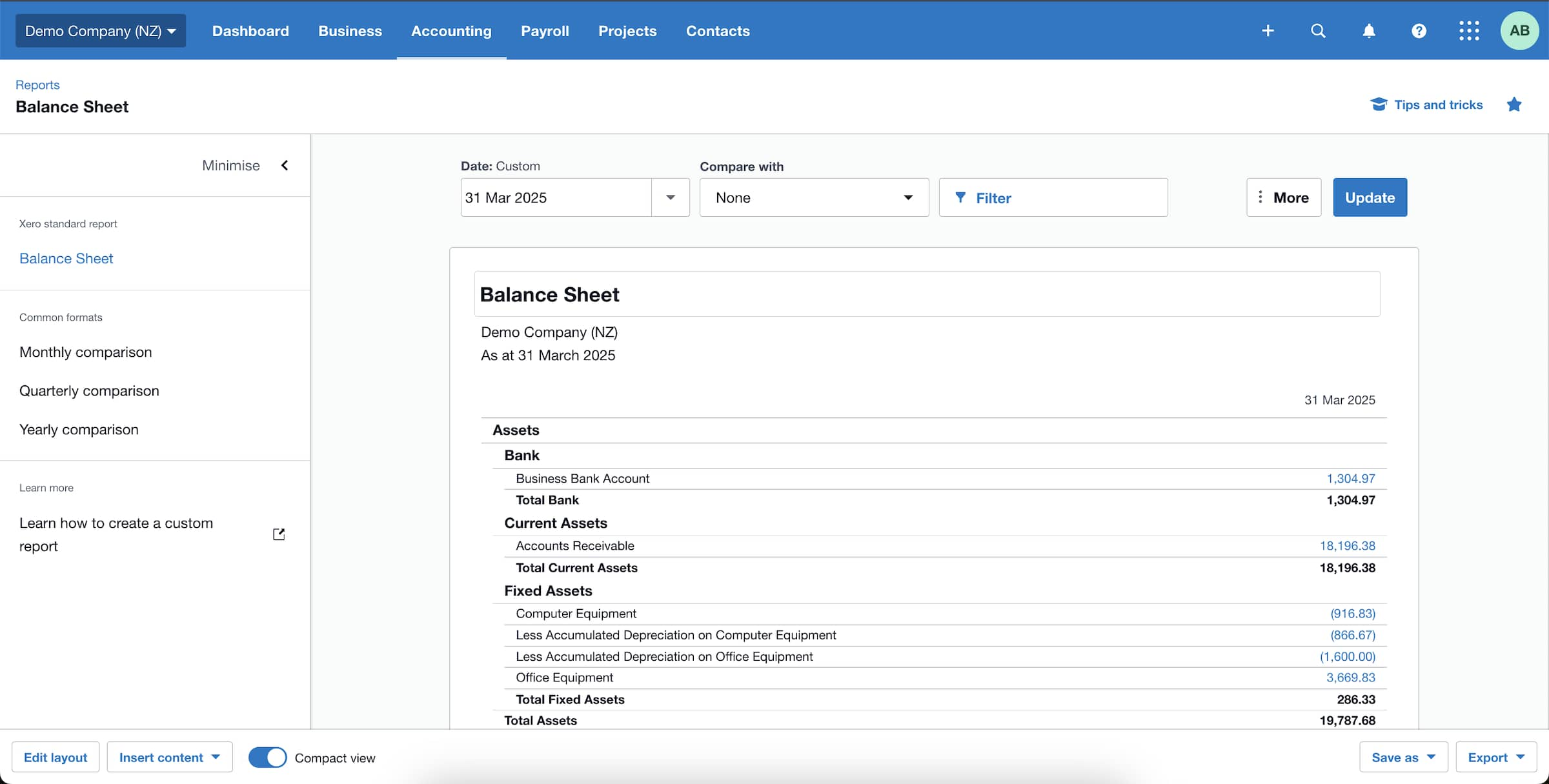
Accumulated depreciation appears under fixed assets (or property, plant, and equipment) on your balance sheet. It reduces the asset's book value by adjusting the original cost downwards to reflect current worth.
For example, if equipment cost $10,000 and has $3,000 in accumulated depreciation, the balance sheet shows a net book value of $7,000.
Accumulated depreciation on the income statement
Depreciation expense (not accumulated depreciation) appears on your income statement. It reduces your taxable income for the period.
As a non-cash expense, depreciation lowers your reported profits without affecting actual cash flow. Accumulated depreciation itself doesn't appear on the income statement; it only shows on the balance sheet.
Accumulated depreciation on the cash flow statement
Depreciation is added back to net income on the cash flow statement because it's a non-cash expense.
This adjustment shows that while depreciation reduces reported profits, no cash actually leaves your business. Your actual cash position remains unchanged by depreciation entries.
Example: Balance sheet for accumulated depreciation
This balance sheet example shows how accumulated depreciation reduces the net book value of fixed assets from their original cost.
How to calculate accumulated depreciation
The straight-line depreciation method is the simplest and most common approach for small businesses. It spreads the asset's cost evenly over its useful life, making calculations predictable and easy to manage.
Here's how to calculate accumulated depreciation using this method.
The straight line depreciation calculation
Calculate annual depreciation expense with this formula:
Annual depreciation expense = (cost of asset − salvage value) / useful life
Here's what each term means:
- cost of asset: the original purchase price
- salvage value: the estimated amount you'll receive when the asset is no longer usable (resale or scrap value)
- useful life: the estimated number of years the asset will function before becoming unusable or obsolete. According to International Accounting Standards, both the useful life and salvage value of an asset must be reviewed at least annually to account for any changes from previous estimates.
Each variable affects your annual depreciation expense:
- shorter useful life: higher annual depreciation (cost spread over fewer years)
- higher salvage value: lower annual depreciation (less total value to depreciate)
- higher purchase cost: higher annual depreciation (more value to spread)
Calculate straight line depreciation
Here's a worked example using the straight-line method.
Example asset details:
- cost: $1,000
- useful life: five years
- salvage value: $100
Step 1: Calculate annual depreciation expense
($1,000 – $100) ÷ 5 = $180 per year
Step 2: Track accumulated depreciation each year
Create a depreciation schedule showing how accumulated depreciation grows:
- year 1: $180
- year 2: $360
- year 3: $540
- year 4: $720
- year 5: $900
Step 3: Calculate book value at any point
Use this formula: Book value = initial cost – accumulated depreciation
After three years: $1,000 – $540 = $460 book value
Straight-line isn't the only way to calculate depreciation. Here are some alternatives.
Other depreciation methods
While straight-line is the most common method for small businesses, other options exist, though some methods are not permitted. For instance, the International Accounting Standards Board amended its rules to prohibit revenue-based depreciation to ensure greater consistency in financial reporting.
- Declining balance: accelerates depreciation in early years, useful for assets that lose value quickly
- Double-declining balance: accelerates depreciation even faster than declining balance
- Units of production: bases depreciation on actual usage rather than time
Most small businesses stick with straight-line for its simplicity and predictability. Consult your accountant if you're unsure which method suits your assets.
Why understanding accumulated depreciation matters for a business
Understanding accumulated depreciation helps your business in several ways.
- Better business planning: Track how asset values change over time, making it easier to plan replacements, upgrades, and maintenance
- Potential tax savings: Reduce your taxable income through depreciation charges, lowering your tax bill and keeping more cash in the business
- Easier financing: Present accurate asset values to improve your chances of attracting investment and getting loan applications approved
Simplify your accounting with Xero
Managing depreciation and calculating accumulated depreciation gets complicated as your business grows. Xero simplifies these tasks by streamlining your accounting processes and helping you track your assets.
With Xero, you can:
- create detailed depreciation schedules automatically
- get a clear view of fixed asset values
- improve the accuracy of your financial reporting
Get one month free and see how Xero supports your business.
FAQs on accumulated depreciation
Still have questions about accumulated depreciation? Here are answers to common queries.
How does accumulated depreciation affect cash flow?
Accumulated depreciation doesn't directly affect cash flow because it's a non-cash expense. No money leaves your business when you record it.
However, depreciation reduces your taxable income, which lowers your tax bill. This indirectly improves your cash position by keeping more money in the business.
What happens to an asset's accumulated depreciation when you sell it?
When you sell an asset, its accumulated depreciation is removed from your balance sheet along with the asset itself. In certain situations, such as when a business routinely sells assets previously held for rental, accounting standards require entities to transfer such assets to inventories before they are sold.
Compare the book value (cost minus accumulated depreciation) to the sale price. If you sell for more than book value, you record a gain. If you sell for less, you record a loss.
Do I record accumulated depreciation as a debit or a credit?
Record accumulated depreciation as a credit. As a contra asset account, it offsets the asset's debit balance.
The journal entry for depreciation:
- debit: depreciation expense (income statement)
- credit: accumulated depreciation (balance sheet)
This entry reduces your reported profit while lowering the asset's book value. Most accounting software like Xero handles this automatically.
Is accumulated depreciation a current liability?
No. Accumulated depreciation is a contra asset, not a liability of any kind.
Current liabilities are debts due within 12 months. Accumulated depreciation isn't a debt you owe; it simply tracks how much value an asset has lost over time.
Here's more about current and non-current liabilities.
Disclaimer
Xero does not provide accounting, tax, business or legal advice. This guide has been provided for information purposes only. You should consult your own professional advisors for advice directly relating to your business or before taking action in relation to any of the content provided.
Start using Xero for free
Access Xero features for 30 days, then decide which plan best suits your business.