Payroll
Learn what payroll is, how it works in Malaysia and which EPF, SOCSO, EIS and PCB deductions you handle.
Published Wednesday 30 September 2026
Table of contents
Key takeaways
- Payroll is how you pay employees and handle the deductions and contributions linked to each pay run. In Malaysia, that covers the Employees Provident Fund (EPF), Social Security Organisation (SOCSO), Employment Insurance System (EIS) and monthly tax deduction (PCB).
- Wages are due within seven days after each wage period ends. EPF, SOCSO, EIS and PCB payments are due by the 15th of the following month.
- The minimum wage is RM1,700 a month for every employer. Budget 2027 on 9 October 2026 may bring a revision, so check the rate before your next pay review.
- You can run payroll yourself, through an accountant, with an outsourced provider or with a payroll app. Xero connects with third-party payroll apps so your pay data flows into your accounting records.
What is payroll?
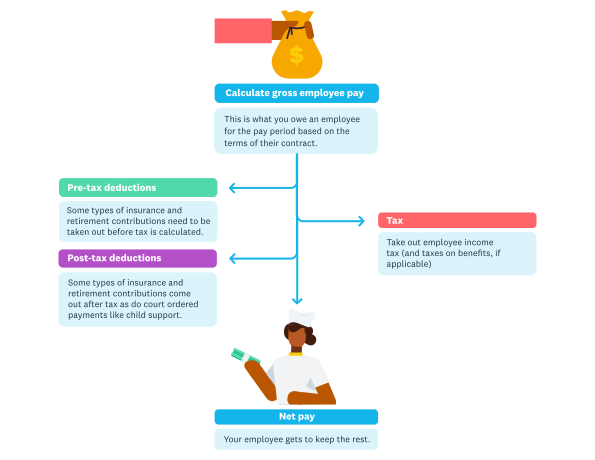
Payroll is what happens each payday and involves sending the right amounts of money to the employee, but also to a number of other locations.
Payroll is the process of paying your employees and handling the deductions and contributions that go with each payment. It also includes the records that show who you paid and when.
Salary is the amount an employee earns. Payroll is the full routine around it: working out gross pay, taking off deductions, paying the net amount and reporting it to the authorities.
Think of salary as the figure in the offer letter. Payroll is the monthly process that turns it into money in your employee’s bank account. If you’re comparing tools, online payroll can cut much of the manual work from each pay run.
How does payroll work in Malaysia?
Payroll in Malaysia follows a monthly cycle. You work out gross pay, take off statutory deductions, pay your employee, then send the deductions to each authority.
Under the Employment Act 1955, wages are due no later than the seventh day after each wage period ends. EPF, SOCSO, EIS and PCB payments are due by the 15th of the following month, as the PERKESO contribution FAQ confirms for SOCSO.
Say you pay a Malaysian employee aged under 60 RM4,000 a month. You’d deduct about RM440 for EPF, RM20 for SOCSO and RM8 for EIS, plus any PCB, then pay the rest into their bank account.
On top of their pay, you’d contribute about RM520 to EPF, RM70 to SOCSO and RM8 to EIS. That brings your monthly cost for this employee close to RM4,600, with exact amounts set by the official contribution tables.
What is included in payroll?
Payroll includes every amount you pay an employee and every amount you deduct or contribute on their behalf. A typical monthly pay run covers:
- basic salary or wages
- overtime pay, where the employee is eligible
- allowances, commission and bonuses
- employee deductions for EPF, SOCSO, EIS and PCB
- employer contributions to EPF, SOCSO and EIS
- the Human Resources Development Corporation (HRD Corp) levy, if you’re registered
Payroll deductions in Malaysia
Statutory deductions are the amounts you take from wages or add on top, and each one goes to a different authority. Each month you’ll handle PCB, EPF, SOCSO and EIS, plus the HRD Corp levy if it applies to you.
Monthly tax deduction (PCB)
Potongan Cukai Bulanan (PCB), also called monthly tax deduction (MTD), is income tax you withhold from each employee’s pay. You work it out using the Schedule of MTD or the computerised calculation method.
You pay PCB to the Inland Revenue Board of Malaysia (LHDN, also known as HASiL) through its MyTax portal, following LHDN’s employer guidance. The amount depends on the employee’s income and reliefs, with resident tax rates of 0%–30% in LHDN’s latest published schedule.
Employees Provident Fund (EPF)
The EPF, also known as KWSP, is a retirement savings scheme that you and your employee both pay into. For Malaysians and permanent residents under 60, KWSP’s contribution rates are 11% from the employee and 13% from you on wages of RM5,000 or less.
Your share drops to 12% when wages go above RM5,000. For Malaysian employees aged 60 and over, you pay 4% and the employee pays 0%, and KWSP’s Third Schedule tables give the exact amounts.
Social Security Organisation (SOCSO)
SOCSO, also known as PERKESO, protects employees against work injuries and invalidity. For employees under 60, PERKESO’s rates are 1.75% from you and 0.5% from the employee.
Employees aged 60 and over, or who first join at 55 or older, fall into a second category where you alone pay 1.25%. This category covers employment injury only. Contributions for both categories are capped at wages of RM6,000 a month, a wage ceiling in place since 1 October 2024.
Employment Insurance System (EIS)
EIS, also run by PERKESO, supports employees who lose their jobs. You and your employee each pay 0.2% of monthly wages, up to the same RM6,000 ceiling.
Under PERKESO’s coverage rules, employees aged 18–60 contribute. Anyone who joins at 57 or older with no earlier contributions is exempt.
HRD Corp levy
The HRD Corp levy funds training for your Malaysian employees. You must register with HRD Corp once you have 10 or more Malaysian employees, and the levy is 1% of their monthly wages.
With five to nine Malaysian employees, you can choose to register and pay a 0.5% levy instead.
Other deductions
Other deductions are amounts outside the statutory schemes, such as salary advance repayments or unpaid leave. Agree these with your employee in writing and check the Employment Act rules, or ask your accountant, before you take anything extra from wages.
Show each deduction on the payslip so your employee can see exactly how you reached their net pay.
How to set up payroll for the first time
Getting started means registering with the authorities, collecting employee details, choosing a method and setting your pay policies. Work through these five steps before your first pay date.
1. Register as an employer
Register with KWSP, PERKESO and LHDN before your first pay run, and get your employer income tax number (E number) from LHDN. If you have 10 or more Malaysian employees, register with HRD Corp too.
2. Collect employee details
For each new hire, collect their identity card (MyKad) or passport number, bank account details and income tax number. LHDN also needs to know about each new employee through Form CP22.
The wider steps for taking on staff, including contracts and onboarding, are worth sorting at the same time.
3. Choose how you’ll run payroll
Decide whether you’ll do it yourself, use an accountant, hand it to an outsourced provider or use payroll software. The next section compares each option.
4. Set your pay period and policies
Pick a wage period and pay date, then write down your rules for overtime, allowances and leave. A monthly wage period lines up with the statutory deadlines on the 15th.
5. Run your first payroll and pay contributions
Calculate gross pay, take off deductions and pay each employee their net wages. Then pay EPF, SOCSO, EIS and PCB by the 15th of the following month and give each employee a payslip.
Ways to run payroll
You can handle pay runs yourself, through an accountant or bookkeeper, through an outsourced provider or with payroll software. The right choice depends on how many people you employ and how much time you have.
Running it yourself with a spreadsheet and the official contribution tables costs little, but you’ll track every rate change and deadline. It suits very small teams with simple pay.
An accountant or bookkeeper can process pay runs and check your statutory filings. You can find a certified advisor near you through the Xero Advisor Directory.
A specialist bureau takes over the whole process for a fee. The trade-offs of outsourcing payroll mostly come down to cost versus control.
Dedicated software works out contributions and PCB from current tables, then produces payslips and statutory files. Many apps also connect with your accounting software, so wage costs land in your books without re-keying.
Payroll compliance and legal requirements
Payroll compliance in Malaysia means paying at least the minimum wage on time and keeping accurate records. The main rules come from the Employment Act 1955 and the Income Tax Act 1967.
The minimum wage has been RM1,700 a month for all employers since 1 August 2025, according to a Ministry of Human Resources statement. Budget 2027 is tabled on 9 October 2026, and the New Straits Times reports a revision could be announced then.
Since 1 January 2023, the amended Employment Act covers all private-sector employees in Peninsular Malaysia and Labuan. Some sections still apply only to employees earning RM4,000 a month or less, or those in set categories like manual labour, as the Employment Act FAQs from Human Resources Online explain.
Those sections cover overtime, rest-day and public holiday pay, shift allowances and termination benefits. For eligible employees, the Employment Act sets normal-day overtime at 1.5 times the hourly rate. Overtime on a rest day is paid at twice the hourly rate, and overtime on a public holiday at three times.
The amendment caps the working week at 45 hours. It also gives employees 98 days of maternity leave and seven days of paternity leave, so build these into your leave and pay policies.
Keep payroll and tax records for seven years, as section 82 of the Income Tax Act 1967 and LHDN’s employer checklist require. The Employment Act also asks you to keep employee registers for at least six years, according to a Lexology legal summary.
Key payroll forms in Malaysia
The main forms are Form EA, Form E and the CP notifications you file with LHDN when employees join or leave. Each form has a set deadline.
- Give each employee a Form EA, their yearly pay statement, by the last day of February
- Submit Form E with Form CP8D to LHDN by 31 March, or usually by 30 April if you file online
- File Form CP22 within 30 days of a new employee’s start date
- File Form CP22A at least 30 days before an employee leaves, or within 30 days of learning of an employee’s death
- File Form CP21 at least 30 days before an employee leaves Malaysia for more than three months
Since 1 January 2024, LHDN’s notification rules require CP21, CP22A and CP22B to be filed online through e-SPC on MyTax. For monthly records, a payslip template gives every pay run the same clear format.
Payroll vs HR
Payroll is the part of people management that pays employees, while human resources (HR) covers the wider working relationship. HR includes hiring, onboarding, performance and leave, and in a small business you might handle both yourself.
The two meet at key moments: a new hire needs a CP22 and an EPF record, and approved unpaid leave changes that month’s pay. Keeping HR and pay data in sync means fewer corrections at month end.
Simplify payroll with Xero
Paying your team is easier when your pay runs and your accounts sit together. Xero connects with third-party payroll apps such as HReasily, Talenox and Deel, available in the Xero App Store.
The app handles pay calculations and statutory contributions, and the results sync into Xero for an up-to-date view of wage costs and cash flow. With your registrations sorted and an app connected, you’re ready for your first pay run. Sign up today and get one month free.
FAQs on payroll
Here are quick answers to common questions about paying employees in Malaysia.
How often do you need to run payroll in Malaysia?
You set the wage period, and wages are due within seven days after it ends. A monthly pay run is the simplest choice, since EPF, SOCSO, EIS and PCB all follow a monthly cycle.
What happens if you pay EPF late?
KWSP adds a late payment charge of at least RM10 after the 15th, plus a dividend charge if payment runs later still. If the 15th falls on a weekend or public holiday, paying on the next working day keeps you clear of the charge.
Do you need to run payroll for 1 employee?
Yes: once you hire your first employee, you register with KWSP, PERKESO and LHDN, and the RM1,700 minimum wage applies. The HRD Corp levy becomes compulsory once you have 10 or more Malaysian employees, and registering is optional with five to nine.
Are foreign workers covered by EPF?
Yes: from October 2025 wages, most foreign workers with a valid work pass pay 2% and their employer 2%, under KWSP’s rules for non-Malaysian employees. Domestic workers are excluded, and permanent residents stay on the standard rates.
What happens if you pay PCB late?
Late or missed PCB payments are an offence under the Income Tax Act 1967, with reported fines of RM200–RM20,000, imprisonment or both. Confirm how any penalty applies to your business with LHDN or a tax adviser.
Related terms
Learn more about payroll
Handy resources
Advisor directory
You can search for experts in our advisor directory
Your guide to hiring
Learn tips for hiring, onboarding and paying an employee, while keeping everyone happy
Payroll with Xero
Learn how Xero can help with your payroll requirements
Disclaimer
This glossary is for small business owners. The definitions are written with their requirements in mind. More detailed definitions can be found in accounting textbooks or from an accounting professional. Xero does not provide accounting, tax, business or legal advice.