Gross profit vs net profit
Learn the difference between gross profit and net profit, how to calculate each, and why both matter.
Published Wednesday 30 September 2026
Table of contents
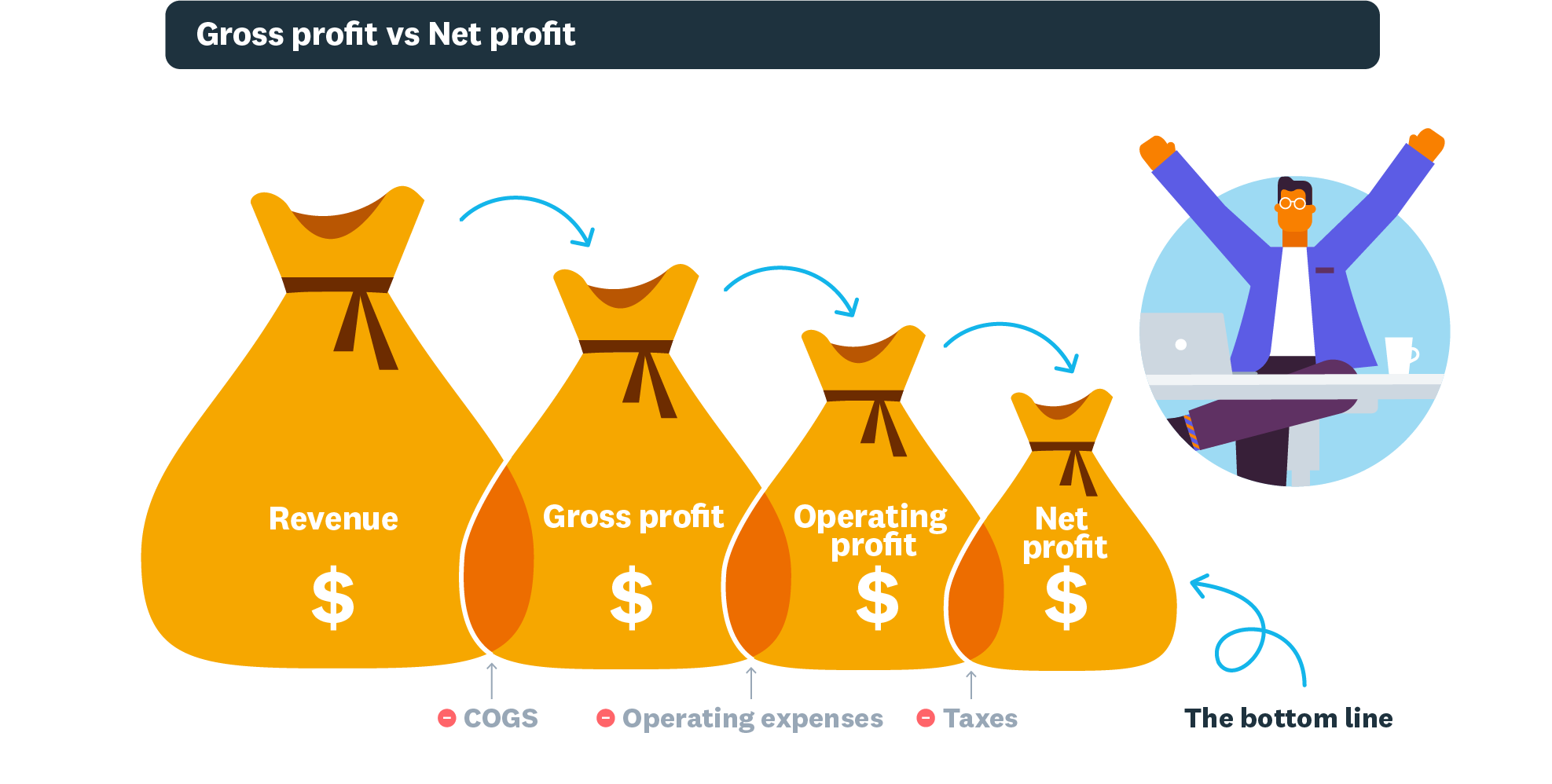
The difference between gross profit and net profit is operating expenses and taxes
Key takeaways
- Gross profit is revenue minus COGS, and it shows whether your prices cover the direct cost of what you sell
- Net profit is what's left after every expense, including loan interest and tax
- Operating profit sits between the two and shows how your core business performs before interest and tax
- Malaysian income tax is charged on chargeable income, which sits much closer to net profit than gross profit
What is gross profit?
Gross profit is the money left from your revenue after you pay the direct costs of what you sell. Net profit is what's left after every expense, including interest and tax.
So gross profit vs net profit comes down to which costs you subtract. The direct costs are known as cost of goods sold (COGS), and gross profit shows whether each sale covers them with room to spare.
Picture a nasi lemak stall: gross profit is what's left after rice, eggs, sambal and banana leaves, before stall rent or the electricity bill. A healthy gross profit is a strong start, and net profit confirms whether the whole business makes money.
What's included in COGS and what isn't
COGS includes only the costs tied directly to making or delivering what you sell. Every other cost of running the business is an operating expense and sits below gross profit.
Here's what a bakery would usually count as COGS.
- Ingredients such as flour, butter, sugar and eggs
- Packaging such as cake boxes and labels
- Wages for the bakers who make the products
- Shipping costs tied to specific customer orders
These costs sit outside COGS because they keep the business running rather than go into each product.
- Rent for your shop or office
- Utilities such as electricity and water
- Marketing and advertising
- Insurance
- Wages for admin and sales staff
- Loan interest and tax
For a service business, COGS is mostly the labour spent delivering client work. Putting each cost in the right group keeps your gross profit accurate, so you can see whether pricing or overheads need attention.
Gross profit formula
To calculate gross profit, subtract COGS from your revenue for the same period. The Corporate Finance Institute sets out the standard formula:
Gross profit = Revenue − COGS
Say you run a small bakery in Kuala Lumpur. This month, your sales bring in RM25,000, and your COGS, including ingredients and your bakers' wages, comes to RM10,000.
Your gross profit is RM25,000 − RM10,000 = RM15,000. That RM15,000 has to cover every other cost, and anything left over becomes net profit.
What is net profit?
Net profit is what remains after you subtract all your business expenses from revenue, including COGS, operating expenses, interest and tax. It's often called your bottom line because it's the last figure on your profit and loss statement.
A positive net profit means your business earns more than it spends. Lenders and investors watch it closely, and it's the starting point for the tax you pay the Inland Revenue Board of Malaysia (LHDN).
For the years of assessment (YA) 2025 and 2026, qualifying small and medium enterprise (SME) companies pay 15% on their first RM150,000 of chargeable income. They pay 17% on the next RM450,000 and 24% above that. Eligible firms need paid-up capital of RM2.5 million or less and gross business income up to RM50 million, plus other conditions, per PwC Worldwide Tax Summaries.
Sole proprietors pay progressive individual rates instead, which reach 30% on chargeable income above RM2,000,000, as PwC's individual tax summary shows. The Ministry of Finance will table Budget 2027 on 9 October 2026, so check for rate changes after that date.
Net profit formula
To calculate net profit, take your gross profit and subtract every remaining expense, including interest and tax. The Corporate Finance Institute's net income definition uses the same approach:
Net profit = Revenue − COGS − Operating expenses − Interest − Tax
Your Kuala Lumpur bakery made RM15,000 in gross profit. Here are its other costs for the month.
- RM3,000 for rent
- RM500 for utilities
- RM800 for marketing
- RM400 for insurance
- RM4,000 for admin wages
- RM600 for loan interest
- RM1,200 for tax
That's RM10,500 in extra expenses, so your net profit is RM15,000 − RM10,500 = RM4,500. The bakery keeps RM4,500 of its RM25,000 in sales once every cost is paid.
Only the interest on your loan belongs in this list. Repaying the loan principal reduces the debt on your balance sheet and stays off your income statement, as AccountingCoach explains.
Key differences between gross profit and net profit
The main difference is the costs you subtract: gross profit removes only COGS, while net profit removes every expense. Here's how the two compare in practice.
- Gross profit measures how efficiently you make or deliver your product, while net profit measures overall profitability
- Gross profit subtracts COGS only, while net profit also subtracts every other expense
- Gross profit shows whether your prices cover production costs, while net profit shows whether the whole business earns money
- Gross profit appears near the top of your profit and loss statement, while net profit sits at the bottom
Both figures appear on the same statement under Malaysia's reporting frameworks. Public companies use the Malaysian Financial Reporting Standards (MFRS), and SMEs can use the Malaysian Private Entities Reporting Standard (MPERS), says the IFRS Foundation.
Operating profit: the step between gross and net profit
Operating profit is what's left after you subtract COGS and operating expenses, but before interest and tax. It sits between gross profit and net profit on your income statement, as the Corporate Finance Institute's guide to operating income sets out.
Because it leaves out interest and tax, operating profit shows how the day-to-day business performs, whatever its financing. It's also called earnings before interest and taxes (EBIT).
Here's how the bakery's figures flow from gross profit down to net profit.
- Gross profit of RM15,000, after RM10,000 in COGS
- Operating profit of RM6,300, after RM8,700 in operating expenses
- Profit before tax of RM5,700, after RM600 in loan interest
- Net profit of RM4,500, after RM1,200 in tax
That gives the bakery an operating profit margin of 25.2% (RM6,300 ÷ RM25,000). Comparing operating profit with net profit shows how much interest and tax take from each month's earnings.
Why a business can have high gross profit but low net profit
A business can have high gross profit but low net profit when overheads and financing costs absorb most of what's left after COGS. Gross profit is almost always the higher figure, because net profit takes out these extra costs.
The gap tends to widen in these situations.
- Rent rises faster than sales, such as after a move to a bigger shop
- Admin and management wages grow ahead of revenue
- Heavy borrowing adds large monthly interest costs
- Marketing spend climbs faster than the sales it brings in
In the bakery example, a 60% gross margin becomes an 18% net margin once the remaining costs are paid. Keep an eye on cash too, since loan principal repayments leave your bank account without reducing net profit.
Why gross profit and net profit both matter for your business
Gross profit and net profit matter together because each one points to a different fix. Gross profit points to pricing and production, while net profit points to overheads and financing.
If gross profit shrinks, your suppliers may have raised prices or your product mix may have shifted. If net profit shrinks while gross profit holds steady, your overheads are the place to look.
Lenders and investors review both figures when you apply for a business loan or raise funds, often through profitability ratios. Gross profit shows the strength of your core offer, and net profit shows whether the whole operation is sound.
How to calculate gross and net profit
You can calculate gross and net profit in five steps using your own figures for a set period. Work through them in order, since each step builds on the last.
1. Add up your total revenue
Start with all the income your business earned in the period, from product and service sales plus any other business income. If you're unsure what counts, get clear on what revenue includes first.
2. Calculate your cost of goods sold
Add up the direct costs of making or delivering what you sell. That usually means raw materials, direct labour, packaging and shipping tied to each order.
3. Subtract COGS from revenue to get gross profit
The result is your gross profit, the amount available before operating expenses. A low or negative figure is a signal to review your pricing or production costs.
4. Add up all remaining expenses
List every other cost, such as rent, utilities, marketing, insurance, non-production wages, depreciation, loan interest and tax. Include the interest on any loan, and leave principal repayments out.
5. Subtract total expenses from revenue to get net profit
Subtract COGS and all remaining expenses from revenue. What's left is your net profit, the amount your business earned after every cost.
With Xero, your profit and loss report breaks down your revenue and costs for you. You can see gross and net profit without doing the sums by hand.
Gross profit margin vs net profit margin
Gross profit margin shows gross profit as a percentage of revenue, while net profit margin does the same for net profit. Percentages make it easier to compare one month with another, or your business with others.
Gross profit margin = (Gross profit ÷ Revenue) × 100
For the bakery, (RM15,000 ÷ RM25,000) × 100 = 60%. So 60 sen of every ringgit in sales is left to cover the other costs.
Net profit margin = (Net profit ÷ Revenue) × 100
For the bakery, (RM4,500 ÷ RM25,000) × 100 = 18%. That means 18 sen of every ringgit is profit once every expense is paid.
What counts as a good net margin depends on your industry. A general US rule of thumb from Brex rates 5% as low, 10% as healthy and 20% as high. Treat these as a rough guide, since they aren't Malaysian averages.
Tracking both margins over time shows whether your business is becoming more efficient. For industry context and practical tips, read about how to calculate and improve profit margins.
How to improve your gross profit
You can improve gross profit by earning more per sale or lowering the direct cost of each product. These steps focus on pricing and COGS.
- Review your prices regularly so they keep pace with rising COGS
- Negotiate bulk discounts with suppliers, or compare quotes from other suppliers
- Reduce waste and spoilage with tighter inventory management
- Speed up production so each item uses less direct labour
- Shift your sales mix towards higher-margin products or services
How to improve your net profit
You can improve net profit by lowering overheads and growing revenue faster than costs. Small changes across several areas can increase profits over a full year.
- Cancel subscriptions and services you rarely use
- Automate bookkeeping tasks like invoicing and bank reconciliation to cut admin hours
- Review expenses every month to spot rising costs early
- Work with a tax agent or accountant to claim all allowable deductions
- Upsell to existing customers or raise prices where your value supports it
Track your gross and net profit with Xero
Knowing both profit figures helps you set prices and control overheads with confidence. Xero's profit and loss report reflects your latest reconciled transactions, so you can check where you stand whenever you need to.
Try Xero today and get one month free.
FAQs on gross profit vs net profit
Here are quick answers to common questions about gross profit and net profit.
Does gross profit include wages?
It depends on the role: wages for staff who make your product or deliver your service go into COGS and reduce gross profit. In a service business, the wages of staff doing client work often make up most of COGS.
What is a good gross profit margin?
NYU Stern's January 2026 data on US public companies shows gross margins of 26.31% in grocery retail, 32.24% in restaurants and 71.72% in software. These are US figures, not Malaysian averages, so also track your own gross profit margin over time.
Can gross profit be negative?
Yes, gross profit turns negative when COGS is higher than revenue. Each sale then costs more to produce than it brings in, so your pricing or supplier costs need urgent attention.
Is net profit the same as cash flow?
No, net profit records income and expenses when they're earned or incurred, while cash flow tracks money moving in and out of your bank. Unpaid customer invoices and non-cash costs like depreciation both make the two figures differ.
Do non-operating expenses affect gross profit?
No, non-operating expenses such as loan interest sit below operating profit, so they reduce net profit and leave gross profit unchanged. Two businesses with the same gross profit can report very different net profit for this reason.
Do you pay tax on gross or net profit in Malaysia?
Under the Income Tax Act 1967, LHDN taxes chargeable income, meaning business income after allowable deductions, which sits much closer to net profit. Companies self-assess and report chargeable income and tax payable in their annual return, according to PwC's Malaysia tax administration summary.
Related terms
Learn more about gross profit vs net profit
Handy resources
Advisor directory
You can search for experts in our advisor directory
Xero Small Business Guides
Discover resources to help you do better business
Financial reporting
Keep track of your performance with accounting reports
Disclaimer
This glossary is for small business owners. The definitions are written with their requirements in mind. More detailed definitions can be found in accounting textbooks or from an accounting professional. Xero does not provide accounting, tax, business or legal advice.