Net profit margin
Learn what net profit margin is, how to calculate it, and what a healthy margin looks like for your business.
Published Monday 17 August 2026
Table of contents

How to calculate net profit margin
Key takeaways


- Net profit margin is the percentage of revenue your business keeps as profit after all expenses, interest and taxes are deducted.
- The formula is (net profit ÷ revenue) × 100, giving you a clear percentage to track over time.
- A "good" net profit margin varies by industry, but as a general rule of thumb, around 10% is considered average while 20% or more is strong.
- Tracking your net profit margin helps you understand your true profitability and make informed pricing and cost decisions.
What is net profit margin?
Net profit margin is the percentage of revenue a business keeps as profit after deducting all expenses, interest and taxes. It's often called the "bottom line" expressed as a percentage, giving you a clear picture of how much of each ringgit earned actually stays in your pocket.
This metric goes beyond surface-level figures. While revenue shows how much money comes in, net profit margin reveals what you truly retain. For small business owners, it's one of the most reliable ways to measure overall financial health, alongside other profitability ratios.
Handy resources
Advisor directory
You can search for experts in our advisor directory
Profit & Loss template
Download Xero’s profit and loss statement template to show how much money your business is making
Financial reporting
Keep track of your performance with accounting reports
Disclaimer
This glossary is for small business owners. The definitions are written with their requirements in mind. More detailed definitions can be found in accounting textbooks or from an accounting professional. Xero does not provide accounting, tax, business or legal advice.
Net profit margin formula
Calculating your net profit margin is straightforward once you know your net profit and total revenue. The formula gives you a percentage that you can use to compare performance over time or against others in your industry.
Net profit margin = (net profit ÷ revenue) × 100
Net profit is your revenue minus cost of goods sold (COGS), operating expenses, interest and taxes.
How to calculate net profit margin
Follow these steps to work out your net profit margin. You'll need your total revenue and a breakdown of all your costs for the period, which you can pull together when you measure your profitability.
- Calculate your net profit by subtracting COGS, operating expenses, interest and taxes from your total revenue.
- Divide your net profit by your total revenue.
- Multiply the result by 100 to get your net profit margin as a percentage.
Example of a net profit margin calculation
Suppose you run a small office cleaning business in Malaysia. In one month, you earn RM20,000 in revenue from cleaning contracts. Your cost of goods sold (cleaning supplies, equipment) totals RM8,000, leaving you with a gross profit of RM12,000.
From that gross profit, you pay RM3,000 in operating expenses (wages, transport, utilities) and RM4,000 in taxes. Your net profit is RM12,000 − RM3,000 − RM4,000 = RM5,000.
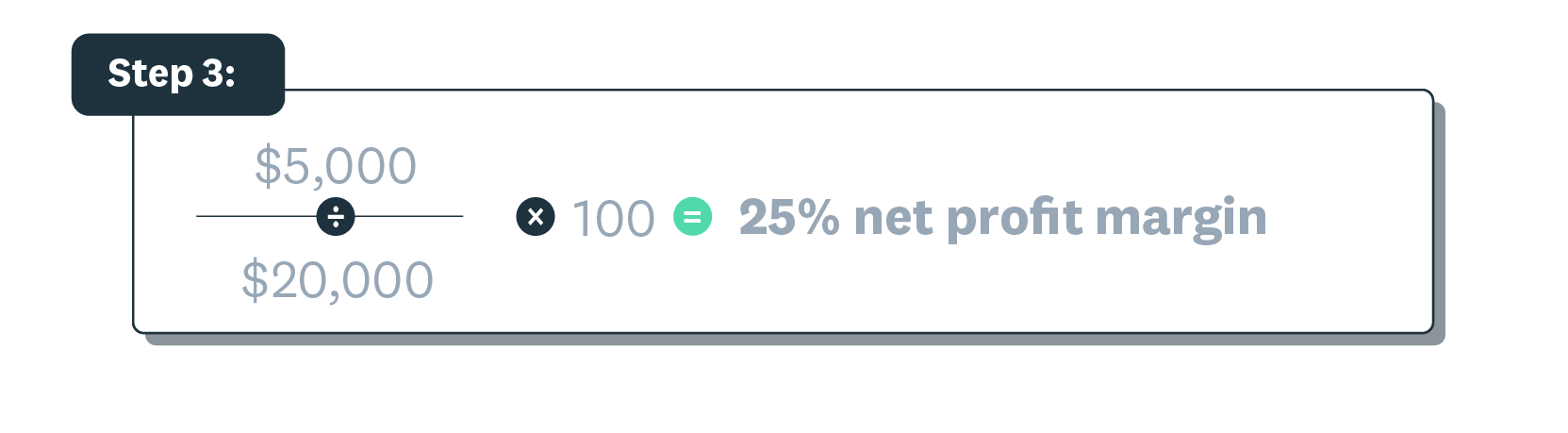
To find your net profit margin, divide RM5,000 by RM20,000 and multiply by 100. That gives you a net profit margin of 25%. This means you keep 25 sen of every ringgit earned after covering all your costs.
What is a good net profit margin?
There's no single answer to what counts as a "good" net profit margin, but general benchmarks can help you gauge where you stand.
- Around 5% is considered low and may signal tight margins or high costs.
- Around 10% is average and suggests a healthy, sustainable business.
- 20% or more is strong and indicates solid profitability.
Keep in mind that acceptable margins vary widely by industry. A grocery retailer might operate on thin margins of 2–3%, while a consultancy could see margins above 20%. Compare your margin to businesses similar to yours, and to your wider profit margins, for a more meaningful picture.
Net profit margin vs gross and operating profit margin
Net profit margin is one of several profitability ratios. Understanding how it differs from gross and operating profit margin helps you see which costs are affecting your bottom line.
- Gross profit margin measures revenue minus cost of goods sold only. It shows how efficiently you produce or deliver your product or service.
- Operating profit margin measures revenue minus COGS and operating expenses, but before interest and taxes. It reflects the profitability of your core operations.
- Net profit margin measures revenue minus all expenses, including COGS, operating expenses, interest and taxes. It captures your true bottom-line profitability.
Of the three, net profit margin gives you the most complete view of how much profit your business actually keeps.
Why net profit margin matters
Your net profit margin is a window into your business's financial health. It tells you whether your pricing covers all your costs and leaves room for growth. Lenders and investors often look at this metric when assessing your business, so a healthy margin can open doors to funding.
Beyond external scrutiny, tracking your margin helps you make smarter decisions. If margins are shrinking, you know to review your expenses or revisit your pricing to increase your profits. A higher margin isn't automatically better, however. Aggressive cost-cutting can harm quality or growth. The key is to track your margin over time and compare it within your industry to spot trends and opportunities.
Track your net profit margin with Xero
Xero accounting software gives you real-time visibility into your profitability. With automated bank feeds and clear financial reports, you can see your net profit margin at a glance and spot changes before they become problems. Ready to take control of your numbers? Get one month free and see how Xero helps small businesses stay on top of their finances.
FAQs on net profit margin
Here are answers to common questions about net profit margin.
How do you calculate net profit margin?
Divide your net profit by your total revenue, then multiply by 100. Net profit is what remains after subtracting COGS, operating expenses, interest and taxes from revenue.
What is a good net profit margin?
It depends on your industry. As a general rule, around 10% is considered average and 20% or more is strong, but some industries naturally operate on thinner margins.
What is the difference between gross profit margin and net profit margin?
Gross profit margin only accounts for cost of goods sold, while net profit margin includes all expenses such as operating costs, interest and taxes. Net profit margin gives a fuller picture of profitability.
What does net profit margin tell you?
It shows what percentage of your revenue you keep as profit after all costs. A higher margin generally indicates better efficiency in turning sales into actual profit.
Is a higher net profit margin always better?
Not necessarily. A very high margin could mean you're underinvesting in growth or quality. The goal is a sustainable margin that supports your business objectives, tracked over time against industry peers.