Liquidity vs solvency: what’s the difference?
Learn how liquidity vs solvency helps you protect cash flow, fund growth, and keep lenders confident.

Written by Lena Hanna—Trusted CPA Guidance on Accounting and Tax. Read Lena's full bio
Published Saturday 21 February 2026
Table of contents
Key takeaways
- Monitor both liquidity and solvency regularly since they measure different aspects of financial health—liquidity shows if you can pay bills in the next 12 months, while solvency reveals whether your total assets exceed total debts for long-term stability.
- Calculate your current ratio by dividing current assets by current liabilities to assess liquidity, aiming for a ratio above 1.0, and your solvency ratio by dividing net income plus depreciation by total liabilities, targeting 20% or higher.
- Improve liquidity by speeding up customer payments through early payment discounts and building cash reserves, while strengthening solvency by attracting investors, renegotiating debt terms, and cutting unnecessary expenses.
- Recognise that a business can be liquid but not solvent or vice versa—having cash on hand doesn't guarantee long-term survival, just as owning valuable assets doesn't help pay immediate bills if they can't be quickly converted to cash.
Liquidity vs solvency: understanding the difference
Liquidity measures whether your business can pay its bills over the next 12 months. Solvency measures whether your business can meet its financial obligations over the long term.
Both metrics matter, but they answer different questions:
- Liquidity: Do you have enough cash or quick-to-sell assets to cover short-term expenses like payroll, rent, and supplier invoices?
- Solvency: Are your total assets worth more than your total debts? Can your business survive financially for years to come?
A business needs both to thrive. Strong liquidity keeps daily operations running smoothly. Strong solvency signals long-term stability to lenders, investors, and partners.
What does liquidity mean in business?
Current assets include:
- cash in the bank
- inventory you can sell
- payments customers owe you
- any assets you can convert to cash quickly
Liquidity is commonly expressed as a ratio, such as the current ratio, quick ratio, or cash ratio.
How liquid are your assets?
Some assets convert to cash faster than others. Here's how common business assets rank by liquidity:
- Cash: Your most liquid asset. Physical currency and bank funds you can withdraw immediately.
- Inventory: Stock you can sell. Liquidity depends on how quickly items move.
Other liquidity ratios
The current ratio is the most common liquidity measure for small businesses, but two other ratios offer different perspectives:
- Quick ratio (acid test ratio): Measures assets you can convert to cash within 90 days. Formula: (cash + short-term investments + accounts receivable) ÷ current liabilities.
- Cash ratio: The strictest liquidity measure, using only cash. Formula: cash and cash equivalents ÷ current liabilities.
Liquidity vs other financial concepts
Liquidity is often confused with related financial terms. Here's how they differ:
- Liquidity: Whether you can cover upcoming costs with current assets.
- Cash flow: The movement of money in and out of your business over time.
- Working capital: The money left after subtracting current liabilities from current assets.
- Free cash flow: Cash remaining after you've made capital investments.
How does liquidity affect business growth?
Strong liquidity supports business growth by helping you:
- Seize opportunities: Have cash ready to launch products or hire staff.
- Handle emergencies: Cover unexpected costs like equipment repairs or property damage.
- Maintain stability: Avoid scrambling for cheaper suppliers or alternative financing.
What does solvency mean in business?
Solvency refers to your business's ability to meet long-term financial commitments. A solvent business has positive net equity, meaning total assets exceed total liabilities.
Put simply: if you sold everything your business owns and paid off all debts, would there be money left over? If yes, your business is solvent.
What factors affect your solvency?
To keep your business solvent, focus on three areas:
- Stay profitable: Generate consistent profits to keep total assets above total liabilities.
- Manage your debts: Negotiate repayment terms and understand the consequences of missed payments, especially for secured loans.
- Use assets wisely: Make sure your assets generate enough returns to cover your debts. Track inventory to reduce waste and improve efficiency.
What is solvency vs profitability?
Solvency measures your ability to pay debts over time. Profitability measures how much you earn compared to your costs.
A profitable business has a better chance of staying solvent because profits build assets. However, poor debt management can undermine profitability.
For example, taking on new loans without paying off existing ones can push total liabilities above total assets, leading to insolvency.
How does solvency affect your business growth?
A solvent business can more easily:
- Secure loans: Lenders feel confident you'll repay them.
- Attract investors: Strong finances draw partners with resources and expertise.
- Negotiate supplier deals: Cash reserves let you buy in bulk at lower per-unit costs.
- Plan for growth: Financial stability supports long-term decision-making.
The main differences between solvency and liquidity
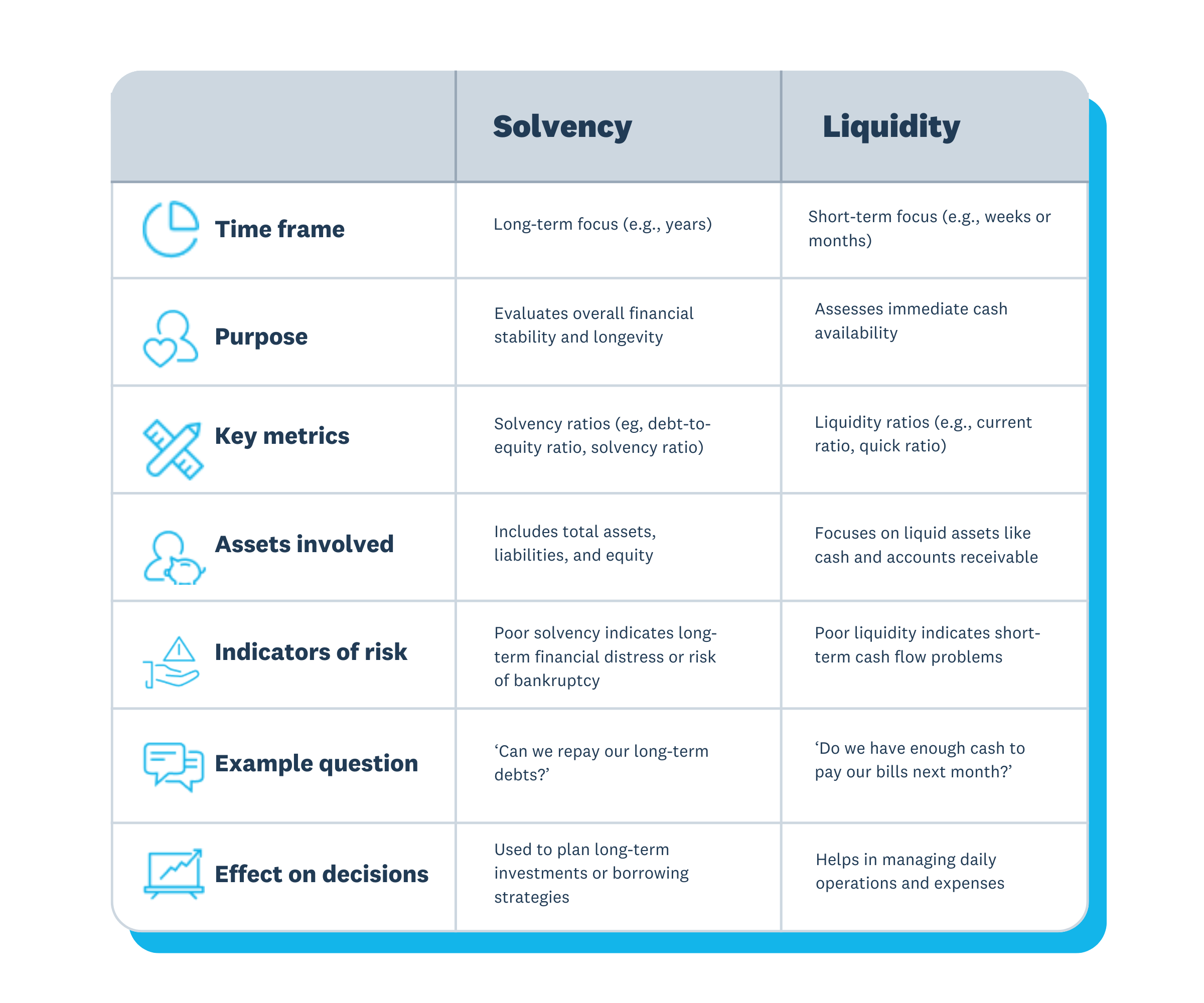
Table of the difference between solvency and liquidity
Solvency takes a long-term view of financial health, while liquidity focuses on the short term. Here's how they compare:
- Time horizon: Liquidity covers the next 12 months. Solvency covers years or the life of your business.
- What it measures: Liquidity compares current assets to current liabilities. Solvency compares total assets to total liabilities.
- Key question: Liquidity asks "Can I pay this month's bills?" Solvency asks "Can my business survive long-term?"
- Warning signs: Low liquidity signals cash flow challenges. Low solvency signals financial risk.
- Who cares: Suppliers and employees watch liquidity. Banks and investors focus on solvency.
Monitor both metrics regularly to maintain a clear picture of your financial health.
Can a business be liquid but not solvent (or vice versa)?
Yes. A business can have strong liquidity but weak solvency, or the reverse. Here's how each scenario works.
Liquid but not solvent
A business might have plenty of cash on hand (high liquidity) but still owe more than it owns overall (low solvency).
Example: A startup receives a large funding round and has $200,000 in the bank. However, it has $500,000 in long-term debt and only $250,000 in total assets. It can pay this month's bills easily, but its total liabilities exceed its assets, making it technically insolvent.
Solvent but not liquid
A business might own valuable assets that exceed its debts (high solvency) but lack ready cash to pay immediate bills (low liquidity).
Example: A property management company owns buildings worth $2 million with only $500,000 in total debt, making it highly solvent. However, most of its cash is tied up in property. When a major repair bill arrives, it needs time to free up funds because property takes longer to convert to cash.
Both situations require attention. Monitoring liquidity and solvency together gives you the full picture of your financial health.
How to measure solvency and liquidity in your business
Calculating your solvency and liquidity ratios gives you a clear, objective view of your financial position. Here's how to work out each one.
Solvency ratio formula
Here's how to calculate your solvency ratio using a real example.
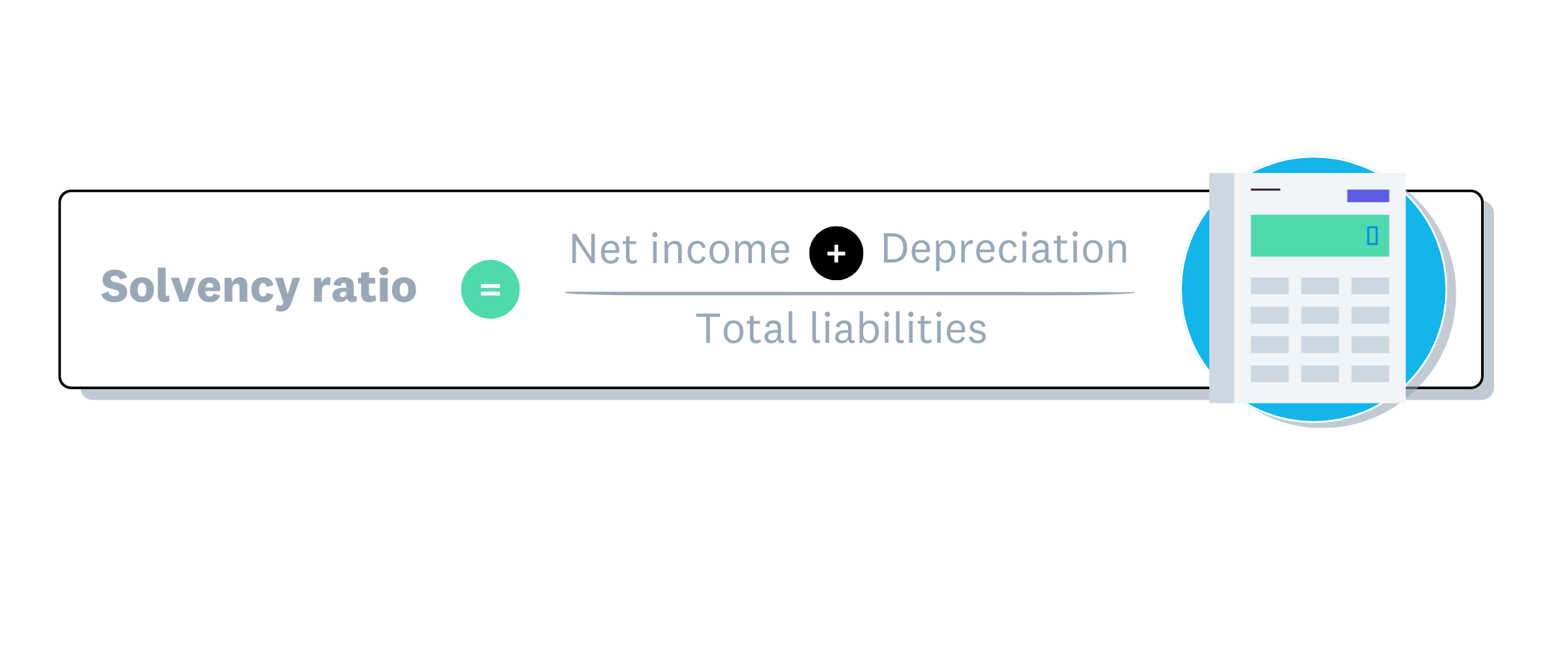
Solvency ratio formula
Martha owns a cafe with:
- Net income: $50,000
- Depreciation: $10,000
- Total liabilities: $300,000
Calculation: ($50,000 + $10,000) ÷ $300,000 = 20%
A solvency ratio of 20% or above is generally considered healthy. Martha's cafe has a good chance of meeting its long-term debt obligations.
Depreciation reflects how asset value changes over time due to normal wear and tear.
Liquidity ratio formula
The most common liquidity measure is the current ratio. Here's how to calculate it.

Sadiq runs a sports shop with:
- Current assets: $120,000
- Current liabilities: $80,000
Calculation: $120,000 ÷ $80,000 = 1.5
A current ratio above 1.0 indicates good liquidity. Sadiq's ratio of 1.5 means he can likely meet his short-term financial commitments.
Why solvency and liquidity matter for your small business
Understanding both metrics helps you make better decisions for daily operations and long-term planning.
Why solvency matters:
- A solvent business is financially stable and can manage risks like delayed payments.
- Strong solvency helps you access funding, attract investors, and plan for growth.
- Maintaining solvency helps you pay debts on time and avoid financial distress.
Why liquidity matters:
- A liquid business can pay staff, suppliers, and bills on time.
- Strong liquidity protects against unexpected costs, slow periods, and market changes.
- Strong liquidity depends on timely customer payments, which keeps cash flow healthy.
Tips to improve your financial solvency and liquidity
Here are practical ways to strengthen both metrics.
To improve solvency:
- Attract investors: Bring in capital to boost your asset base.
- Renegotiate debt terms: Lower interest rates or extend repayment periods to improve your liability position.
- Review your cost structure: Identify areas to cut expenses and improve profitability.
To improve liquidity:
- Monitor cash flow regularly: Plan payments around when money comes in.
- Speed up customer payments: Offer early payment discounts or make invoicing easier.
- Build a cash reserve: Set aside funds for unexpected expenses.
- Benchmark against your industry: Compare your ratios to similar businesses to identify opportunities for improvement.
Track your financial health with Xero
Track liquidity and solvency regularly to spot issues early and make confident decisions.
With real-time financial reporting, you get instant visibility into both your daily cash position and long-term financial health. See what's coming in, what's going out, and whether your business is on solid ground.
Get one month free and start monitoring your financial health today.
FAQs on solvency and liquidity
Here are answers to common questions about measuring and managing your business's financial health.
What does it mean to provide liquidity?
To provide liquidity means ensuring your business has enough cash to cover short-term obligations. You can do this by improving cash flow, such as offering early payment discounts to customers.
Can my business have good solvency but poor liquidity?
Yes. A business can be solvent (total assets exceed total liabilities) while struggling with liquidity (limited cash on hand). For example, owning valuable property doesn't help pay this month's bills if you can't quickly convert it to cash.
What is a good solvency ratio for my small business?
A solvency ratio of 20% or higher is generally considered healthy, though benchmarks vary by industry. Compare your ratio to similar businesses to get a clearer picture.
Which is more important for small businesses: liquidity or solvency?
Both matter, but liquidity often needs more day-to-day attention. Low liquidity can force you to close even if your business is technically solvent. Monitor liquidity weekly or monthly, and review solvency quarterly or annually.
What happens if my business becomes insolvent?
Insolvency means your total liabilities exceed your total assets. Addressing this early helps you secure loans, maintain creditor relationships, and protect your business. If you're approaching insolvency, seek advice from an accountant or financial advisor to explore your options.
Start using Xero for free
Access Xero features for 30 days, then decide which plan best suits your business.