Accounting period
Learn what an accounting period is, its main types, and how it works for Hong Kong businesses.
Published Friday 24 July 2026
Table of contents
Key takeaways
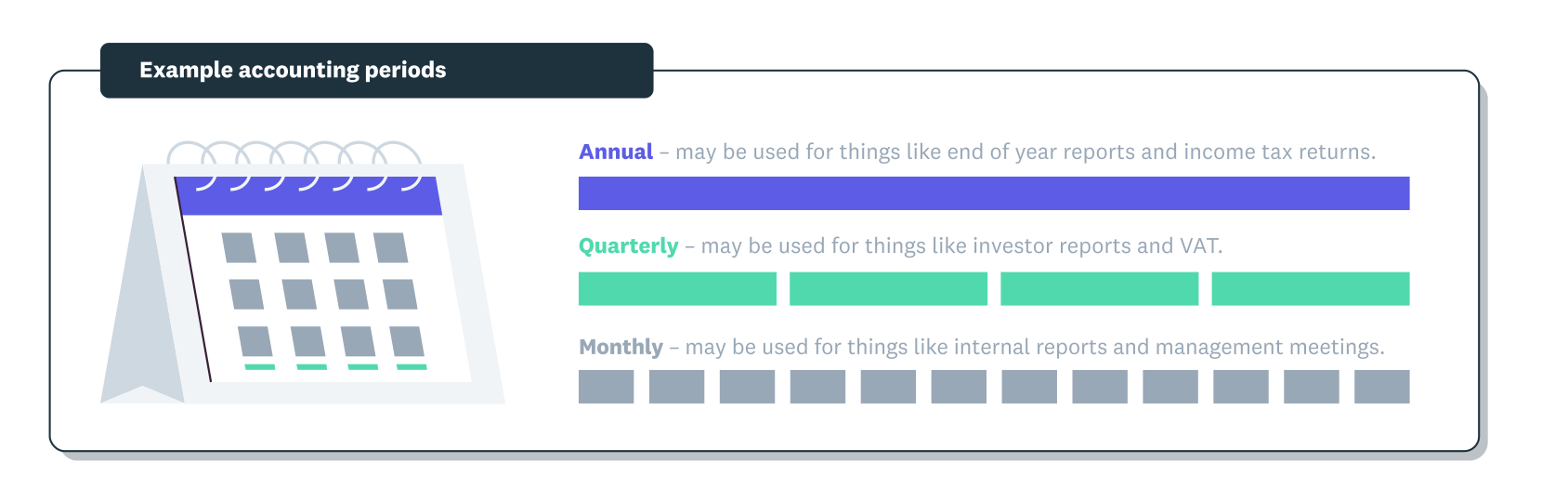
Annual accounting periods don’t have to start in January. Nor do monthly accounting periods have to start on the first of the month.
- An accounting period is any time frame used for financial reporting, and it's often 12 months long.
- Common types include the calendar year, a financial (fiscal) year, and monthly or quarterly periods.
- Many Hong Kong companies set their financial year end at 31 December or 31 March.
- The Inland Revenue Department (IRD) assesses profits tax on your accounting period once you close the books.
What is an accounting period?
An accounting period is any time frame used for financial reporting. Transactions that fall within a given date range form part of the statements or reports for that accounting period.
An accounting period is often 12 months long, and you'll also see it called a reporting period. For example, the IRD assesses your Hong Kong profits tax on the accounting period your business reports. Getting comfortable with periods is a core part of small business accounting.
Handy resources
Advisor directory
You can search for experts in our advisor directory
Xero Small Business Guides
Discover resources to help you do better business
Try Xero for free
Try Xero’s fast, simple, powerful online accounting software for your small business
Disclaimer
This glossary is for small business owners. The definitions are written with their requirements in mind. More detailed definitions can be found in accounting textbooks or from an accounting professional. Xero does not provide accounting, tax, business or legal advice.
Types of accounting periods
Handy resources
Advisor directory
You can search for experts in our advisor directory
Xero Small Business Guides
Discover resources to help you do better business
Try Xero for free
Try Xero’s fast, simple, powerful online accounting software for your small business
Accounting periods come in a few common lengths, and you can pick what suits your business. Here are the main types you'll come across.
- Calendar year: runs from 1 January to 31 December
- Financial year (fiscal year): any 12 consecutive months, and it doesn't have to start in January
- Monthly period: covers a single month, and it doesn't have to start on the first of the month
- Quarterly period: covers 3 months, and it's often used for interim reporting
Why accounting periods matter
Accounting periods give your numbers a consistent shape, so you can see how your business is really doing. They matter for a few reasons.
- Comparing performance: you can measure one period against another to spot trends
- Reporting consistently: you record transactions in set windows, so your reports stay reliable
- Meeting tax obligations: you file and pay profits tax based on your accounting period
Accounting periods and the financial year end in Hong Kong
If you run a company in Hong Kong, your accounting period is closely tied to your financial year end and your tax filing. Here's how it works locally.
The Hong Kong Government fiscal year runs from 1 April to 31 March. Many companies set their own financial year end at 31 December, matching the calendar year, or at 31 March, aligning with the Government year.
Under the Companies Ordinance, your company's first financial year end should fall within 18 months of incorporation. The IRD then issues a Profits Tax Return and assesses your profits tax on that accounting period.
What happens at the end of an accounting period
When an accounting period closes, you tidy up your records and report on the results. This is where steady bookkeeping through the year pays off.
First you close the books, which means finalising every transaction for the period. Then you prepare your financial statements to show how the business performed. You'll typically prepare 3 core statements.
- Income statement: shows your revenue and expenses over the period
- Balance sheet: shows what you own and owe at the period end
- Cash flow statement: shows how cash moved in and out of the business
Changing your accounting period or financial year end
Your accounting period isn't fixed forever, and you can change your financial year end if your circumstances shift. There are a couple of things to keep in mind.
In Hong Kong, changing your financial year end is permitted under the Companies Ordinance when you have valid reasons. The IRD may review the change for its tax implications, so it's worth planning ahead.
Track every accounting period with Xero
Xero brings your transactions, reconciliations and reports together, so each accounting period stays organised from start to close. See how Xero keeps every accounting period organised and reconciled, and get one month free to try it for your business.
FAQs on accounting periods
Here are answers to frequently asked questions about accounting periods.
Is an accounting period always 12 months?
No, an accounting period can be any length you choose for reporting. Many businesses use 12 months, but monthly and quarterly periods are also common.
What is the difference between an accounting period and a financial year?
A financial year is a specific 12-month accounting period used for annual reporting. An accounting period is the broader term, and it can cover any length of time.
What financial year end do most Hong Kong companies use?
Many Hong Kong companies choose 31 December, matching the calendar year, or 31 March, aligning with the Government fiscal year.
What happens at the end of an accounting period?
You close the books and prepare your financial statements, including the income statement, balance sheet and cash flow statement. These show how your business performed over the period.
Can you change your accounting period in Hong Kong?
Yes, you can change your financial year end under the Companies Ordinance when you have valid reasons. The IRD may review the change for its tax implications.