What is owner's equity?
Learn what owner's equity means, how to calculate it, and why it matters to your business.
Written by Lena Hanna—Trusted CPA Guidance on Accounting and Tax. Read Lena's full bio
Published Monday 15 June 2026
Table of contents
Key takeaways
- Owner's equity is the value of your business after subtracting all liabilities from all assets. Calculating it regularly gives you a clear picture of what your business is truly worth.
- Growing equity signals a healthy business that's building value over time, while shrinking or negative equity is a warning to review expenses, boost revenue, or reduce debt.
- Your statement of changes in equity shows exactly what caused your equity to rise or fall during a period, including profits earned, money invested, and withdrawals taken.
- Banks and investors review your equity position when deciding whether to lend to or invest in your business, so keeping it strong supports your funding options.
What is owner's equity?
Owner's equity is the value of your business that belongs to you after paying off all debts. It's the foundation of understanding your business's financial position.
The Australian Accounting Standards Board (AASB) defines equity as the residual interest in the assets of an entity after deducting all its liabilities. In plain terms, it represents your ownership stake, calculated by subtracting what you owe from what you own. This concept sits at the heart of the accounting equation: Assets = Liabilities + Owner's Equity.
Think of it like home ownership. If your house is worth $500,000 and you still owe $200,000 on the mortgage, your equity in the home is $300,000. The same principle applies to your business.
Owner's equity shows up on your balance sheet and changes over time as your business earns profits, takes on debt, or pays out withdrawals. It's sometimes called net worth, net assets, or shareholders' equity (in companies with multiple owners).
How to calculate owner's equity (or net worth)
Owner's equity equals your total assets minus your total liabilities. This formula shows what your business is worth after all debts are paid.
Owner's equity = Assets - Liabilities

Follow these 3 steps to calculate your owner's equity.
1. Add up all your assets
Assets are everything your business owns that has value. This includes both tangible items and intangible property.
Common business assets include:
- Cash in bank accounts and on hand
- Equipment, vehicles, machinery, and tools
- Property and real estate
- Inventory and products available for sale
- Accounts receivable (money customers owe you)
- Intellectual property, patents, and brand value
2. Add up all your liabilities
Liabilities are everything your business owes to others. These are debts and obligations that must be paid.
Common business liabilities include:
- Bank loans and lines of credit
- Accounts payable (money owed to suppliers)
- Credit card balances
- Wages payable to employees
- Tax obligations, including goods and services tax (GST) and income tax
3. Subtract liabilities from assets
Take your total assets and subtract your total liabilities. The result is your owner's equity.
For example, if your business has $500,000 in total assets and $200,000 in total liabilities, your owner's equity is $300,000.
What are the main components of owner's equity?
Understanding the components of owner's equity helps you track how your business value changes over time. For most small businesses, four main components determine your total equity position.
The main components are:
- Initial investment: the money you put in when starting the business. This could be cash, equipment, or other assets you contributed from the outset.
- Retained earnings: profits the business has earned and kept rather than distributing to owners. These accumulated profits are a major driver of equity growth over time.
- Additional investments: extra money or assets you've added to the business after the initial setup. These top-ups increase your equity balance.
- Owner withdrawals (drawings): money or assets you've taken out of the business for personal use. Every withdrawal reduces your equity.
Examples of owner's equity
Owner's equity works the same way whether you're calculating personal wealth or business value. Here's how the formula applies in practice at different stages.
Personal example: If you own a house worth $600,000 with a $250,000 mortgage, your equity is $600,000 - $250,000 = $350,000.
New business example
Sarah opens a graphic design studio and invests $30,000 in cash plus $10,000 in computer equipment.
- Total assets: $40,000 (cash + equipment)
- Total liabilities: $0
- Owner's equity: $40,000
At this stage, Sarah's equity equals her initial investment because she hasn't taken on any debt.
Growing business example
After 2 years, Sarah's studio has grown. She took out a $20,000 business loan to expand and has built up accounts receivable from clients.
- Total assets: $95,000 (cash $30,000 + equipment $15,000 + accounts receivable $50,000)
- Total liabilities: $25,000 (business loan $20,000 + accounts payable $5,000)
- Owner's equity: $70,000
Sarah's equity has grown from $40,000 to $70,000 because her retained earnings have increased the value of the business.
Established business example
After 5 years, Sarah's studio is well established. She's paid down most of her loan and reinvested profits into the business.
- Total assets: $220,000 (cash $80,000 + equipment $40,000 + accounts receivable $60,000 + office fitout $40,000)
- Total liabilities: $35,000 (remaining loan $10,000 + accounts payable $15,000 + tax owing $10,000)
- Owner's equity: $185,000
Sarah's consistent profitability and reinvestment have built her equity from $40,000 to $185,000 over 5 years.
How owner's equity differs by business structure
The way equity is recorded and distributed depends on your business structure. Australian businesses operate under different legal frameworks, and each one treats ownership equity differently.
Sole trader
As a sole trader, you're the only owner, so all equity belongs to you. Your equity account reflects your initial investment plus retained profits minus any drawings (personal withdrawals). There's no legal separation between your personal and business finances, which means your personal assets could be at risk if your business can't pay its debts.
Partnership
In a partnership, equity is split between partners according to the partnership agreement. Each partner has their own equity account that tracks their capital contributions, share of profits, and drawings. When a partner joins or leaves, the equity accounts need to be adjusted to reflect the change in ownership.
Company
A company's equity is called shareholders' equity and is divided into shares. This includes share capital (money invested by shareholders), retained earnings, and reserves. Unlike sole traders and partnerships, a company is a separate legal entity, so shareholders' personal assets are generally protected from business debts. Equity changes when the company issues new shares, buys back shares, or retains profits.
Why owner's equity matters to your business
Tracking your owner's equity helps you understand your business's true financial position and make better decisions about growth, funding, and personal finances.
Your equity position helps you in several practical ways:
- Assess business health: a growing equity balance shows your business is building value over time, while a declining balance signals problems that need attention.
- Prepare for funding: banks and investors review your equity when evaluating loan applications or investment opportunities. Strong equity makes your business a more attractive prospect.
- Plan withdrawals: knowing your equity helps you understand how much you can take out without weakening the business.
- Track progress: comparing your equity over months or years measures whether your efforts are paying off.
- Value your business: if you ever want to sell, your equity position is a starting point for determining what your ownership stake is worth.
What if your equity is negative?
Negative equity occurs when your total liabilities exceed your total assets. This means your business owes more than it owns.
Negative equity isn't always a sign of failure. New businesses often have negative equity in their early stages because startup costs and loans outweigh the assets built up so far. However, if equity stays negative or keeps declining, it's a serious warning signal. You may need to cut expenses, increase revenue, bring in additional investment, or restructure your debt.
How to increase your owner's equity
Building your owner's equity strengthens your financial position and gives you more options for growth, borrowing, and long-term security. Here are four practical strategies.
Increase profitability
Higher profits flow directly into retained earnings, which increases your equity. Look for ways to grow revenue, whether by raising prices, attracting more customers, or expanding your product range. At the same time, review your expenses to cut costs that don't contribute to growth.
Reinvest earnings
Rather than withdrawing all your profits, reinvest a portion back into the business. This could mean upgrading equipment, investing in marketing, or building up a cash reserve. Every dollar reinvested adds to your equity balance.
Reduce liabilities
Paying down debt directly increases your equity because the formula subtracts liabilities from assets. Prioritise high-interest debts first, and avoid taking on new debt unless it will generate a clear return.
Limit owner withdrawals
Every withdrawal reduces your equity. Set a consistent, sustainable drawing amount that meets your personal needs without draining the business. If you need to take out a larger amount, plan for it and ensure the business can absorb it without weakening your equity position.
Where to find owner's equity
Your owner's equity appears in the financial reports that your accounting software generates. Two reports are particularly useful for tracking equity.
The balance sheet shows your current equity position at a specific date. It lists your total assets, total liabilities, and the resulting equity figure. Running a balance sheet in Xero gives you an up-to-date snapshot of where your business stands financially.
The statement of changes in equity shows how your equity changed over a period and what caused those changes. It breaks down the impact of profits, investments, and withdrawals so you can see exactly what's driving your equity up or down.
You can run these financial reports at any time to check your equity position and track how it changes from month to month or year to year.
What is a statement of changes in equity?
A statement of changes in equity tracks how your owner's equity increased or decreased during a specific period. It provides a reconciliation as required by the AASB presentation standards, connecting your profit and loss statement to your balance sheet.
This statement is one of four main financial reports your business should produce:
- Profit and loss (P&L): shows income and expenses over a period
- Balance sheet: shows assets, liabilities, and equity at a point in time
- Cash flow statement: tracks money moving in and out of the business
- Statement of changes in equity: shows how equity changed and why
The statement calculates your closing equity using this formula:
Closing equity = Opening equity + Net profit + New investments - Owner withdrawals - Taxes
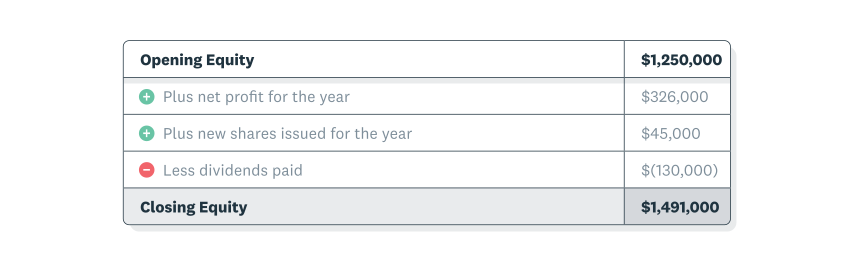
Statement shows closing equity is equal to the opening equity plus the year’s net profit and money from investors, minus owner withdrawals and taxes.
Example for a sole trader
A sole trader starts the financial year with $50,000 in equity. During the year, the business earns $40,000 in net profit, the owner introduces $5,000 in additional capital, withdraws $25,000 in drawings, and owes $8,000 in income tax.
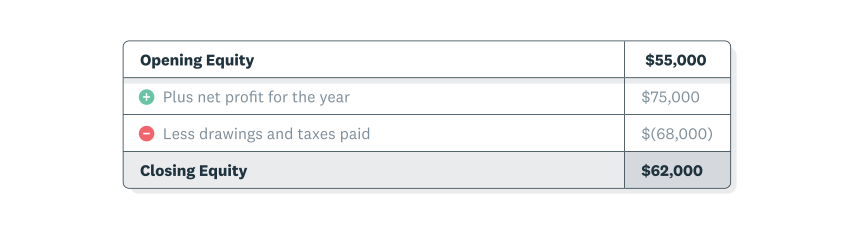
Statement shows closing equity is equal to the opening equity plus the year’s net profit, minus owner withdrawals and taxes.
Closing equity = $50,000 + $40,000 + $5,000 - $25,000 - $8,000 = $62,000.
Example for a partnership
A partnership with two equal partners starts the year with $100,000 in combined equity ($50,000 each). The business earns $60,000 in net profit, one partner introduces $10,000 in additional capital, the partners withdraw a combined $30,000, and the partnership owes $12,000 in tax.
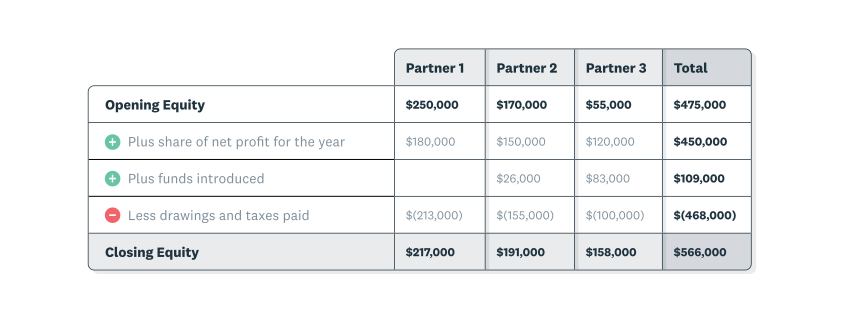
Statement shows closing equity is equal to the opening equity plus the year’s net profit and money introduced, minus owner withdrawals and taxes.
Closing equity = $100,000 + $60,000 + $10,000 - $30,000 - $12,000 = $128,000. Each partner's share is then calculated according to their partnership agreement.
Simplify your business finances with Xero
Understanding your owner's equity is easier when your financial data is accurate and up to date. Xero accounting software automatically tracks your assets, liabilities, and equity, so you can run a balance sheet or statement of changes in equity whenever you need one. Spend less time on the books and more time building your business. Get one month free.
FAQs on owner's equity
Here are some frequently asked questions about owner's equity.
How does owner's equity affect your ability to get a business loan?
Lenders assess your owner's equity to gauge financial stability before approving a loan. A strong equity position shows you have more assets than debts, which makes your business a lower-risk borrower and can improve your chances of approval and better terms.
What's the difference between owner's equity and shareholder equity?
Owner's equity and shareholder equity refer to the same concept, just in different business structures. Owner's equity is used for sole traders and partnerships, while shareholder equity applies to companies where ownership is divided into shares.
How often should you calculate owner's equity?
Review your owner's equity at least quarterly, or monthly if you're actively managing cash flow or planning for growth. Your accounting software can generate an up-to-date balance sheet at any time.
What's the difference between owner's equity and retained earnings?
Retained earnings are one component of owner's equity. Owner's equity includes your total investment, retained earnings, additional contributions, and withdrawals, while retained earnings only reflect the accumulated profits your business has kept rather than distributed.
Disclaimer
Xero does not provide accounting, tax, business or legal advice. This guide has been provided for information purposes only. You should consult your own professional advisors for advice directly relating to your business or before taking action in relation to any of the content provided.
Get one month free
Purchase any Xero plan, and we will give you the first month free.