What is the difference between bookkeeping and accounting
Learn the key differences between bookkeeping and accounting, and decide which your Australian business needs.
Published Thursday 23 July 2026
Table of contents
Key takeaways
- Bookkeepers handle day-to-day financial record-keeping and data entry, while accountants provide strategic analysis and business insights based on that financial data.
- Hire a bookkeeper when you spend more than 5 hours a week on financial tasks or need help with invoicing and monthly reports, but add an accountant when your annual revenue exceeds $500,000 or you need strategic financial planning.
- Bookkeepers typically need certificate-level qualifications, while accountants need bachelor's degrees and often CPA (Certified Practising Accountant) or CA (Chartered Accountant) certification, which affects both their service scope and fees.
- A combined approach, using a bookkeeper for daily financial management and an accountant for tax compliance and strategic planning, gives you comprehensive financial support without paying for services you don't need.
Bookkeeping vs accounting
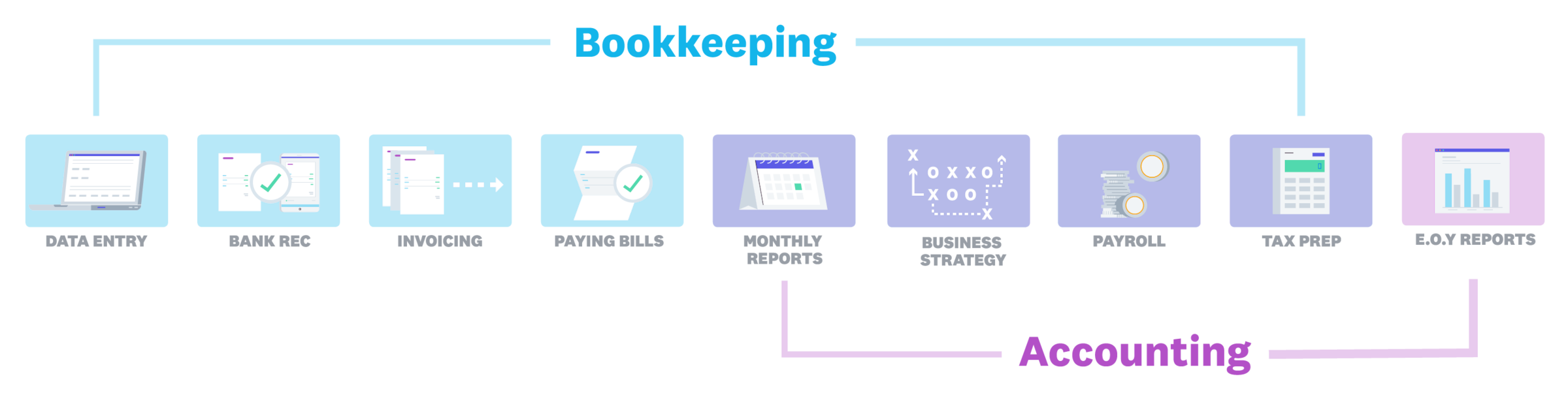
Bookkeeping is the day-to-day recording and organising of financial transactions. Accounting involves analysing, interpreting, and reporting on financial data to provide strategic business insights.
The core difference is straightforward: bookkeepers handle data entry and basic financial tasks, while accountants provide analysis and strategic advice. Both roles are essential for managing business finances, but they serve different purposes at different stages of your financial management process.
What bookkeepers do
Bookkeepers handle the day-to-day financial record-keeping that keeps your business organised and compliant. In Australia, bookkeepers who lodge Business Activity Statements (BAS) must be registered as a BAS Agent with the Tax Practitioners Board. Their core responsibilities cover both daily and monthly tasks.
Typical daily bookkeeping tasks include:
- Managing accounts payable and receivable
- Processing invoices and payments
- Using tools such as Xero, bank feeds, and receipt capture apps to streamline data entry
Keeping on top of invoicing matters. According to Xero Small Business Insights, Australian small businesses waited an average of 23.9 days to be paid in the December quarter of 2025, the fastest result since tracking began in 2017, with payments arriving an average of 6.6 days after the due date. A bookkeeper who actively manages accounts receivable and follows up on overdue invoices can help your business stay as close to those benchmarks as possible.
On a monthly basis, bookkeepers also handle:
- Generating financial reports for business owners
- Preparing preliminary tax documentation, including BAS preparation
Some bookkeepers also provide basic financial analysis and highlight trends in your business performance, helping you spot cash flow issues before they become problems.
What accountants do
Accountants are trained financial analysts who interpret your business data to provide strategic insights and ensure compliance. They typically hold accounting degrees and professional certifications such as CPA (Certified Practising Accountant) or CA (Chartered Accountant).
In Australia, accountants who provide tax advice or lodge tax returns must be registered as a Tax Agent with the Tax Practitioners Board. Those offering financial planning advice may also need an Australian Financial Services Licence (AFSL) through ASIC. Core accounting services include:
- Preparing official financial statements (income statements, balance sheets, cash flow statements)
- Filing tax returns and managing tax compliance
- Conducting financial analysis and forecasting
- Providing strategic business advice based on financial data
- Using tools such as Xero, tax lodgement software, and financial modelling tools
Beyond compliance work, accountants offer strategic services that help you grow your business:
- Business planning and budgeting
- Investment and growth strategy recommendations
- Risk assessment and financial planning
- Audit preparation and representation
Some accounting firms also offer bookkeeping services, so you can manage all your financial needs in 1 place.
Key differences between bookkeeping and accounting
While bookkeeping and accounting overlap, they differ across 5 key dimensions. Understanding these differences helps you decide which professional your business needs and when.
Focus and scope
Bookkeepers focus on accurately recording your daily financial transactions: receipts, invoices, payments, and bank reconciliations. Accountants take those financial records and analyse them to provide strategic insights, tax advice, and business recommendations.
Skills required
Bookkeeping requires strong attention to detail, data accuracy, and proficiency with accounting software. Accounting requires analytical thinking, knowledge of tax legislation and Australian Accounting Standards, and the ability to translate financial data into business advice.
Tools used
Both bookkeepers and accountants use cloud accounting software like Xero for day-to-day financial management. Bookkeepers rely heavily on bank feeds, receipt capture, and reconciliation tools. Accountants also use tax lodgement software, financial modelling tools, and reporting platforms for deeper analysis.
Timeframe
Bookkeepers work on a day-to-day and week-to-week cycle, keeping your financial records current. Accountants typically work on periodic cycles: monthly, quarterly, and annual reporting, tax returns, and year-end compliance.
Regulation in Australia
In Australia, bookkeepers who lodge BAS must register as BAS Agents with the Tax Practitioners Board. Accountants who provide tax services must register as Tax Agents, and those offering financial advice may need an AFSL. CPA Australia and Chartered Accountants Australia and New Zealand (CA ANZ) are the 2 main professional bodies for accountants.
Salary comparison
According to Seek salary data for 2025, bookkeepers typically earn between $55,000 and $70,000 per year, while accountants earn between $65,000 and $95,000 depending on experience and qualifications. Senior accountants and those with CPA or CA designations can earn over $100,000. These ranges reflect the difference in qualification requirements and scope of services.
Australian qualifications for bookkeepers and accountants
The qualifications you'll find in your bookkeeper or accountant directly affect the scope of services they can provide and the fees they charge. Here's what to look for in Australia.
Bookkeeper qualifications
Australian bookkeepers typically follow this qualification pathway:
- Certificate IV in Accounting and Bookkeeping (FNS40222), the standard industry qualification
- Membership with the Institute of Certified Bookkeepers (ICB) Australia
- BAS Agent registration with the Tax Practitioners Board, required for bookkeepers who prepare or lodge BAS on behalf of clients
- Practical experience of 1 to 3 years in a bookkeeping role
Accountant qualifications
Accountants in Australia need more extensive qualifications:
- Bachelor's degree in accounting or a related field (minimum)
- Membership with CPA Australia (Certified Practising Accountant) or CA ANZ (Chartered Accountants Australia and New Zealand)
- Tax Agent registration with the Tax Practitioners Board, required for accountants who provide tax advice or lodge returns
- Professional experience of at least 3 years, including a supervised mentoring program for CPA or CA candidates
Higher qualifications generally mean higher fees, but they also mean your financial professional can offer a broader range of services. A BAS Agent can handle your day-to-day compliance, while a registered Tax Agent with CPA or CA credentials can advise on complex tax planning and business strategy.
When to hire a bookkeeper vs accountant
Your business needs determine which professional to hire first. The right choice depends on the complexity of your finances and where you are in your business journey.
Hire a bookkeeper when you:
- Have regular transactions that need organising
- Spend more than 5 hours a week on financial record-keeping
- Need help with invoicing, bill payments, and BAS preparation
- Want monthly financial reports to track performance
Hire an accountant when you:
- Need strategic financial advice for business decisions
- Have complex tax situations or multiple revenue streams
- Are planning significant business changes (expansion, investment, or loans)
- Require detailed financial analysis and forecasting
Hire both a bookkeeper and an accountant if you:
- Have annual revenue over $500,000
- Operate across multiple states or industries
- Need both daily financial management and strategic planning
- Want to focus entirely on running your business, not managing finances
Most small businesses start with a bookkeeper and add an accountant as they grow. For example, a cafe owner might begin with a bookkeeper to manage daily sales records and BAS lodgement, then bring in an accountant when they're ready to open a second location and need advice on business structuring and tax planning.
How technology is changing bookkeeping and accounting
Cloud accounting software is transforming how both bookkeepers and accountants work. Tools like Xero automate routine bookkeeping tasks such as bank feeds, reconciliation, and invoicing, freeing up time for higher-value work.
AI-powered features are reducing manual data entry and basic transaction categorisation. This shift is changing what both roles look like in practice:
- Bookkeepers are spending less time on data entry and more time on compliance tasks, advisory work, and helping business owners understand their numbers.
- Accountants are focusing more on strategic analysis, scenario planning, and proactive business advice rather than retrospective reporting.
- Business owners get real-time visibility into their finances, making collaboration with both professionals more productive.
Technology makes both roles more valuable, not redundant. Automation handles the repetitive tasks so your bookkeeper and accountant can focus on the work that actually moves your business forward.
Choose the right financial support for your business
The right financial professional depends on your business stage and needs. Start with a bookkeeper if you need organised records and basic reporting. Add an accountant when you need strategic advice and complex financial analysis.
You can use a bookkeeper for daily financial management and an accountant for strategic planning and tax compliance. This approach helps you keep accurate records and gives you the insights you need to grow your business. Xero works alongside both professionals, giving everyone a single, up-to-date view of your finances. Get one month free.
FAQs on bookkeeping vs accounting
Here are some frequently asked questions about bookkeeping vs accounting.
Can a bookkeeper handle my accounting needs?
A bookkeeper can handle financial record-keeping and basic reporting, but they typically can't provide strategic financial analysis, tax planning, or complex business advice. For those services, you'll need a qualified accountant.
How do I find a qualified bookkeeper or accountant in Australia?
Check that your bookkeeper holds a Certificate IV and BAS Agent registration, and that your accountant is a member of CPA Australia or CA ANZ. You can search for Xero-certified advisors through the Xero advisor directory, which lists qualified professionals in your area.
What is a BAS Agent and do I need one?
A BAS Agent is a bookkeeper or accountant registered with the Tax Practitioners Board to prepare and lodge Business Activity Statements. If you need someone to handle your BAS lodgements, they must hold this registration by law.
What is the difference between CPA Australia and CA ANZ?
CPA Australia (Certified Practising Accountant) and CA ANZ (Chartered Accountants Australia and New Zealand) are the 2 main professional accounting bodies in Australia. Both require a degree and a structured program of study and experience; they differ in curriculum focus, but either credential signals a qualified accountant.
Is accounting software like Xero considered bookkeeping or accounting?
Accounting software handles both bookkeeping tasks (recording transactions, bank reconciliation) and some accounting functions (financial reporting, tax preparation). The software doesn't replace professional expertise but helps both bookkeepers and accountants work more efficiently.
Can a bookkeeper and accountant work together on my business?
Yes, and this is the most common arrangement for growing businesses. Your bookkeeper handles daily record-keeping and BAS lodgement, while your accountant uses those records for tax planning, financial strategy, and year-end compliance.
Handy resources
Advisor directory
You can search for experts in our advisor directory
When you should hire a bookkeeper
Find out all the things bookkeepers can do for your business
Xero dashboard
See your key information on the business dashboard
Disclaimer
This glossary is for small business owners. The definitions are written with their requirements in mind. More detailed definitions can be found in accounting textbooks or from an accounting professional. Xero does not provide accounting, tax, business or legal advice.