Break-even point formula
Learn the break-even point formula and how to calculate your break-even point in units or sales value.
November 2023 | Published by Xero
Published Monday 17 August 2026
Table of contents
Key takeaways
- The break-even point is where your total sales equal your total costs, so your business makes neither a profit nor a loss.
- There are two versions of the formula: one gives you the number of units to sell, the other gives you the sales value (revenue) to reach.
- Both versions rely on your contribution margin, which is your selling price per unit minus your variable cost per unit.
- Knowing your break-even point helps you set sales targets, price with confidence, and see how cost or price changes affect profitability.
What is the break-even point?
The break-even point is the level of sales at which your total revenue exactly covers your total costs, so you make no profit and no loss. Every sale beyond it starts to add profit.
For a small business, it is a practical milestone. It tells you the minimum you need to sell to keep the lights on, and it gives you a clear target to build sales and pricing decisions around. It also works hand in hand with tracking how efficiently your sales turn into profit.
The break-even point formula
There are two ways to express the break-even point, and both start from the same idea. The first tells you how many units you need to sell, and the second tells you how much sales value (revenue) you need to bring in.
Both versions use your contribution margin, which is what each sale contributes toward your fixed costs once its own variable cost is covered:
Contribution margin = selling price per unit – variable cost per unit
The two formulas are:
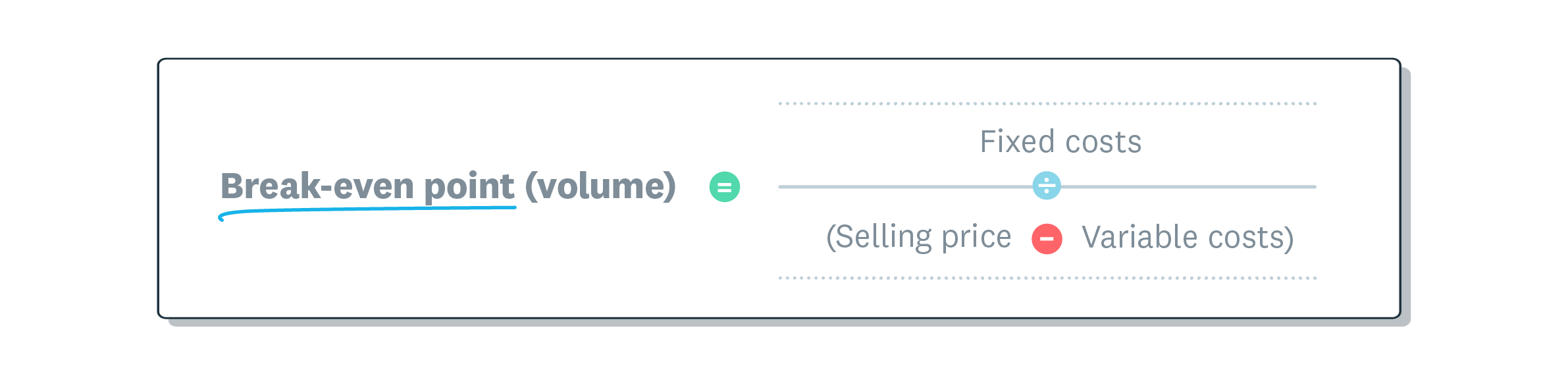
Break-even point (units) = fixed costs ÷ (selling price per unit – variable cost per unit)
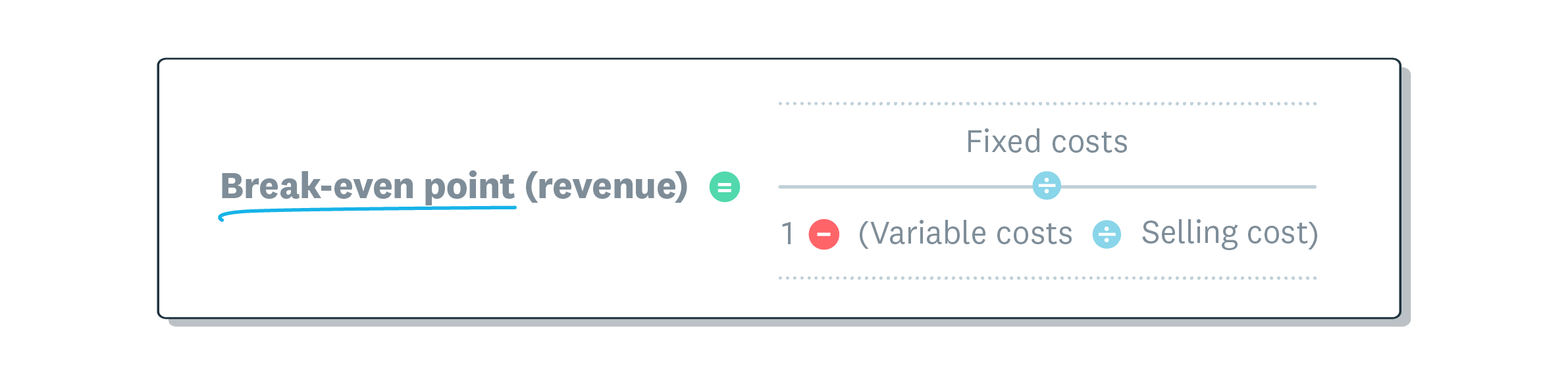
Break-even point (sales value) = fixed costs ÷ (1 – (variable cost per unit ÷ selling price per unit))
Each formula draws on three figures:
- Fixed costs: expenses that stay the same no matter how much you sell, such as rent and insurance
- Variable costs: expenses that rise and fall with sales, such as raw materials and hourly wages
- Selling price: what you charge for one unit of your product or service
Your variable cost per unit is also the starting point for working out the cost of producing one more unit, which is useful when you weigh up making and selling more.
How to calculate your break-even point
Once you have your cost and price figures, the calculation follows a short sequence of steps.
- List your fixed costs for the period, such as a month, adding up expenses like rent, salaries, and insurance
- Work out your variable cost per unit, including materials, packaging, and any per-sale fees
- Confirm your selling price per unit
- Find your contribution margin by subtracting the variable cost per unit from the selling price per unit
- Divide your fixed costs by the contribution margin for the answer in units, or by the contribution margin ratio for the answer in sales value
Break-even calculation examples
These two worked examples show the same method for a product business and a service business, with the revenue and unit break-even points for each.
Example for a product-based business
A milk tea shop has fixed monthly costs of ₱60,000 for rent, utilities, and insurance. Its variable costs are ₱30 per cup, and it sells each cup for ₱90. Its contribution margin is ₱90 – ₱30 = ₱60.
Units: ₱60,000 ÷ ₱60 = 1,000 cups. The shop needs to sell 1,000 cups a month to break even.
Sales value: ₱60,000 ÷ (1 – (₱30 ÷ ₱90)) = ₱60,000 ÷ 0.667 = ₱90,000. The shop needs ₱90,000 in monthly sales to break even.
Example for a service-based business
A freelance graphic designer has fixed monthly costs of ₱24,000. Variable costs are ₱300 per hour to hire a contractor, and clients are charged ₱700 per hour. The contribution margin is ₱700 – ₱300 = ₱400.
Units: ₱24,000 ÷ ₱400 = 60 hours. The designer needs to bill 60 hours a month to break even.
Sales value: ₱24,000 ÷ (1 – (₱300 ÷ ₱700)) = ₱24,000 ÷ 0.571 = ₱42,000. The designer needs ₱42,000 in monthly fees to break even.
How to use and lower your break-even point
Your break-even point is a planning tool as much as a number. Use it to set sales targets, and combine it with your buffer before sales dip into a loss to gauge how much risk you are carrying.
You can lower your break-even point in three ways: charge more, spend less on fixed costs, or spend less on each unit you sell. A considered approach to adjusting what you charge lifts your contribution margin, while renegotiating rent or suppliers trims the costs the formula divides.
It also pays to look at the sales side. Growing your income from existing and new customers moves you past break-even faster, and reviewing your figures regularly keeps them current as costs change.
Track your break-even point with Xero
Your break-even point is only as accurate as the cost and sales figures behind it. Xero accounting software keeps those numbers organised and up to date, with reports that show where your revenue and expenses stand, so you always know how close you are to breaking even. Sign up to get one month free and see how it fits your business.
FAQs on the break-even point
Here are answers to common questions about the break-even point.
What is contribution margin?
Contribution margin is your selling price per unit minus your variable cost per unit. It is the amount each sale contributes toward covering your fixed costs.
What is the difference between fixed and variable costs?
Fixed costs stay the same regardless of how much you sell, such as rent and insurance. Variable costs move with your sales volume, such as materials and per-hour contractor fees.
How often should you recalculate your break-even point?
Recalculate whenever your prices, fixed costs, or variable costs change, and at least once a quarter. Regular reviews keep your sales targets realistic as conditions shift.
What are the limitations of break-even analysis?
It assumes your prices and costs stay steady and that you sell a single product or a stable mix. It also leaves out external factors like changing demand, so use it alongside your wider cash flow and profit planning.
Related terms
Learn more about the break-even point
Handy resources
Advisor directory
You can search for experts in our advisor directory
How to increase revenue
Find out how businesses grow their sales income.
Stay on top of your numbers with Xero
Accounting software tracks your performance while you sleep.
Disclaimer
This glossary is for small business owners. The definitions are written with their requirements in mind. More detailed definitions can be found in accounting textbooks or from an accounting professional. Xero does not provide accounting, tax, business or legal advice.