Gearing ratio explained: how to calculate it for your business
Learn how your gearing ratio affects risk, cash flow and borrowing costs, and how to keep it healthy.

Written by Shaun Quarton—Accounting & Finance Content Writer and Growth Marketer. Read Shaun's full bio
Published Tuesday 6 October 2026
Table of contents
Key takeaways
- Calculate your gearing ratio by dividing total debt by total equity and multiplying by 100. Most small businesses aim for 25–50%.
- Review your gearing ratio quarterly or before major financial decisions to spot trends early and manage debt without straining cash flow.
- Interpret your ratio against industry standards: capital-intensive businesses like manufacturing can run up to 80%, while service businesses typically sit at 20–40%.
- Use your gearing ratio to assess borrowing capacity and show investors and lenders a balanced, stable funding structure.
Gearing ratio definition
Your gearing ratio compares your business’s debt to its equity. It shows how reliant you are on borrowed funds relative to your own capital, giving you insight into your financial health.
In finance, gearing refers to the balance between debt and equity a company uses to fund its operations:
- Debt: borrowed money, such as loans and lines of credit, that must be repaid with interest
- Equity: the owner’s investment in the business, including retained earnings and share capital
Lenders and investors use gearing ratios to assess financial stability:
- Higher ratio: signals greater reliance on debt, which means increased financial risk but also potential for higher returns
- Lower ratio: suggests a stronger equity position, reducing risk but potentially limiting growth opportunities
Types of gearing ratios
Several gearing ratios help measure how much your business relies on debt. Each examines a different aspect of your business’s stability:
- Debt-to-equity ratio: compares total debt to total equity, showing how much of your business is funded by creditors versus owners
- Debt-to-capital ratio: measures the proportion of total capital (debt + equity) funded by debt, with higher ratios suggesting greater reliance on borrowing
- Equity ratio: is the share of total assets financed by equity, with higher ratios indicating stronger financial stability
- Times interest earned (TIE) ratio: assesses your ability to cover interest payments with pre-tax earnings, reassuring lenders you can meet debt obligations
Debt-to-equity ratio versus gearing ratio
The debt-to-equity ratio and gearing ratio both measure how much you rely on borrowed money, but they have different uses:
- the debt-to-equity ratio compares your total debt to shareholders’ equity, which is useful for a quick check on your finances
- the gearing ratio is a broader measure that weighs different types of debt against your capital structure, helping you plan long term
Both ratios help you evaluate financial risk.
Why does your gearing ratio matter?
Your gearing ratio indicates your business’s financial health and long-term solvency. Tracking and managing it helps you:
- judge whether you can take on more debt without straining cash flow or increasing financial risk
- signal financial stability to investors and lenders with a balanced ratio
- match your debt-to-equity structure with growth goals, whether you’re aiming for rapid expansion or steady, low-risk growth
- free up more cash for reinvestment with a lower ratio, or plan for higher debt repayments with a higher ratio
- spot financial vulnerabilities early by reviewing your ratio regularly and taking corrective action
How to calculate the gearing ratio
To calculate your gearing ratio, divide total debt by total equity (or by total debt plus total equity), then multiply by 100. These six steps walk you through it using figures from your balance sheet.
1. Pull your latest balance sheet
Every figure you need sits on your balance sheet, which Malaysian companies often call the statement of financial position. Use the most recent one so the ratio reflects where your business stands today.
Take all your figures from the same date. A loan balance from March paired with equity from December gives you a ratio that matches no real point in time.
2. Add up your total debt
Total debt usually means your interest-bearing borrowings. Look through both current and non-current liabilities for bank loans, overdrafts, hire purchase agreements, lease liabilities and any loans from directors or shareholders. Include the portion of each loan due within 12 months as well as the longer-term balance.
Most analysts leave out trade payables, such as supplier bills, because they’re part of day-to-day trading rather than borrowing. Some analysts count all liabilities instead, which produces a higher ratio. Either approach works, as long as you use the same one every time you calculate.
3. Work out total equity
Total equity, also called owner’s equity, is the money the owners have put in plus the profit the business has kept. Add your share capital to retained earnings and any reserves listed in the equity section of your balance sheet.
If your business has built up losses, retained earnings can be negative. That lowers total equity and pushes your gearing ratio up, even when your debt hasn’t changed.
4. Choose your formula
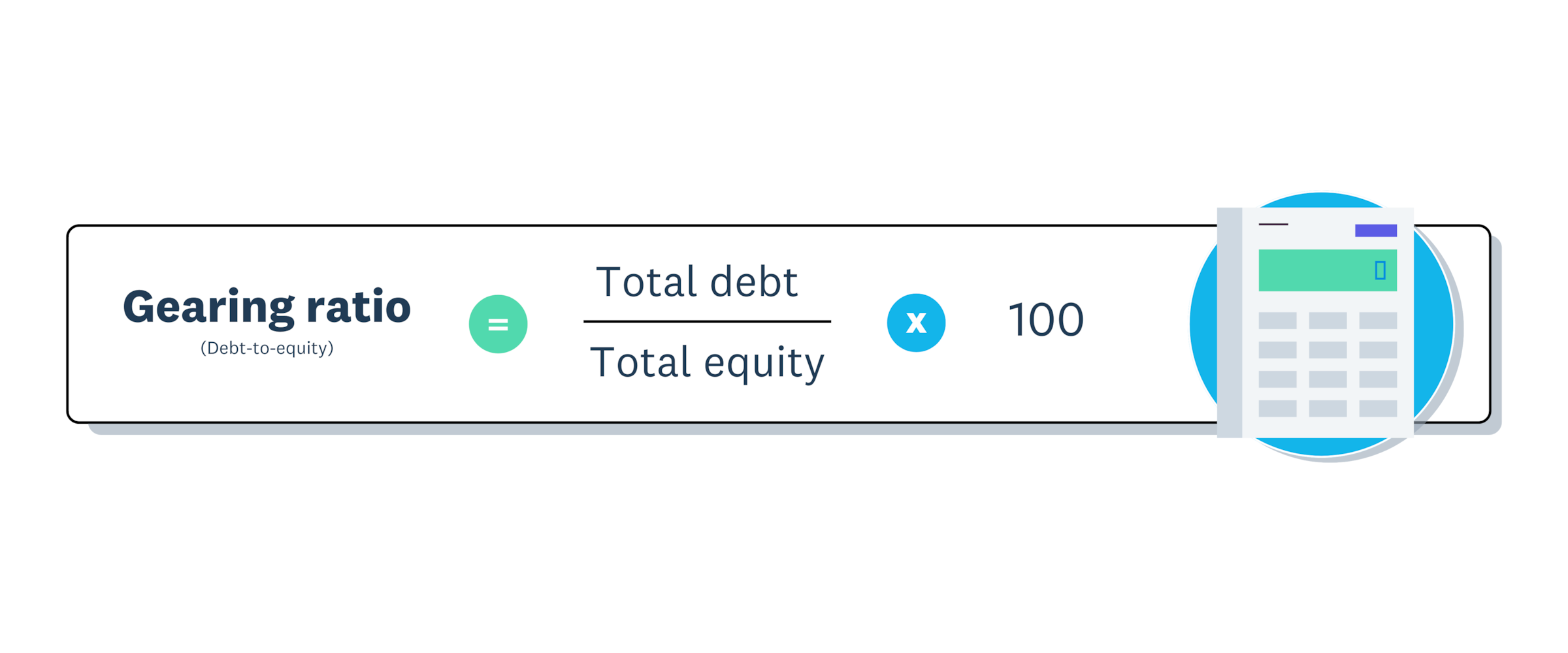
You can use one of two formulas, depending on what you want to see. The debt-to-equity version compares what you’ve borrowed with what the owners have invested and kept:
Gearing ratio = (Total debt ÷ Total equity) × 100
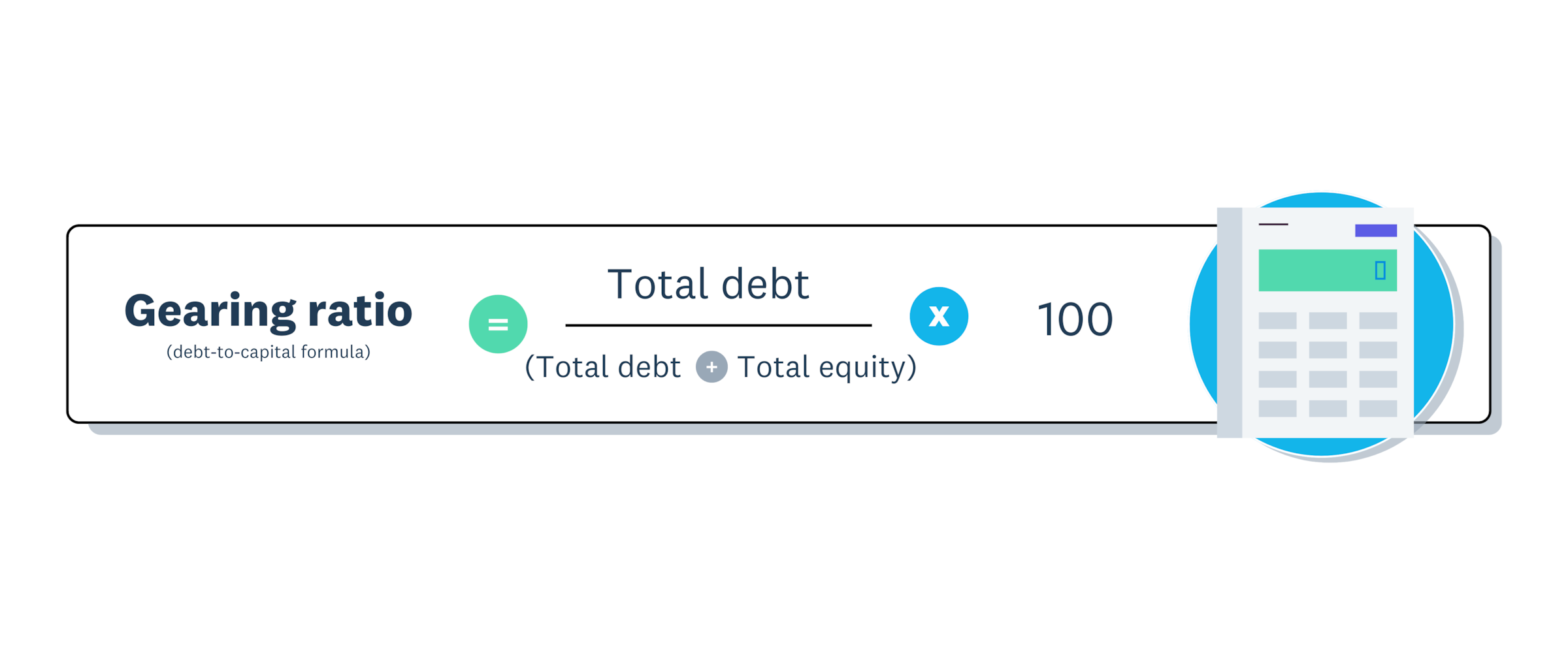
The debt-to-capital version shows what share of your total funding comes from borrowing, so the result always stays below 100% while equity is positive:
Gearing ratio = (Total debt ÷ (Total debt + Total equity)) × 100
The ranges in the gearing ratio analysis section of this guide are based on debt-to-equity. Use debt-to-capital when you want the borrowed share of your funding, and stick with your chosen formula so each period compares fairly.
5. Divide and multiply by 100
Divide total debt by the figure your formula calls for. Then multiply the answer by 100 to turn the decimal into a percentage, so a result of 0.45 becomes 45%.
Round to one decimal place. This keeps results easy to compare across periods.
6. Compare the result with past periods and industry norms
A single ratio shows where you stand today, while a trend shows where you’re heading. Calculate your ratio each quarter and check it against previous periods to see whether debt is growing faster than equity.
Next, weigh it against businesses in your industry, since capital-intensive sectors usually carry higher ratios than service businesses. Gearing measures long-term risk, so read it alongside liquidity ratios, which show whether you can cover bills due in the next 12 months.
Gearing ratio worked example
Here’s how the six steps play out for Seri Kopi, a fictional café in Penang. The owner wants to know whether the business can take on a loan for a second outlet.
Seri Kopi’s latest balance sheet shows three interest-bearing debts. There’s a $60,000 bank loan for the fit-out, a $15,000 overdraft and $25,000 left on the delivery van’s hire purchase. Together, that’s $100,000 of total debt, with supplier bills left out as in step 2.
On the equity side, the owner has $50,000 in share capital and $150,000 in retained earnings. That gives the café total equity of $200,000.
Calculating Seri Kopi’s gearing ratio
With both totals in hand, the owner can run each formula. Using debt-to-equity, $100,000 ÷ $200,000 = 0.5, and 0.5 × 100 gives a gearing ratio of 50%.
Using debt-to-capital, the owner first adds debt and equity to get total capital of $300,000. Then $100,000 ÷ $300,000 = 0.333, which becomes 33.3% after multiplying by 100 and rounding.
A 50% debt-to-equity ratio sits right at the top of the 25–50% moderate range. The café is balanced for now, but a new loan would tip it into high gearing. The 33.3% debt-to-capital result tells the same story another way: a third of the café’s funding is borrowed.
How paying off the overdraft changes the ratio
One change to the balance sheet can move the ratio noticeably. Say the owner uses $15,000 of cash to clear the overdraft, bringing total debt down to $85,000.
Equity stays at $200,000, because paying off debt with cash reduces an asset and a liability by the same amount. Debt-to-equity becomes $85,000 ÷ $200,000 × 100 = 42.5%, and debt-to-capital becomes $85,000 ÷ $285,000 × 100 = 29.8%.
At 42.5%, Seri Kopi sits comfortably inside the moderate range, with room to borrow for the second outlet. The trade-off is a smaller cash buffer, so check your current ratio too before you use cash to repay debt.
Gearing ratio analysis
A good gearing ratio typically falls between 25% and 50% for most small businesses. Anything in this range is generally considered healthy, though this varies by industry and growth stage. Read your results like this:
- a ratio below 25% is low gearing, suggesting a strong equity position with lower risk exposure and greater stability
- a ratio of 25–50% is moderate gearing, generally a balanced financial approach for most small and medium-sized businesses (SMBs)
- a ratio above 50% is high gearing, indicating heavier reliance on debt and increased financial risk
Typical gearing ratios vary by industry, growth stage and risk tolerance. A 30–50% debt mix lets many SMBs use borrowed funds to support growth while relying on equity for stability.
High versus low gearing: what’s the difference?
The difference between high and low gearing comes down to how you balance debt and equity to fund your business.
High gearing means relying more on debt than equity. If you take out a large loan to buy inventory and renovate, you’d have a high gearing ratio. This approach works well when:
- your business has stable cash flow that can service debt
- you’re in a high-growth industry and need to borrow to keep pace with rising revenue
The risk? If revenues drop or interest rates jump, high debt becomes a burden.
Low gearing means using more equity and less debt. If you expand by using saved profits, you may grow more slowly but keep financial risk to a minimum. Low gearing is the ‘safety first’ choice when:
- market conditions are unstable
- you’re prioritising long-term security and want to protect your credit rating
Finding the right balance helps you manage financial risk so your business is ready to seize growth opportunities.
Manage your gearing ratio with Xero
Manage your business’s finances simply and efficiently with Xero. Track your gearing ratio and other important metrics with up-to-date balance sheets and real-time financial reports. Spend less time on accounting tasks and share clear, current information with investors and lenders.
Get one month free and make confident financial decisions for your business.
FAQs on gearing ratios
Here are answers to common questions about gearing ratios for small businesses.
How often should I review my gearing ratio?
Review your gearing ratio quarterly, or whenever you’re considering new debt or making major financial decisions. Monitoring regularly helps you spot trends and address issues early.
Can my gearing ratio be too low?
Yes. A ratio below 25% may mean you’re missing chances to fund expansion with affordable debt and lift returns on equity when interest rates are low.
How does my gearing ratio affect my ability to get a loan?
Lenders use your gearing ratio to assess risk. A ratio above 50% may make borrowing more difficult or expensive, while a balanced ratio (25–50%) signals you can manage additional debt responsibly.
What should I do if my gearing ratio is too high?
Pay down existing debt, or hold off on new borrowing until your ratio improves. You can also increase equity through retained earnings or new investment, such as issuing new company shares.
Does my industry affect what’s considered a good gearing ratio?
Yes. Capital-intensive industries like manufacturing or property can exceed 80% to finance expensive equipment, while service businesses typically sit at 20–40%.
Start using Xero for free
Access Xero features for 30 days, then decide which plan best suits your business.