Owner’s equity definition and how to calculate yours
Discover how to define owner's equity, check business health, and plan for growth with clear numbers.
Written by Jotika Teli—Certified Public Accountant with 24 years of experience. Read Jotika's full bio
Published Thursday 2 April 2026
Table of contents
Key takeaways
- Calculate your owner's equity by subtracting total liabilities from total assets to determine your business's net worth at any point in time.
- Include all business assets (equipment, property, inventory, cash, accounts receivable) and all liabilities (loans, accounts payable, wages payable, tax obligations) for an accurate equity calculation.
- Review your owner's equity monthly on your balance sheet to track changes and make informed business decisions about loans, investments, or selling your business.
- Recognise that negative owner's equity occurs when liabilities exceed assets and often signals financial difficulty that may affect your ability to secure loans or attract investors.

What is owner's equity?
Owner's equity is the value of a business after subtracting what it owes from what it owns. Officially, the International Financial Reporting Standards (IFRS) define equity as the residual interest in the assets of an entity after deducting all its liabilities. It represents the book value, or net worth, of your business at any point in time.
Owner's equity doesn't tell you what your business would sell for. You won't know that until you negotiate with a buyer.
How to calculate owner's equity
To calculate owner's equity, use a simple formula: total assets minus total liabilities. Add up everything your business owns, subtract everything it owes, and what's left is your equity.
When calculating owner's equity
To get an accurate equity figure, count your assets and liabilities correctly. Here's what to include:
Assets are everything your business owns:
- Equipment and machinery: tools, vehicles, computers
- Property: buildings, land, office space
- Inventory: products you hold for sale
- Accounts receivable: money customers owe you
- Cash: funds in the bank
- Intangibles: intellectual property, trademarks, brand value
Liabilities are everything your business owes:
- Loans: amounts owed to banks or lenders
- Accounts payable: bills owed to suppliers
- Wages payable: amounts owed to employees
- Tax obligations: amounts owed to the tax office
Understanding what makes up your equity helps you see the full financial picture of your business.
What's included in owner's equity
Owner's equity has several components beyond the basic assets-minus-liabilities calculation. Here's what typically makes up owner's equity:
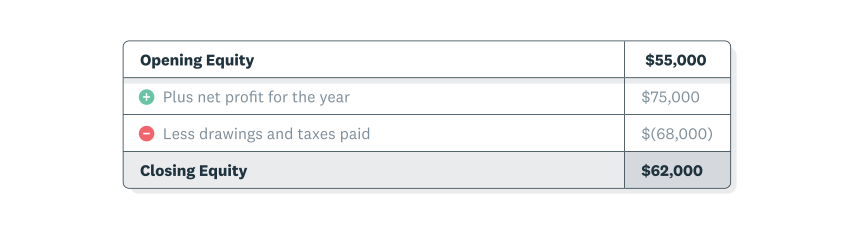
Statement shows closing equity is equal to the opening equity plus the year’s net profit, minus owner withdrawals and taxes.
- Initial capital: money you invested when starting the business
- Retained earnings: accumulated profits that haven't been withdrawn
- Additional contributions: extra funds you've put into the business over time
- Drawings: money you've taken out of the business (this reduces equity)
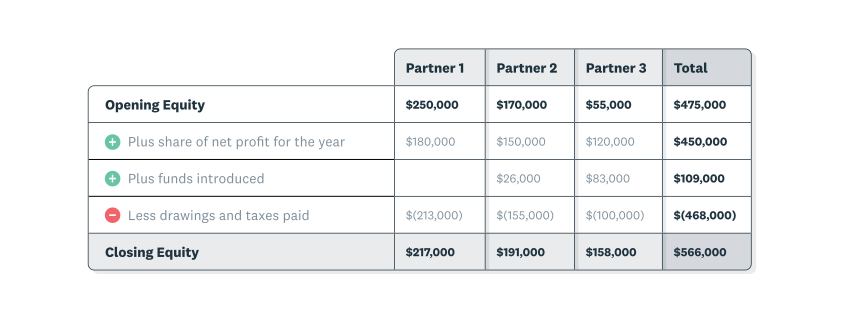
Statement shows closing equity is equal to the opening equity plus the year’s net profit and money introduced, minus owner withdrawals and taxes.
For companies with shareholders, owner's equity may also include share capital and reserves. According to international accounting standards, a company's statement of financial position must present issued capital and reserves within the equity section. The specific components depend on your business structure, but the principle stays the same: equity represents what's left after paying all debts.
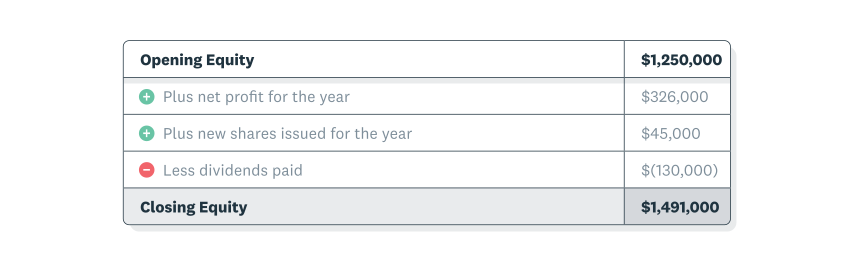
Statement shows closing equity is equal to the opening equity plus the year’s net profit and money from investors, minus owner withdrawals and taxes.
Examples of owner's equity
Here's a simple example using home ownership:
- Asset: House worth $300,000
- Liability: Mortgage of $120,000
- Equity: $300,000 − $120,000 = $180,000
The $180,000 is what you'd keep if you sold the house and paid off the mortgage.
The same principle applies to business ownership, just with different types of assets and liabilities.
Business example of owner's equity
Here's how owner's equity works for a small business:
- Assets: $600,000 garage + $50,000 machinery + $50,000 inventory = $700,000
- Liabilities: $300,000 owed on premises
- Owner's equity: $700,000 − $300,000 = $400,000
The repair shop owner has $400,000 of equity in the business.
Your balance sheet shows this equity figure and how it changes over time.
Where to find owner's equity
Owner's equity appears on your balance sheet. You'll find it listed after the assets and liabilities sections, and international accounting standards require a statement of changes in equity that reconciles the opening and closing balances for the period.
The balance sheet shows your equity at a specific point in time. Most accounting software, including Xero, generates this report automatically so you can check your equity whenever you need to.
Understanding your equity position helps you make informed business decisions.
FAQs on owner's equity
Here are answers to common questions about owner's equity.
Is shareholder's equity the same thing as owner's equity?
Yes, they mean the same thing. Sole proprietors and partnerships use "owner's equity" while companies and corporations typically call it "shareholder's equity." Accounting standards specify that an entity without share capital, like a partnership, must disclose changes in each category of its equity interest.
Can owner's equity be negative?
Yes, owner's equity can be negative. This happens when your liabilities exceed your assets, meaning you owe more than you own. Negative equity often signals financial difficulty and may affect your ability to secure loans or attract investors.
How often should I calculate owner's equity?
Review your owner's equity monthly when you check your balance sheet, or quarterly at minimum. You should also calculate it before major decisions like applying for a loan, bringing on investors, or planning to sell your business.
Does owner's equity affect my ability to get a loan?
Yes, lenders often review your owner's equity when assessing loan applications. Higher equity shows you have a stake in the business and suggests financial stability. Low or negative equity may make it harder to qualify for financing.
Disclaimer
Xero does not provide accounting, tax, business or legal advice. This guide has been provided for information purposes only. You should consult your own professional advisors for advice directly relating to your business or before taking action in relation to any of the content provided.
Start using Xero for free
Access Xero features for 30 days, then decide which plan best suits your business.