What is a sales funnel? Stages and how to build one
Turn browsers into buyers with a clear sales funnel. See steps to attract, convert, and keep customers.

Written by Shaun Quarton—Accounting & Finance Content Writer and Growth Marketer. Read Shaun's full bio
Published Thursday 26 February 2026
Table of contents
Key takeaways
- Focus your qualification efforts on leads with clear needs, adequate budget, and decision-making authority, as only 27% of leads sent to sales teams are actually qualified.
- Track conversion rates at each funnel stage to identify drop-off points and bottlenecks, then use this data to make targeted improvements that compound into significant overall gains.
- Prioritise customer retention through loyalty programmes, proactive check-ins, and upselling opportunities, since existing customers spend 67% more than new buyers and are far more cost-efficient to serve.
- Align your marketing and sales teams to create seamless lead handoffs and consistent messaging, as aligned companies are 67% more effective at closing deals and grow 20% annually.
What is a sales funnel?
A sales funnel is a step-by-step model that maps the journey a potential customer takes before making a purchase. It helps you visualise where prospects enter, where they drop off, and where they convert.
The funnel guides prospects from the top of funnel (TOFU), where they first become aware of your brand. As leads move through each stage, the funnel narrows. Some drop off due to budget constraints or alternative solutions, but a primary reason is a lack of nurturing, which causes an estimated 79% of leads to never convert.
By the bottom of funnel (BOFU), only the most qualified leads remain, ready to buy.
For example, imagine an online store selling speciality coffee beans. A customer might discover the brand through Instagram, browse the website, join the email list for a 10% discount, add a bag of beans to their cart, and complete the purchase.
A sales funnel is also known as a business growth funnel, conversion funnel, or purchase funnel. Each stage reflects increasing commitment. Understanding this process helps you nurture prospects more effectively and improve conversion rates.
What are the sales funnel stages?
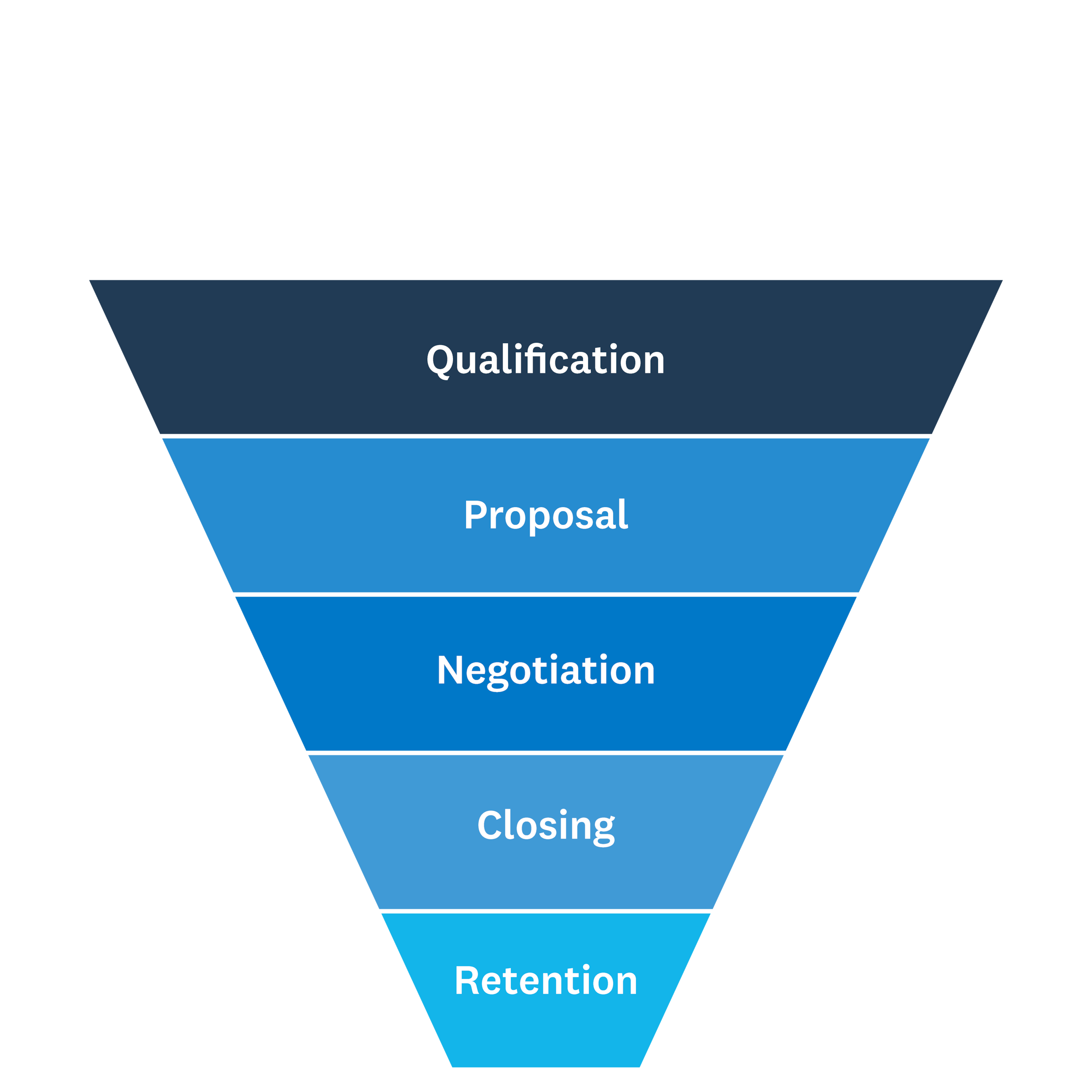
A typical sales funnel consists of five key stages that guide prospects from initial interest to long-term loyalty.
Before prospects enter your funnel, marketing grabs their attention. Once they engage with your business, whether by visiting your website, signing up to a newsletter, or asking for more info, they've entered the sales funnel.
Here are the five stages:
- Qualification: Identify best-fit prospects based on their needs, budget, and timeframe. This reduces time spent on leads unlikely to convert, which is critical when data shows that while 61% of business-to-business (B2B) marketers send all leads to sales, only 27% are qualified.
- Proposal: Present your product or service to qualified prospects and demonstrate its value. This moves interested leads toward a decision.
- Negotiation: Address remaining objections and discuss terms, pricing, or contract details. This clears final barriers to purchase.
- Closing: Finalise the sale by securing an agreement and processing payment. This converts prospects into paying customers.
- Retention: Ensure customer satisfaction to encourage repeat business. This builds long-term loyalty and increases lifetime value.
What are the benefits to using a sales funnel?
A sales funnel helps small businesses convert more leads, forecast revenue accurately, and identify where prospects drop off. These benefits help you compete more effectively, even with limited resources.
Better understand customer behaviour
Tracking your sales funnel reveals which customer segments convert best. By identifying patterns in successful conversions, you can recognise ideal customers earlier and focus resources on the most promising leads.
Examining each stage of the funnel provides insight into what drives purchasing decisions. This helps you tailor your messaging to connect with potential customers.
Here's how customer behaviour data helps:
- Identify high-converting segments: Data might show that leads from specific industries convert more often. Prioritise similar prospects to save time.
- Adapt to regional trends: Consumer behaviour varies by location. Understanding local patterns helps you maximise conversions in your market.
Forecast sales more accurately
Sales funnel data improves forecasting accuracy. By analysing conversion rates at each stage, you can estimate future sales volumes with confidence.
For example, if 20% of qualified leads request a callback and 40% of those convert, you can project sales based on your current lead pool. This insight also helps you determine how much to invest in lead acquisition while still generating positive returns.
Drive business growth
A sales funnel supports data-driven growth by providing performance insights at every stage. Track key metrics to identify bottlenecks, then take targeted action to fix them.
For example, if 40% of people who download your brochure request a demo, but only 3% of those demos lead to a price quote, you've found a weak point. Refining your demo presentation could significantly increase prospects reaching the next stage.
Consistently optimising your funnel at critical points compounds into major gains in overall conversions.
Focus on retention. Track metrics like customer lifetime value, repeat purchase rate, and churn to develop nurturing strategies. Creating a separate funnel for upselling active customers can be highly effective, as nurtured leads are known to make 47% larger purchases than non-nurtured leads. Selling to existing buyers is far more cost-efficient than acquiring new ones, as research shows that returning customers spend 67% more than new buyers.
Sales funnel vs marketing funnel
The marketing funnel and sales funnel work together but serve different purposes.
- Marketing funnel: Focuses on awareness and interest. It attracts prospects through content, ads, and brand-building activities.
- Sales funnel: Focuses on desire and action. It converts interested prospects into paying customers through qualification, proposals, and closing.
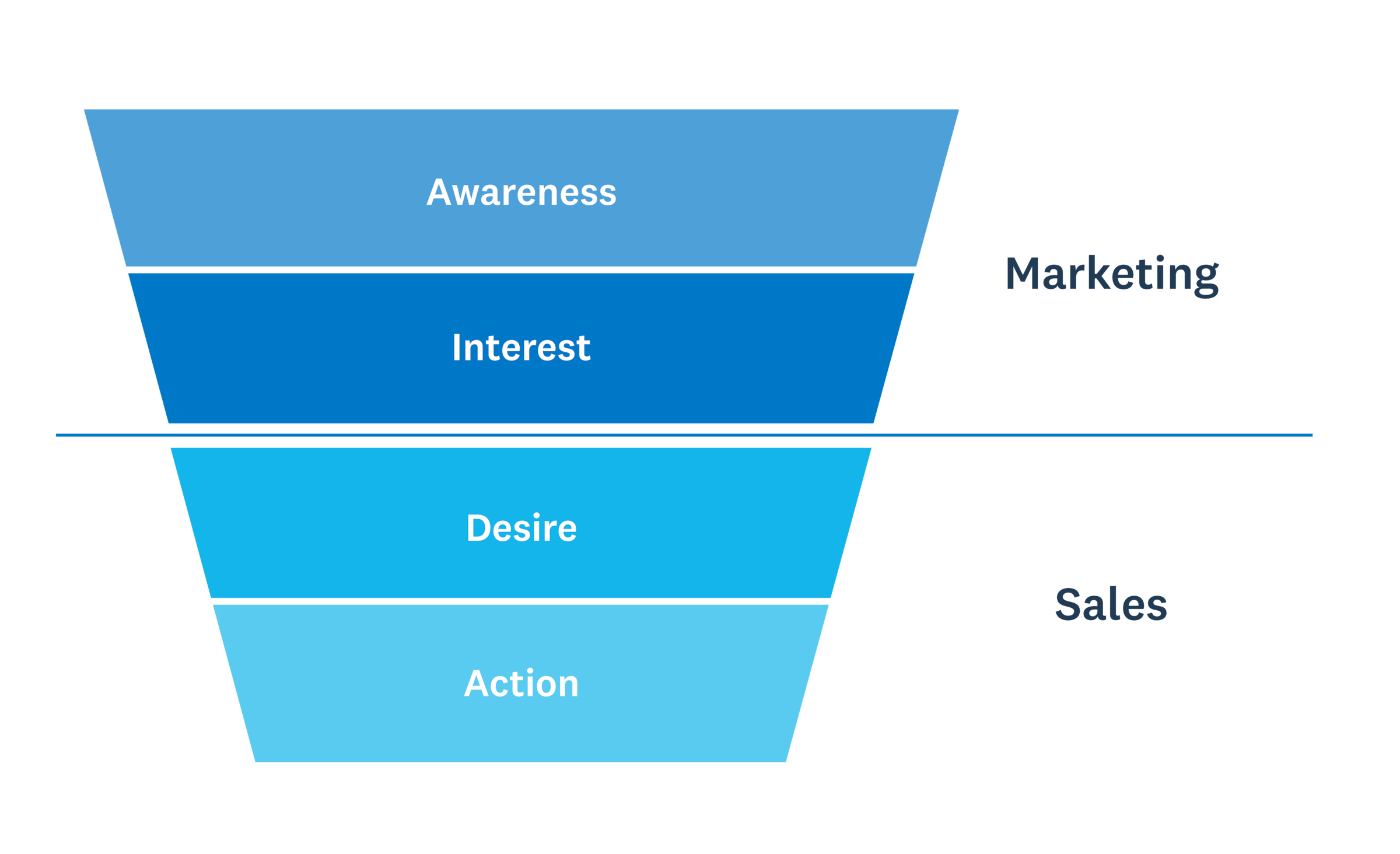
The marketing funnel fills the top of your sales funnel with leads. The sales funnel converts those leads into revenue.
Why aligning marketing and sales matters
Companies with aligned marketing and sales teams are 67% more effective at closing deals. When sales and marketing work together, they create a seamless customer experience and drive better results, with aligned companies growing 20% annually while their poorly aligned peers see revenues decline.
- Hand off leads smoothly: Qualified leads from marketing help sales focus on high-potential prospects.
- Keep messaging consistent: Using the same language helps you communicate clearly and cohesively.
- Share insights across teams: Combined data gives a complete view of the customer journey, allowing both teams to optimise strategies.
Sales funnel vs sales pipeline
A sales funnel and a sales pipeline track different things. Understanding the distinction helps you use both effectively.
- Sales funnel: Measures volume and conversion rates. It shows how many prospects move through each stage and where they drop off. The funnel focuses on the customer's journey.
- Sales pipeline: Tracks individual deals and their status. It shows which prospects are at which stage and their estimated value. The pipeline focuses on your sales team's workflow.
Think of it this way: the funnel tells you "20% of leads convert to customers." The pipeline tells you "these five deals worth $50,000 are being negotiated."
Most small businesses benefit from tracking both. Use your funnel to identify conversion problems. Use your pipeline to manage active deals and forecast revenue.
Sales funnel examples
While every business tailors its sales funnel to its audience, the core structure remains the same.
Here are three examples of how different business models apply the sales funnel stages to optimise results.
eCommerce sales funnel
The eCommerce sales funnel aims to move customers from product discovery to purchase swiftly and with minimal friction. Learn more about ecommerce metrics.
- Attract: Ads, search engine optimisation (SEO), social media.
- Engage: Product page, images, and reviews.
- Capture: Discounts or freebies for email sign-ups.
- Nurture: Retargeting ads, abandoned cart emails.
- Convert: Seamless checkout experience.
- Retain: Personalised product recommendations.
B2B sales funnel
The B2B sales funnel focuses on building trust and demonstrating expertise to drive high-value conversions.
- Attract: Content marketing, networking, referrals.
- Engage: Webinars, case studies, whitepapers.
- Capture: Gated content, consultation offers.
- Nurture: Follow-up emails, demos, personalised outreach.
- Convert: Proposals and negotiations.
- Retain: Ongoing support, upsells.
SaaS sales funnel
The SaaS sales funnel converts prospects into users through free trials or demos, then retains them with ongoing value.
- Attract: SEO, pay-per-click (PPC), content marketing.
- Engage: Landing pages, videos, case studies.
- Capture: Free trials, demos, limited-access plans.
- Nurture: Onboarding emails, tutorials, in-app prompts.
- Convert: Upgrades for premium features, time-limited offers.
- Retain: Strong support, regular updates, loyalty incentives.
How to create a sales funnel
Building a sales funnel requires planning across each stage. Follow these five steps to guide prospects smoothly toward conversion.
1. Qualify your leads
Evaluate each lead to determine if they're a good fit. Consider these factors:
- Needs: Does your product solve their problem?
- Budget: Can they afford your solution?
- Decision-making authority: Can they approve the purchase?
Understanding demographics, pain points, and purchasing behaviours helps you gauge how likely prospects are to convert and tailor your approach.
External factors matter too. Leads in thriving industries or regions are often more valuable. Focus your efforts where the potential is highest.
2. Propose your product or service
Present your product or service to qualified leads through sales calls, demos, or formal proposals.
A personalised approach works best. Directly address their pain points and clearly highlight your unique value proposition (what makes you different from competitors).
3. Negotiate the details
Discuss terms, address objections, and negotiate pricing or contract details. Tailor your approach to each prospect's specific concerns to move them closer to closing.
Being flexible matters. Timing and urgency play a major role in decision-making. Economic factors like interest rates and inflation can also influence willingness to commit, so stay adaptable to shifting conditions.
4. Close the sale
Make it as easy as possible for the prospect to say "yes." Reduce last-minute friction with a seamless checkout or contract process and flexible payment options.
Exclusive discounts or free upgrades can provide the final push needed to close the deal.
5. Retain your customers
Turning one-time buyers into repeat customers increases lifetime value. Strong post-sale support helps satisfy customers and build loyalty.
Retention tactics that work:
- Loyalty programmes: Reward repeat purchases with points or discounts
- Proactive check-ins: Follow up to ensure customers get value from their purchase
- Upsell opportunities: Offer complementary products or premium upgrades
Tips for optimising your business' sales funnel
Optimising your sales funnel helps you convert more prospects at every stage. Here are key strategies small businesses can use.
Strengthen lead qualification
Continuously refine your targeting criteria to ensure leads are the right fit for your business. Use customer relationship management (CRM) tools to track how leads engage, score leads based on behaviour, and prioritise the most promising prospects.
Use data to refine and scale your sales funnel
Track conversion metrics at each stage to identify drop-off points. Use tools like Google Analytics to understand user behaviour and find areas to improve. For instance, one business used the tool to analyse user flow, optimise key pages with better information, and ultimately achieved improved conversion rates.
Key optimisation strategies:
- Eliminate bottlenecks: Simplify forms and reduce user friction
- Segment your audience: Tailor messaging to different customer groups
- Run A/B tests: Test email subject lines, landing page copy, and other elements to maximise how well they perform
Enhance the post-sale experience
Create a structured onboarding process that sets customers up for success from day one. Automate timely follow-ups that help customers get value from their purchase.
Effective post-sale content includes:
- Onboarding emails: Guide customers through setup and first steps
- Case studies: Show how others achieved results
- Personalised tips: Help customers get more from their purchase
Understand and map customer journeys
Customer journey mapping visualises the steps a customer takes from initial awareness to when they convert and beyond. It helps you identify drop-off points, tailor your messaging, and improve conversions.
The four core stages:
- Awareness: Discover your business through social media, search engines, or word of mouth
- Interest: Engage by clicking an ad, visiting your website, or signing up for your email list
- Desire: Consider purchasing by reading reviews, requesting a demo, or asking questions
- Action: Commit by negotiating terms, signing a contract, or paying
Understanding how prospects move through each stage helps you optimise your sales funnel for maximum results.
Tools and software to support your sales funnel
The right tools help you build, track, and optimise your sales funnel. Most small businesses need to combine several software tools to manage the full customer journey.
Key tool categories:
- Customer relationship management (CRM) software: Track leads, manage relationships, and monitor pipeline progress. Examples include HubSpot, Salesforce, and Pipedrive.
- Email marketing platforms: Nurture leads with automated sequences and targeted campaigns. Examples include Mailchimp and ConvertKit.
- Analytics tools: Measure conversion rates and identify drop-off points. Google Analytics is a free starting point.
- Accounting software: Track revenue, monitor cash flow, and measure the financial impact of your funnel. Xero integrates with many CRM and marketing tools, giving you a complete view of how your sales funnel affects your bottom line.
Start with the essentials: a CRM to track leads and accounting software to measure results. Add specialised tools as your funnel matures.
Gain deeper insights for your sales funnel with Xero
Use data-driven insights to refine your sales funnel and make smarter decisions. Tracking your funnel performance helps you identify what's working and where to improve.
Xero Small Business Insights offers trends and analysis to help you stay informed and adapt to changing market conditions. With clear visibility into your business performance, you can optimise your funnel with confidence.
Ready to get started? Get one month free and explore Xero Small Business Insights.
FAQs on sales funnels
Here are answers to common questions about sales funnels for small businesses.
What's the difference between a five-stage and seven-stage sales funnel?
A five-stage funnel typically covers awareness, interest, evaluation, decision, and purchase. A seven-stage funnel extends this to include post-purchase stages like retention and advocacy. Choose the model that fits your business. Most small businesses start with fewer stages and add complexity as they grow.
How long does it take to build a sales funnel?
Most small businesses can build a basic sales funnel in two to four weeks. This includes defining your stages, setting up how you track progress, and creating initial content for each stage. Optimising your funnel is ongoing work that improves results over time.
Can I use a sales funnel if I'm just starting my business?
Yes. A simple sales funnel helps you understand how customers find you and what convinces them to buy. Start with the basics: track where leads come from, what actions they take, and how many convert. You can add sophistication as your business grows.
How much does sales funnel software cost?
Costs vary widely. Free tools like Google Analytics and basic CRM plans can get you started. Paid CRM and marketing automation tools typically range from $15 to $150 per month for small businesses. Choose tools that fit your current needs and budget, then upgrade as your funnel generates more revenue.
Disclaimer
Xero does not provide accounting, tax, business or legal advice. This guide has been provided for information purposes only. You should consult your own professional advisors for advice directly relating to your business or before taking action in relation to any of the content provided.
Start using Xero for free
Access Xero features for 30 days, then decide which plan best suits your business.