Break-even point formula
Learn the break-even point formula, with worked examples, to find the sales you need to cover costs.
November 2023 | Published by Xero
Published Friday 24 July 2026
Table of contents
Key takeaways
- The break-even point is where total sales cover total costs, so you make neither a profit nor a loss.
- Revenue break-even shows the sales value you need, while volume break-even shows the number of units or hours you need.
- Contribution margin, your selling price minus your variable cost per unit, sits at the heart of both formulas.
- You can lower your break-even point by cutting fixed costs, raising your selling price, or reducing variable costs.
Break-even point formula (calculation)
Break-even point is business costs divided by sales prices. The result shows the level of sales you need before your business becomes profitable.
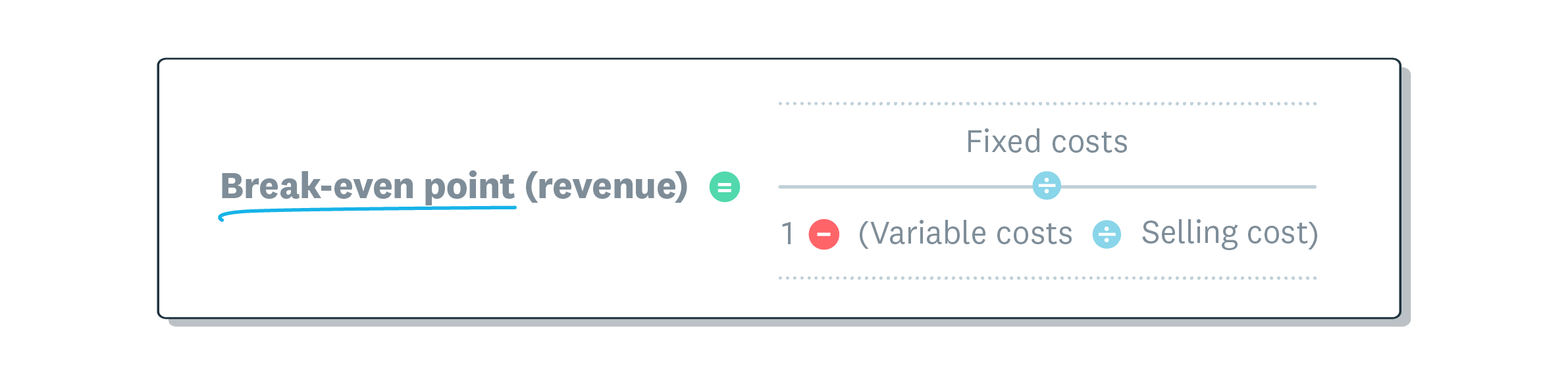
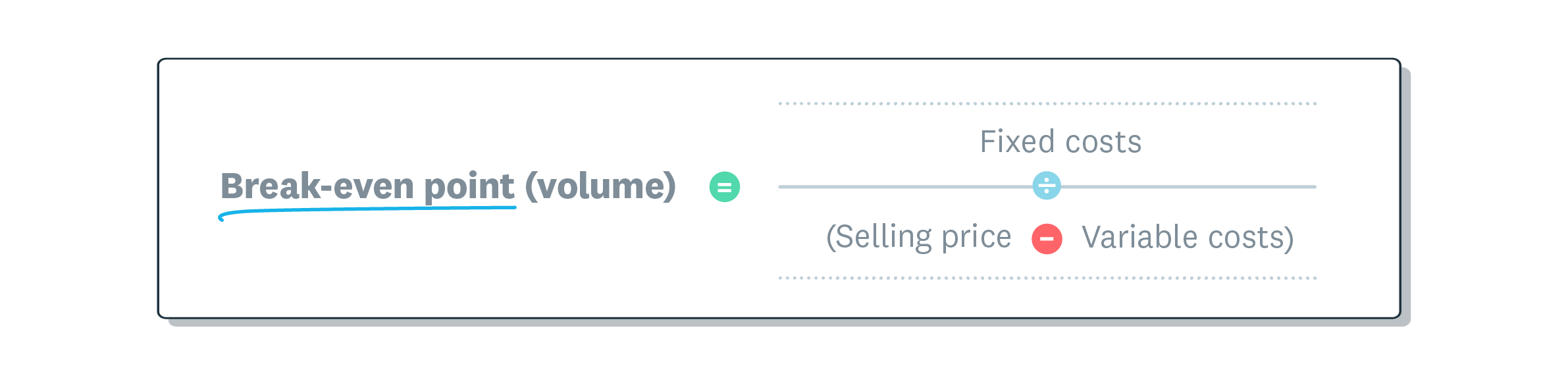
There are two break-even formulas. One works out the value of sales (revenue) you need to break even, and the other works out the number of sales (volume) you need.
What is the break-even point?
The break-even point is the moment when your sales cover all your costs, with nothing left over and nothing owing. It marks the start of profitability, because every sale after it adds to your bottom line.
Think of it like filling a bucket that has a small hole in the bottom. Your costs are the water leaking out, and your sales are the water going in. Once you pour in faster than it drains, the bucket fills up, and that tipping point is your break-even.
Why break-even analysis matters
Break-even analysis turns a vague sense of "am I making money?" into a clear number you can plan around. For a small business owner juggling many jobs at once, that single figure guides some of your most important decisions.
- Set realistic sales targets for the day, week, or month
- Test whether a new price protects or erodes your margin
- Spot hidden costs that quietly push your target higher
- Support funding conversations with lenders or investors using solid numbers
Understanding contribution margin
Contribution margin is your selling price minus the variable cost of making one unit. It shows how much money each sale contributes towards covering your fixed costs and, after that, towards profit.
Contribution margin is the engine behind both break-even formulas. The bigger the gap between what you charge and what each sale costs you, the fewer sales you need to break even.
The two break-even point formulas
Both formulas rely on the same three inputs and give you two views of the same target. The revenue formula gives you a dollar figure to beat, and the volume formula gives you a number of units or hours to reach.
Revenue break-even = fixed costs / (1 - (variable costs / selling price))
Volume break-even = fixed costs / (selling price - variable costs)
Your fixed costs are the expenses that stay the same no matter how much you sell, such as rent, insurance, and software subscriptions. Your variable costs change with how much you produce, such as raw materials or hourly wages. Your selling price is simply what you charge for each unit of your goods or services.
Break-even calculation examples
These two worked examples show the revenue and volume break-even points side by side. The first is a product-based business and the second is a service-based business, so you can follow whichever fits you best.
Break-even example for a product-based business
A kombucha brewery has fixed monthly costs of $6,000 for rent, utilities, insurance, and advertising. Its variable costs are $2 per bottle for packaging, ingredients, and labour, and it sells each bottle for $7.
Revenue required = fixed costs / (1 - (variable costs / selling price))= $6,000 / (1 - ($2 / $7))= $6,000 / (1 - 0.286)= $6,000 / 0.714= $8,403
To break even, the kombucha brewery must bring in $8,403 each month.
Volume required = fixed costs / (selling price - variable costs)= $6,000 / ($7 - $2)= $6,000 / $5= 1,200
To break even, the kombucha brewery must sell 1,200 bottles each month.
Break-even example for a service-based business
A graphic designer has fixed monthly costs of $2,700 for utilities, hardware leases, software subscriptions, and advertising. Their variable cost is $35 per hour to hire a contractor, and they charge clients $75 per hour.
Revenue required = fixed costs / (1 - (variable costs / selling price))= $2,700 / (1 - ($35 / $75))= $2,700 / (1 - 0.467)= $2,700 / 0.533= $5,064
To break even, the graphic designer must earn $5,064 each month.
Volume required = fixed costs / (selling price - variable costs)= $2,700 / ($75 - $35)= $2,700 / $40= 67.5
To break even, the graphic designer must bill 67.5 hours each month.
How to interpret and lower your break-even point
Your break-even point splits your sales into three simple zones. Below it you make a loss, at it you cover your costs exactly, and above it every extra sale turns into profit.
If your target feels out of reach, you have three practical levers to pull. You can reduce fixed costs by trimming recurring overheads, raise your selling price where the market allows, or cut variable costs by sourcing materials or labour more cheaply. To see how much breathing room sits between your sales and your break-even point, take a look at the margin of safety calculation.
Limitations of break-even analysis
Break-even analysis is a useful planning tool, but it rests on a few assumptions that can limit how far you rely on the number. Keep these points in mind when you apply it to your own business.
- Assumes your selling price and costs stay stable over time
- Assumes a straight-line relationship between your costs and your sales volume
- Gets more complex when you sell several products at different prices
- Leaves out shifts in customer demand
Track your break-even point with Xero
Xero brings your costs and sales into one clear set of reports, so you always know how close you are to covering your costs and turning a profit. When your fixed and variable costs update automatically, your break-even point stays current without any manual sums. Try it for yourself and get one month free.
FAQs on break-even point
Here are answers to some frequently asked questions about break-even point to help you apply the formula with confidence.
What is the break-even point formula?
The break-even point formula divides your fixed costs by your contribution margin to show the sales you need to cover all your costs. You can express it in revenue (a dollar figure) or in volume (units or hours).
What is a good break-even point?
A good break-even point is one you can reach comfortably within your normal sales cycle, leaving room for profit on top. The lower it sits relative to your usual sales, the more resilient your business is to a slow month.
What is the difference between the revenue and volume break-even formulas?
The revenue formula tells you the dollar value of sales you need, which suits businesses with mixed prices. The volume formula tells you the number of units or hours you need, which suits a single product or one hourly rate.
How can you lower your break-even point?
You can lower it by reducing fixed costs, raising your selling price, or cutting the variable cost of each sale. Any of these widens your contribution margin, so fewer sales are needed to break even.
Related terms
Learn more about break-even point
Handy resources
Advisor directory
You can search for experts in our advisor directory
How to increase revenue
Find out how businesses grow their sales income.
Stay on top of your numbers with Xero
Accounting software tracks your performance while you sleep.
Disclaimer
This glossary is for small business owners. The definitions are written with their requirements in mind. More detailed definitions can be found in accounting textbooks or from an accounting professional. Xero does not provide accounting, tax, business or legal advice.