How to calculate net profit margin
Learn what net profit margin is, the formula to calculate it, and what a good margin looks like.
Published Monday 17 August 2026
Table of contents

How to calculate net profit margin
Key takeaways


- Net profit margin shows what percentage of revenue remains as profit after deducting all expenses, including cost of goods sold, operating expenses, interest and taxes.
- Calculate net profit margin by dividing net profit by revenue, then multiplying by 100 to get a percentage.
- A good net profit margin depends on your industry, so compare your results against similar businesses and track changes over time.
- Net profit margin accounts for all expenses, while gross profit margin only considers the cost of goods sold.
What is net profit margin?
Net profit margin is the percentage of revenue that remains as profit after all expenses have been deducted. It measures how much of every dollar your business earns actually turns into profit.
This metric accounts for all costs, including cost of goods sold (COGS), operating expenses, interest and taxes. A higher net profit margin indicates your business is more efficient at converting revenue into actual profit. Understanding your net profit margin helps you assess overall financial health and make informed decisions about pricing, cost management and growth. Learn more about different types of profit margins and how they apply to your business.
Handy resources
Advisor directory
You can search for experts in our advisor directory
Profit & Loss template
Download Xero’s profit and loss statement template to show how much money your business is making
Financial reporting
Keep track of your performance with accounting reports
Disclaimer
This glossary is for small business owners. The definitions are written with their requirements in mind. More detailed definitions can be found in accounting textbooks or from an accounting professional. Xero does not provide accounting, tax, business or legal advice.
Net profit margin formula
The net profit margin formula is: net profit margin = (net profit ÷ revenue) × 100.
Here's what each component means:
- Net profit: revenue minus all expenses (COGS, operating expenses, interest and taxes)
- Revenue: total income from sales before any deductions
- The result is expressed as a percentage
How to calculate net profit margin
Calculating your net profit margin takes just a few steps. You can also use the net profit margin calculator to check your figures.
- Work out net profit by subtracting all expenses from revenue, including cost of goods sold, operating expenses, interest and taxes.
- Divide your net profit by your total revenue.
- Multiply by 100 to convert the result into a percentage.
Example of a net profit margin calculation
Suppose a cleaning business earns $20,000 in revenue. The cost to provide the services (COGS) is $8,000, leaving $12,000 in gross profit.
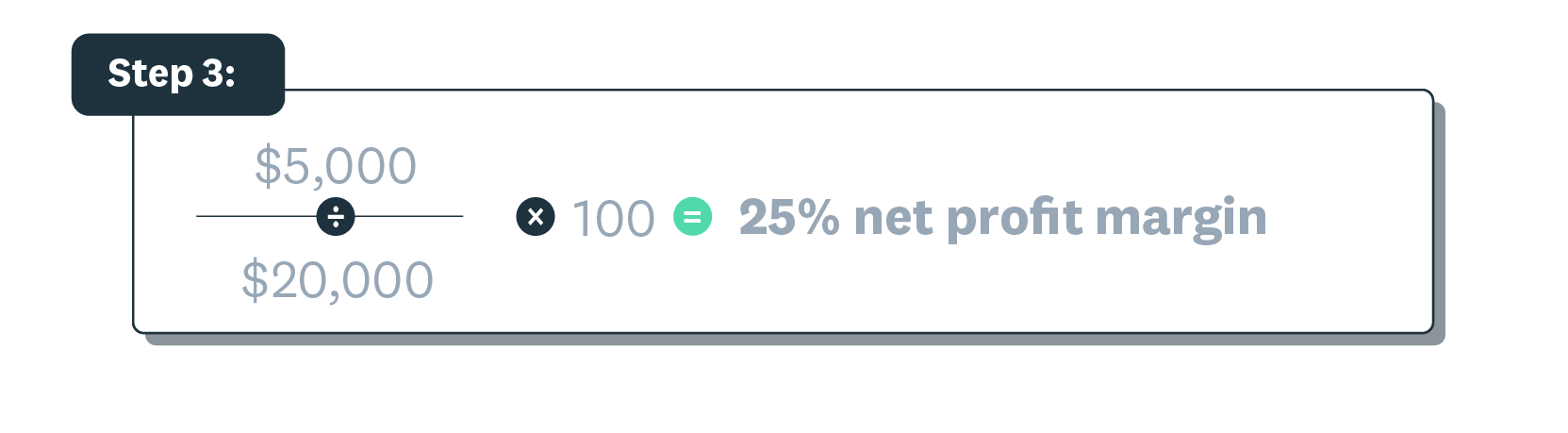
After paying a further $7,000 on operating expenses and taxes, the business has $5,000 remaining as net profit. Using the formula: $5,000 ÷ $20,000 × 100 = 25% net profit margin. This means the business keeps 25 cents of every dollar earned as profit after covering all costs.
What is a good net profit margin?
A good net profit margin varies by industry and business model. Service businesses often have higher margins than retail businesses due to lower overhead costs.
Rather than focusing on a single benchmark, compare your margin against similar businesses in your industry. Track your net profit margin over time to spot trends and identify areas for improvement. Declining margins may signal rising costs or pricing issues that need attention. Review your key profitability ratios regularly to stay on top of your financial performance.
Net profit margin vs gross profit margin
Both metrics measure profitability, but they account for different expenses. Here's how they differ:
- Gross profit margin: measures the percentage of revenue remaining after deducting the cost of goods sold only. Learn more about calculating gross profit margin.
- Net profit margin: measures the percentage of revenue remaining after deducting all expenses, including COGS, operating expenses, interest and taxes.
- Gross profit margin shows production efficiency, while net profit margin reveals overall business profitability.
- A business can have a healthy gross margin but a low net margin if operating costs are high.
Track your net profit margin with Xero
Keeping track of your net profit margin helps you make confident business decisions and find ways to increase your profits. Xero's reporting tools pull your financial data into clear, visual reports so you can monitor margins over time. See where your money goes and identify opportunities to improve profitability when you get one month free.
FAQs on net profit margin
Here are answers to common questions about net profit margin.
What is a good net profit margin?
A good margin depends on your industry, location and business size. Compare your margin to competitors in your sector and aim to improve it year on year.
What is the difference between net profit margin and gross profit margin?
Gross profit margin only deducts the cost of goods sold from revenue. Net profit margin goes further by also subtracting operating expenses, interest and taxes.
How can a business improve its net profit margin?
Reduce operating costs, negotiate better supplier rates, adjust pricing, or find efficiencies in your workflows. Regularly reviewing your expenses helps identify savings.
Is net profit margin the same as net profit?
No. Net profit is a dollar amount, while net profit margin is a percentage. The margin shows how efficiently your business converts revenue into profit.