NOPAT: definition, formula, example and how to use
Learn how net operating profit after tax (NOPAT) improves decisions, and use a checklist and FAQs to optimise results.

Written by Kari Brummond—Content Writer, Accountant, IRS Enrolled Agent. Read Kari's full bio
Published Monday 23 February 2026
Table of contents
Key takeaways
- Calculate NOPAT using the simple formula: Operating Income × (1 – Tax Rate) to measure your business's after-tax profit from core operations, excluding the effects of financing decisions and debt structure.
- Use NOPAT to benchmark your business against competitors fairly, since it removes the impact of different financing structures and focuses purely on operational efficiency and profitability.
- Track your NOPAT margin (NOPAT ÷ revenue) over time to evaluate whether operational changes like new equipment or process improvements are actually boosting your core business profitability.
- Apply NOPAT as a starting point for calculating return on invested capital (ROIC) to measure how effectively you're using your business assets and support better investment decisions.
What is NOPAT?
Net operating profit after tax (NOPAT) measures how much profit your business generates from its core operations after paying taxes, but before accounting for interest expenses or financing decisions. This metric strips away the effects of debt and capital structure, giving you a clearer picture of your operational efficiency.
The focus on operating profit is so crucial that new international accounting standards, like International Financial Reporting Standards (IFRS) 18, will require companies to present defined subtotals for operating profit to improve financial reporting.
NOPAT helps you answer a simple question: how profitable is your business at what it actually does? Unlike net income, which includes interest payments and other non-operating items, NOPAT focuses purely on operating performance.
For small business owners, NOPAT is useful when you want to:
- Compare performance: Benchmark your business against competitors regardless of how each is financed.
- Track operational efficiency: See whether your core business is improving over time.
- Make informed decisions: Evaluate whether changes to operations are actually boosting profitability.
How to calculate NOPAT
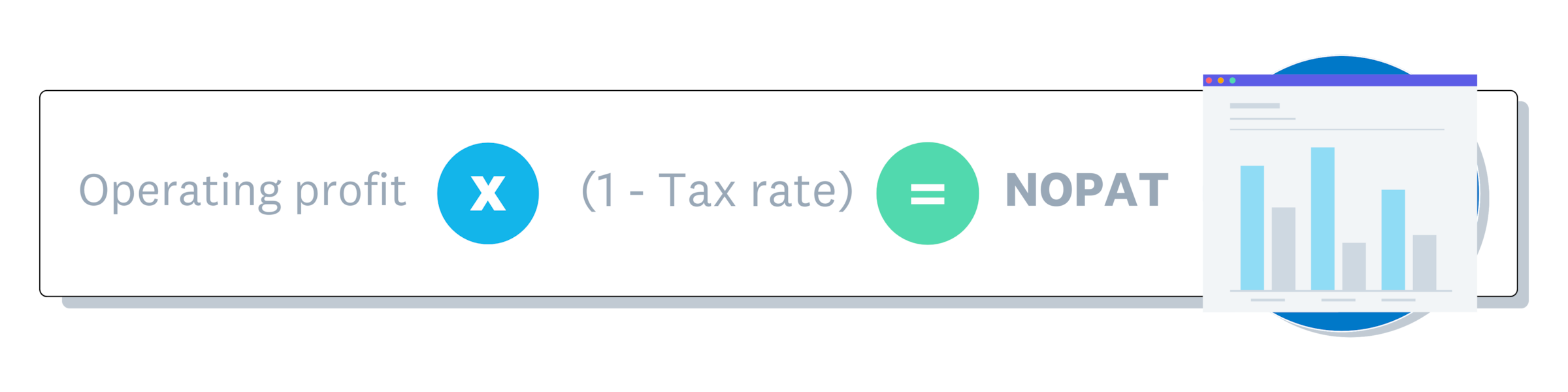
You can calculate NOPAT using a straightforward formula: NOPAT = Operating Income × (1 – Tax Rate). This gives you your after-tax operating profit in one step.
There are two approaches to calculating NOPAT, depending on how much detail you need.
Simple NOPAT formula
Use this method when you have operating income readily available:
- Find your operating income (also called earnings before interest and taxes, or EBIT) from your profit and loss statement
- Determine your effective tax rate by dividing taxes paid by taxable income
- Subtract your tax rate from 1
- Multiply operating income by the result
Example: If your operating income is $100,000 and your tax rate is 25%, your NOPAT is $100,000 × (1 – 0.25) = $75,000.
Detailed NOPAT formula
Use this method when you need to work backwards from net income:
- Start with your net income from your profit and loss statement
- Add back interest expense (since NOPAT excludes financing costs)
- Subtract the tax benefit of interest (interest expense × tax rate)
Formula: NOPAT = Net Income + Interest Expense – (Interest Expense × Tax Rate)
This approach is helpful when your accounting software shows net income more prominently than operating income.
NOPAT calculation example
Here's how a small retail business might calculate NOPAT using real numbers.
Scenario: Sarah runs a boutique clothing shop. Her profit and loss statement shows:
- Revenue: $500,000
- Cost of goods sold: $200,000
- Operating expenses: $150,000
- Interest expense: $10,000
- Tax rate: 25%
Step 1: Calculate operating income
$500,000 – $200,000 – $150,000 = $150,000
Step 2: Apply the NOPAT formula
$150,000 × (1 – 0.25) = $112,500
Result
Sarah's NOPAT is $112,500. This tells her that her shop generates $112,500 in after-tax profit from its core retail operations, separate from any financing decisions she's made.
If Sarah wants to compare her business to a competitor who has more debt, NOPAT gives her a fair comparison because it removes the impact of interest payments from both calculations. This focus on operations over financing is increasingly relevant, as a recent survey found only 24% of CFOs consider interest deductibility an important factor in determining debt, a significant drop from 60% in 2001.
How to use NOPAT for your business
NOPAT helps you make better business decisions by showing your true operational profitability. Here are practical ways to use this metric.
- Track performance over time: Calculate NOPAT quarterly or annually to see whether your core operations are becoming more or less profitable, independent of any changes to your financing.
- Benchmark against competitors: Compare your NOPAT margin (NOPAT ÷ revenue) to industry averages to see how efficiently you convert sales into operating profit.
- Evaluate business changes: Measure NOPAT before and after operational changes (like new equipment or process improvements) to see their real impact on profitability.
- Support investment decisions: Use NOPAT as a starting point for calculating return on invested capital (ROIC), which shows how effectively you're using your business assets. According to research from Morgan Stanley, the aggregate ROIC for companies has increased from 7.6% to 11.4% in recent years, highlighting a broad improvement in capital efficiency.
NOPAT is especially useful when you're considering taking on debt or bringing in investors. Because it excludes financing effects, it shows potential lenders or investors what your business earns from operations alone.
Use Xero to track NOPAT components
Xero's reporting features give you the financial data you need to calculate NOPAT without manual spreadsheet work.
Here's where to find each component in Xero:
- Operating income: Run a Profit and Loss report and look at your operating profit line, which shows revenue minus cost of sales and operating expenses.
- Tax information: Check your tax settings or review historical tax payments in your account transactions.
- Interest expenses: Filter your expense accounts to identify interest payments, or use the chart of accounts to track them separately.
Xero's customisable reports let you pull these figures for any date range, so you can calculate NOPAT monthly, quarterly, or annually to track trends over time.
Get one month free and see how Xero helps you stay on top of your business performance.
FAQs on NOPAT
Here are answers to common questions about NOPAT and how it compares to other profitability metrics.
Is NOPAT the same as EBIT?
No. EBIT (earnings before interest and taxes) is your operating profit before taxes, while NOPAT is your operating profit after taxes. To convert EBIT to NOPAT, multiply EBIT by (1 – tax rate).
What's the difference between NOPAT and free cash flow?
NOPAT measures operating profit after taxes, while free cash flow measures actual cash generated after accounting for capital expenditures and changes in working capital. This latter component is significant, as research shows net working capital has declined for US companies from nearly 30% of assets in the 1970s to under 10% today, reflecting major gains in efficiency.
NOPAT is a starting point for calculating free cash flow, but they measure different things.
Is NOPAT the same as net income?
No. Net income includes interest expenses and non-operating items, while NOPAT excludes them. NOPAT shows profit from core operations only, making it more useful for comparing businesses with different debt levels.
When should I use NOPAT instead of net income?
Use NOPAT when you want to compare operational efficiency across businesses with different capital structures, or when evaluating your core business performance separate from financing decisions. Use net income when you need to see your actual bottom-line profit after all expenses.
What's a good NOPAT margin for small businesses?
A good NOPAT margin varies by industry, but generally ranges from 5% to 20% for small businesses. Compare your margin to industry benchmarks rather than a universal target, and track your own trend over time to measure improvement.
Disclaimer
Xero does not provide accounting, tax, business or legal advice. This guide has been provided for information purposes only. You should consult your own professional advisors for advice directly relating to your business or before taking action in relation to any of the content provided.
Start using Xero for free
Access Xero features for 30 days, then decide which plan best suits your business.