Profit
Profit is what your business keeps after costs. See the types, how to calculate it and how it’s taxed in Ireland.
Published Wednesday 30 September 2026
Table of contents
Key takeaways
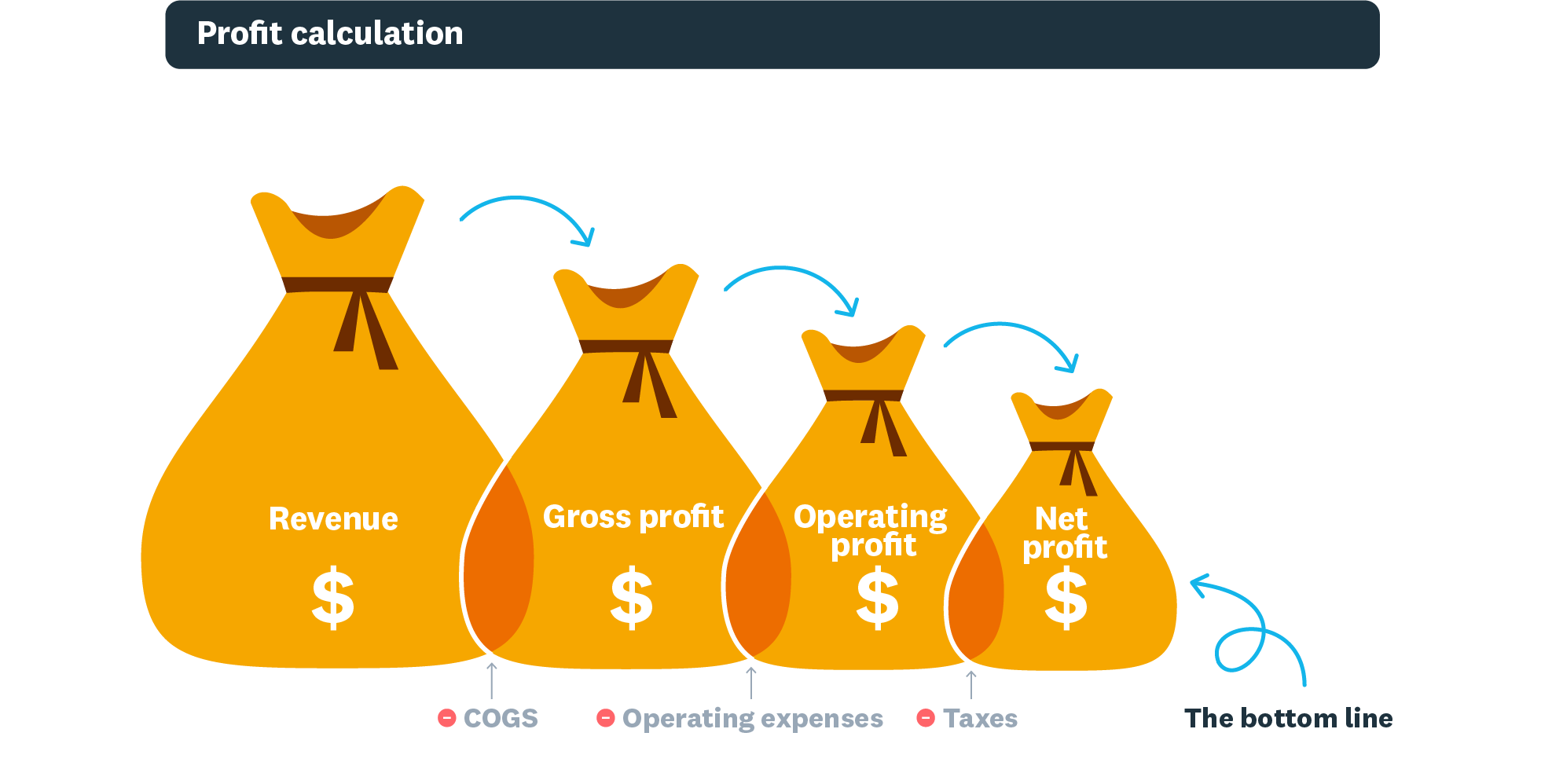
There are three types of profit. Net profit is what you get to keep.
- Profit is the money your business keeps after paying its costs, while revenue is everything you bring in before costs
- Gross profit, operating profit and net profit each subtract a further layer of costs, ending with interest and tax
- Irish companies pay Corporation Tax on profits, and sole traders pay income tax on business profits through self-assessment
- A profitable business can still run short of cash, so track profit and cash flow side by side
What is profit?
Profit is the money you have left after paying your business expenses. It’s the clearest sign of whether your business earns more than it spends.
Think of a hair salon that takes in €5,000 in a week and spends €3,500 on products, wages and rent. The €1,500 left over is its profit for the week.
Accountants break profit into gross, operating and net figures. Each one tells you something different about how your business is doing.
Profit vs revenue
Profit and revenue are easy to mix up, but they sit at opposite ends of your profit and loss statement. Revenue is the total money you earn from sales before any costs come out.
Profit is what remains once you subtract those costs. A shop with €300,000 in sales and €290,000 in costs has high revenue and a profit of just €10,000.
You can boost profit by selling more, keeping costs in check, or both.
Types of profit
There are three main types of profit, and each one removes another layer of costs. Gross profit is the biggest figure, operating profit comes next and net profit comes last.
Gross profit
Gross profit shows how much money is left after paying for the goods and services you sold. It’s a quick check on whether your prices cover what it costs to make or buy what you sell.
Gross profit = revenue − cost of goods sold
The cost of goods sold covers direct costs such as stock, materials and production labour. The Corporate Finance Institute describes gross profit the same way: sales minus the direct costs of producing them.
Operating profit
Operating profit shows what’s left after you also pay the day-to-day costs of running the business.
Operating profit = gross profit − operating expenses
Operating expenses are your overheads, such as rent, electricity, phones, insurance and staff wages. The Corporate Finance Institute explains that this figure leaves out interest and tax, so it reflects your core trading alone.
Net profit
Net profit is what you’ve made after deducting every cost, including interest and tax. It’s the money your business gets to hold onto.
Net profit = operating profit − interest − tax
Because it sits on the last line of your profit and loss statement, net profit is often called the bottom line. The Corporate Finance Institute’s net income definition treats net income and net profit as the same measure.
How to calculate profit
You can work out all three types of profit from your sales and expense records. Follow these steps in order, as each result feeds into the next one.
- Add up your total revenue for the period.
- Subtract the cost of goods sold to find gross profit.
- Subtract operating expenses from gross profit to find operating profit.
- Subtract interest on any loans to find profit before tax.
- Subtract tax to find net profit after tax.
Here’s how the steps work for a café in Galway that trades as a limited company. The figures cover one full accounting year.
- Revenue is €200,000
- Cost of goods sold, such as coffee beans, milk, food and packaging, is €80,000, so gross profit is €120,000
- Operating expenses, such as rent, wages, electricity and insurance, are €70,000, so operating profit is €50,000
- Interest on a business loan is €5,000, so profit before tax is €45,000
- Corporation Tax at 12.5% is €5,625, so net profit after tax is €39,375
This example keeps things simple. Your taxable profit can differ from your accounting profit, so your accountant will confirm the final tax figure.
Profit before tax and profit after tax in Ireland
Profit before tax is your profit once interest is paid but before tax comes out. Profit after tax is what remains once you’ve paid it, and the tax you pay depends on how your business is set up.
Companies pay Corporation Tax on the profits they make in each accounting period. According to Revenue’s Corporation Tax basis of charge, trading income is taxed at 12.5%. Non-trading income, such as rental and investment income, is taxed at 25%.
Sole traders pay income tax on their business profits instead. You declare those profits each year through self-assessment, which the Revenue guide to self-assessment explains step by step.
Profit vs cash flow
Profit and cash flow measure different things. Profit shows whether you earn more than you spend over a period. Cash flow shows when money moves in and out of your bank account.
A profitable business can still run short of cash. Here are four common reasons:
- Customers pay their invoices weeks after you’ve recorded the sale
- Stock ties up cash on your shelves until you sell it
- Loan repayments reduce your cash, though only the interest counts as an expense against profit
- Large purchases, such as equipment, leave your bank account at once but reach your profit figures gradually
Watching both numbers helps you plan for quieter months. For example, a builder with a strong year on paper can keep wages covered by chasing invoices early.
Why profit matters for your business
The three types of profit are core measures of business success. Together, they show how well each part of your business is performing:
- gross profit shows your business can make money from what it sells
- operating profit shows your day-to-day operations make money
- net profit shows what’s left after all costs and tax
Regularly checking these figures is the simplest way to measure profitability over time. They also give you solid numbers for decisions like these:
- setting prices that cover your costs and leave a margin
- reinvesting in staff, equipment or marketing
- paying yourself a salary or dividend you can afford
- borrowing with confidence, as lenders look closely at profit
When one type of profit dips, you know which layer of costs to review. That makes it easier to find practical ways to increase profits.
Track your profit with Xero
Knowing your gross, operating and net profit helps you price with confidence, plan for tax and grow at a pace you can sustain. Xero brings your figures together so you can see all three at a glance.
Xero’s financial reports turn your up-to-date accounts into a clear profit and loss view you can share with your accountant. See how it works with your own numbers when you get one month free.
FAQs on profit
Here are quick answers to common questions about profit.
Does profit mean gain?
Yes, profit is a financial gain: the amount by which what you earn is more than what you spend. In business, it helps to say which type you mean, as gross and net profit can be very different figures.
What’s another word for profit?
Common alternatives are earnings, surplus and bottom line, and accountants often call net profit “net income”. Charities and clubs usually use surplus instead of profit.
Is profit after tax the same as net profit?
Usually, yes: profit after tax is the figure left once tax is paid, which is how most small businesses define net profit. Some reports use net profit for the figure before tax, so check which line you’re reading.
Why do profits decrease after tax?
Tax is charged on the profit itself, so paying it lowers what your business keeps. Setting aside part of your profit through the year keeps you ready when the bill is due.
Can profit be negative?
Yes, when your expenses are higher than your revenue, the result is a loss. Many new businesses make a loss while they invest in equipment and customers, so look at the trend over several periods.
Related terms
Learn more about profit
Handy resources
Advisor directory
You can search for experts in our advisor directory
Financial reporting
Keep track of your performance with accounting reports
Disclaimer
This glossary is for small business owners. The definitions are written with their requirements in mind. More detailed definitions can be found in accounting textbooks or from an accounting professional. Xero does not provide accounting, tax, business or legal advice.