Owner’s equity: definition and how to calculate it
Owner's equity shows what's left in your business after debts are paid. Here's what it means and why it matters.
Written by Lena Hanna—Trusted CPA Guidance on Accounting and Tax. Read Lena's full bio
Published Friday 27 March 2026
Table of contents
Key takeaways
- Calculate your owner's equity by subtracting total liabilities (loans, supplier debts, wages owed, taxes) from total assets (cash, equipment, inventory, receivables) — the result tells you your business's net worth at any point in time.
- Track changes in your equity over time using the statement of changes in equity, which shows how profits, capital contributions, and owner's draws shift your net worth between reporting periods.
- Use owner's equity as a practical tool when preparing for growth or financing — lenders and investors look at it to assess risk, so knowing your equity figure before those conversations puts you in a stronger position.
- Recognise that owner's equity and capital are not the same thing: capital is what you've put in, while equity is the broader measure that also includes retained earnings minus any withdrawals.
What is owner's equity?
Owner's equity is the book value of your business after subtracting what you owe from what you own. It shows your net worth at any point in time.
Owner's equity doesn't predict what your business would sell for. You won't know that until you negotiate with a buyer. But it gives you a clear starting point for understanding your business's financial position.
Why owner's equity matters
Owner's equity shows whether your business is building value or losing ground over time. It's a key measure of financial health that goes beyond your day-to-day cash flow.
Understanding your equity helps you:
- assess business health: positive equity means your assets exceed your debts
- plan for growth: track how profits and investments change your net worth over time
- prepare for financing: lenders and investors look at equity to gauge risk
- value your business: equity provides a starting point when you're ready to sell
Knowing your equity gives you a clearer picture of where your business stands financially.
How to calculate owner's equity
To calculate owner's equity, subtract your total liabilities from your total assets. The result is your equity.
Add up everything your business owns (assets), then subtract everything it owes (liabilities). What's left is your owner's equity.
Owner's equity formula
The formula for owner's equity is straightforward:

When calculating owner's equity
Count your assets and liabilities correctly to get an accurate equity figure.
Assets include:
- tangible items like equipment, real estate, inventory, and cash in the bank
- accounts receivable (money customers owe you)
- intangible items like intellectual property or brand value
Liabilities include:
- loans from lenders
- amounts owed to suppliers
- wages owed to employees
- taxes payable
What's included in owner's equity
Owner's equity is made up of several components that reflect how value has been added or removed from your business over time.
The main components include:
- capital contributions: money or assets you've invested in the business
- retained earnings: profits kept in the business rather than withdrawn
- owner's draws: money or assets you've taken out of the business, which reduces equity
- net profit or loss: earnings from the current period before any withdrawals
For companies, equity may also include share capital and reserves. The specific components depend on your business structure.
Examples of owner's equity
Here are two examples of owner's equity, starting with a familiar personal scenario before moving to a business one.
Personal example: If you own a house worth $300,000 but have a $120,000 mortgage, your equity is $180,000.
Here's the breakdown:
- asset: $300,000 (house value)
- liability: $120,000 (mortgage)
- equity: $180,000 ($300,000 − $120,000)
Business example of owner's equity
The same principle applies to your business. Here's how it works for a repair shop.
Business example: A repair shop owns a $600,000 garage, $50,000 in machinery, and $50,000 in inventory. It owes $300,000 on the premises.
Here's the breakdown:
- total assets: $700,000
- total liabilities: $300,000
- owner's equity: $400,000 ($700,000 − $300,000)
Where to find owner's equity
Owner's equity appears on your balance sheet, listed after assets and liabilities. It's also tracked on the statement of changes in equity.
Your balance sheet shows equity at a single point in time. The statement of changes in equity shows how it moved over a period.
What is a statement of changes in equity?
A statement of changes in equity shows how your owner's equity moved over a period. It connects your profit and loss statement to your balance sheet.
This statement is one of four basic financial reports:
- profit and loss (P&L)
- balance sheet
- cash flow statement
- statement of changes in equity
The statement shows how earnings from your P&L affect the equity figure on your balance sheet.
Example of statement of changes in equity for sole proprietor
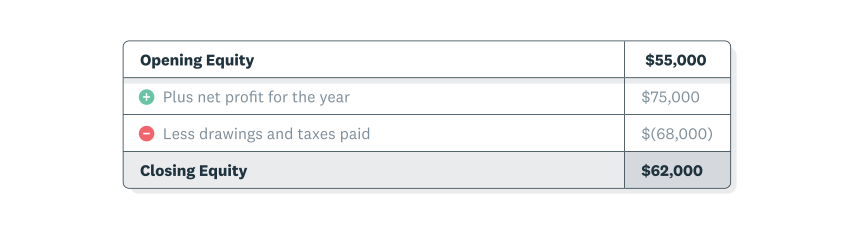
Statement shows closing equity is equal to the opening equity plus the year’s net profit, minus owner withdrawals and taxes.
Statement shows closing equity is equal to the opening equity plus the year's net profit, minus owner withdrawals and taxes.
Partnerships track equity similarly but account for multiple owners.
Example of statement of changes in equity for a partnership
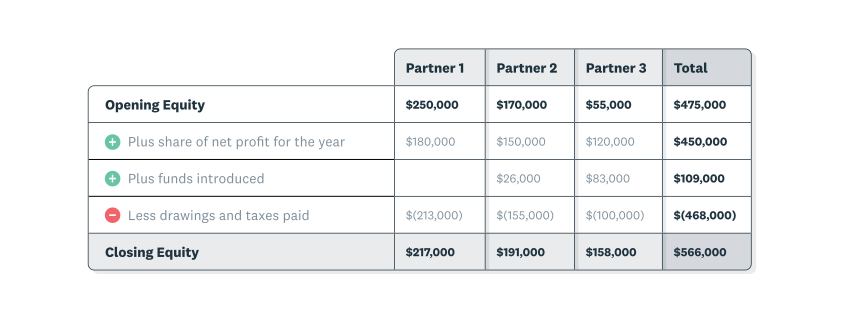
Statement shows closing equity is equal to the opening equity plus the year’s net profit and money introduced, minus owner withdrawals and taxes.
Statement shows closing equity is equal to the opening equity plus the year's net profit and money introduced, minus owner withdrawals and taxes.
Companies have additional equity components like share capital.
Example of statement of changes in equity for a company
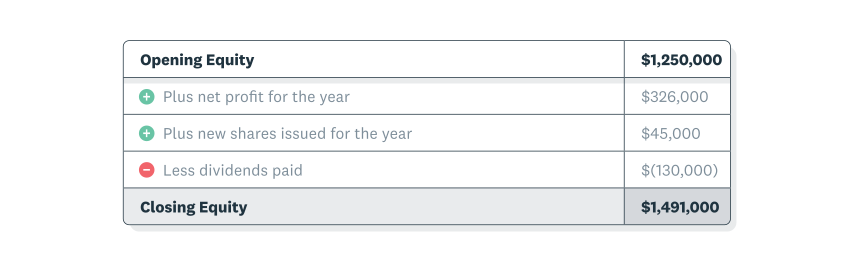
Statement shows closing equity is equal to the opening equity plus the year’s net profit and money from investors, minus owner withdrawals and taxes.
Statement shows closing equity is equal to the opening equity plus the year's net profit and money from investors, minus owner withdrawals and taxes.
Understanding how businesses use this statement helps you apply it to your own financial tracking.
How the statement of changes in equity is used
Most small business owners focus on the P&L and balance sheet for day-to-day decisions. The statement of changes in equity is useful for tracking how your net worth shifts over time, but it's less central to managing performance.
Track your owner's equity with Xero
Owner's equity shows your business's net worth at any point in time. Tracking it helps you understand financial health, plan for growth, and prepare for conversations with lenders or buyers.
With Xero's automated balance sheet and financial reporting, you can monitor your equity in real time without manual calculations. Get one month free and see how Xero simplifies your financial management.
FAQs on owner's equity
Here are answers to common questions about owner's equity.
Is shareholder's equity the same thing as owner's equity?
Yes. Sole proprietors and partnerships call it owner's equity, while companies call it shareholder's equity. The terms mean the same thing.
Is owner's equity equal to capital?
Not exactly. Capital refers to money or assets invested in a business. Owner's equity includes capital plus retained earnings, minus any withdrawals. Equity is the broader measure of total ownership value.
Is owner's equity a debit or credit?
Owner's equity normally carries a credit balance. Increases to equity (like profits or capital contributions) are recorded as credits. Decreases (like owner's draws) are recorded as debits.
Do all transactions affect owner's equity?
Most transactions affect owner's equity. Sales increase assets, which raises equity. Expenses reduce assets or increase liabilities, which lowers equity.
Disclaimer
Xero does not provide accounting, tax, business or legal advice. This guide has been provided for information purposes only. You should consult your own professional advisors for advice directly relating to your business or before taking action in relation to any of the content provided.
Start using Xero for free
Access Xero features for 30 days, then decide which plan best suits your business.