Gearing ratio: definition, formula and healthy range
Learn how the gearing ratio shows your debt risk, and how to calculate it fast to guide smarter decisions.

Written by Shaun Quarton—Accounting & Finance Content Writer and Growth Marketer. Read Shaun's full bio
Published Friday 20 February 2026
Table of contents
Key takeaways
- Calculate your gearing ratio by dividing total debt by shareholders' equity to measure how much of your business relies on borrowed money versus owner investment.
- Aim for a gearing ratio between 25%–50% to balance growth opportunities with financial stability, as this range is considered optimal by most lenders.
- Monitor your gearing ratio regularly before applying for loans, planning expansion, or making major financial decisions since it directly affects your borrowing capacity and interest rates.
- Improve a high gearing ratio by paying down existing debt, retaining more profits in your business, or bringing in additional equity investment rather than taking on new borrowing.
Table of contents
Key takeaways
Here are the main points to remember about gearing ratios.
- Calculate your gearing ratio by dividing total debt by shareholders' equity to measure your business's financial leverage.
- Aim for a gearing ratio between 25%–50% to balance growth potential with financial stability.
- Use the debt-to-equity ratio as your primary measure since most lenders reference this calculation.
- Monitor your ratio regularly to spot warning signs before they affect loan applications or cash flow.
- Improve a high gearing ratio by paying down debt, retaining profits, or bringing in equity investment.
What is a gearing ratio?
Gearing ratio is a financial metric that measures how much of your business is funded by borrowed money compared to owner investment. It shows the balance between debt and equity on your balance sheet.
Lenders and investors use this ratio to assess risk. A business with high gearing relies heavily on debt, which means higher interest payments and more financial pressure during slow periods. A business with low gearing has more equity cushion but may be missing growth opportunities.
For small business owners, your gearing ratio matters most when you're:
- applying for a loan: lenders check this ratio to decide if you can handle more debt
- planning expansion: it helps you understand how much borrowing room you have
- reviewing financial health: it flags whether your debt levels are sustainable
- talking to investors: it shows how much risk you're carrying
Your gearing ratio is expressed as a percentage or decimal. A ratio of 50% (or 0.5) means your business has equal amounts of debt and equity funding.
Types of gearing ratios
There are several ways to measure gearing, and different lenders may ask for different calculations. Understanding the main types helps you prepare the right figures and speak confidently about your financial position.
Debt-to-equity ratio
The debt-to-equity ratio is the most common gearing measure. It compares what you owe to what you own.
Formula: Total debt ÷ Shareholders' equity
This ratio tells you how many dollars of debt you have for every dollar of equity. For example, a ratio of 0.42 means that for every dollar in equity, the business has 42 cents in leverage.
A result of 1.0 means equal debt and equity. Most lenders consider this the standard gearing calculation.
Debt ratio
The debt ratio shows what percentage of your total assets is funded by debt.
Formula: Total debt ÷ Total assets
This gives you a broader view of leverage across your entire balance sheet. A debt ratio of 0.4 means 40% of your assets are financed through borrowing.
Equity ratio
The equity ratio measures the opposite: how much of your business is funded by owner investment.
Formula: Shareholders' equity ÷ Total assets
A higher equity ratio indicates lower financial risk. This calculation is useful when you want to emphasise stability rather than debt levels.
How to calculate gearing ratio
Calculating your gearing ratio takes just a few minutes if you have your balance sheet handy. The most common method uses the debt-to-equity formula.
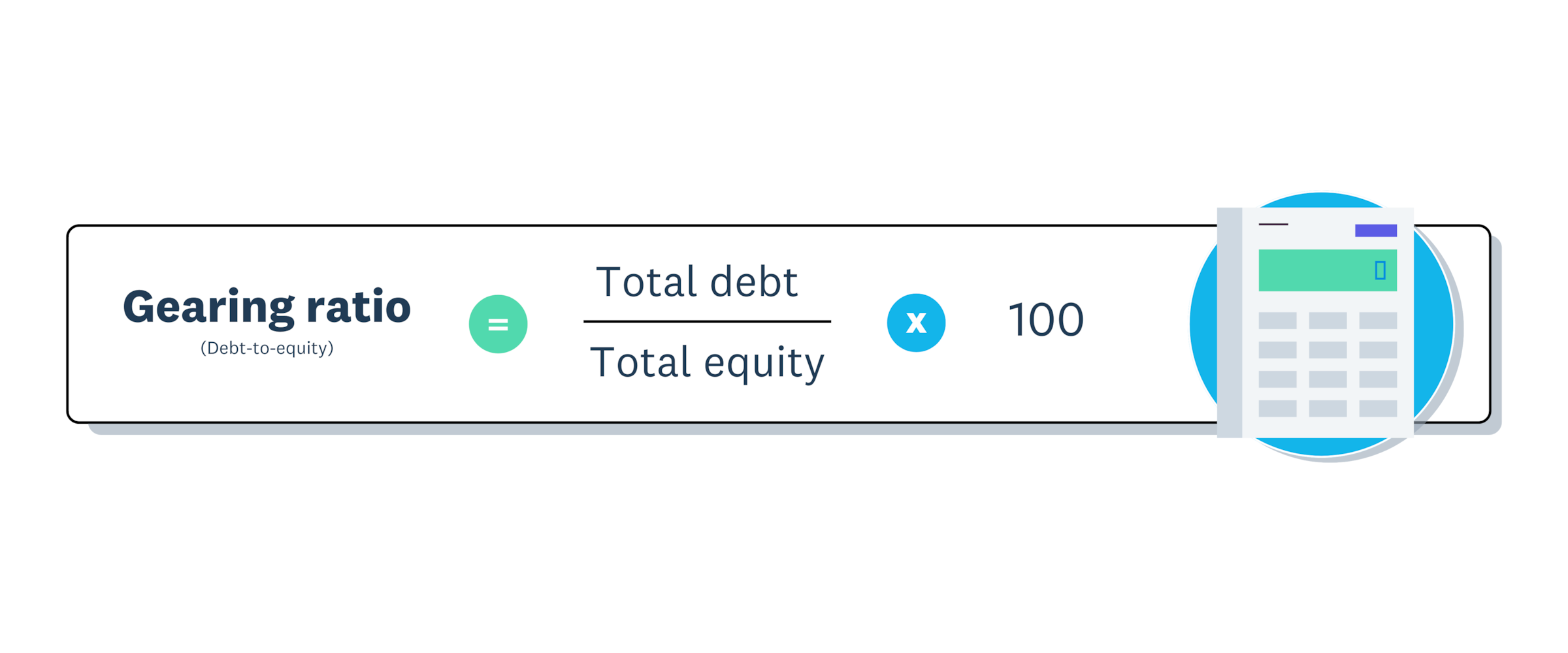
Gearing ratio formula
Gearing ratio = Total debt ÷ Shareholders' equity
To find these numbers:
- Locate your total debt on the balance sheet (this includes loans, credit lines, and other borrowings)
- Find shareholders' equity (total assets minus total liabilities)
- Divide total debt by shareholders' equity
- Multiply by 100 to express as a percentage
Example: calculating gearing ratio for a small business
Sam runs a coffee shop with the following balance sheet figures:
- Total debt: £80,000 (business loan plus equipment finance)
- Shareholders' equity: £120,000 (initial investment plus retained profits)
Calculation: £80,000 ÷ £120,000 = 0.67 or 67%
Sam's gearing ratio of 67% means the business has £0.67 of debt for every £1 of equity. This sits slightly above the typical "healthy" range, which may prompt Sam to focus on paying down debt before taking on new borrowing.
What is a good gearing ratio?
A good gearing ratio typically falls between 25%–50%. This range is considered optimal for established businesses because it suggests a healthy balance between using debt to grow and maintaining financial stability.
Here's what different ranges generally indicate:
- Below 25%: low gearing means conservative financing with minimal debt risk, but you may be missing growth opportunities that strategic borrowing could fund
- 25%–50%: moderate gearing suggests a balanced approach where you're using debt productively without overextending
- 50%–75%: higher gearing indicates significant reliance on debt, which increases risk during downturns but may be acceptable for capital-intensive industries
- Above 75%: high gearing signals potential financial stress. This makes the company more vulnerable to loan defaults and bankruptcy. It can also make it harder to secure new loans or survive cash flow disruptions
What counts as 'good' also depends on your industry. Capital-intensive sectors like manufacturing or property typically carry higher gearing than service businesses with fewer assets. Industries like utilities and transportation often operate with higher gearing due to the need for major infrastructure investment. A 60% ratio might concern a lender evaluating a consulting firm but seem reasonable for a construction company.
Lenders also consider trends. A ratio that's improving over time looks better than one that's climbing, even if the current number is similar.
Why gearing ratio matters for small businesses
Your gearing ratio isn't just a number for financial reports. It directly affects your ability to borrow, grow, and weather tough times.
- Loan applications: banks and lenders check your gearing ratio before approving credit. A ratio above their threshold may result in rejection or higher interest rates. Knowing your number before you apply helps you either improve it or choose the right time to borrow.
- Growth decisions: when you're considering expansion, your gearing ratio shows how much borrowing capacity you have. Taking on debt when you're already highly geared increases risk. Understanding your current position helps you decide whether to fund growth through loans, retained profits, or new investment.
- Cash flow pressure: higher gearing means higher interest payments. During slow periods, these fixed costs don't shrink with your revenue. A lower gearing ratio gives you more breathing room when cash is tight.
- Investor confidence: if you're seeking investment, your gearing ratio signals how much risk you're already carrying. Investors may be reluctant to put money into a business that's heavily indebted.
- Early warning system: tracking your ratio over time helps you spot problems before they become serious. A steadily rising gearing ratio suggests you're relying more on debt, which may need attention.
Manage your business finances with Xero
Keeping track of your gearing ratio is easier when your financial data is accurate and up to date. Xero's cloud-based accounting software gives you real-time visibility into your debt levels, equity position, and overall financial health.
With Xero, you can pull balance sheet reports whenever you need them. Track how your ratio changes over time. Share clear financial snapshots with lenders or advisors. Automated bank feeds that reconcile transactions mean your numbers stay current without manual data entry.
Ready to take control of your business finances? Get one month free and see how Xero helps you make confident decisions about borrowing, growth, and financial stability.
FAQs on gearing ratio
Here are answers to common questions about gearing ratios for small businesses.
What is a gearing ratio formula?
The most common gearing ratio formula is total debt divided by shareholders' equity. This calculation shows how much borrowed money your business uses compared to owner investment.
Is a high or low gearing ratio better?
Neither is universally better. Low gearing (below 25%) means less financial risk but may limit growth. High gearing (above 50%) allows faster expansion but increases vulnerability during downturns. Most small businesses aim for moderate gearing between 25%–50%.
Is 50% gearing considered high?
A 50% gearing ratio sits at the upper end of the moderate range. Most lenders view ratios between 25%–50% as healthy. Above 50% is generally considered high gearing, though acceptable levels vary by industry.
What does a gearing ratio of 60% mean?
A 60% gearing ratio means your business has £0.60 of debt for every £1 of equity. This indicates higher-than-average reliance on borrowed money, which may make lenders cautious and increases your interest payment burden.
How can I improve my gearing ratio?
You can lower your gearing ratio by paying down existing debt, retaining more profits in the business instead of withdrawing them, or bringing in additional equity investment. Avoid taking on new debt until your ratio reaches a healthier level.
Start using Xero for free
Access Xero features for 30 days, then decide which plan best suits your business.