Marginal cost formula: how to calculate with examples
The marginal cost formula shows you exactly when making more means earning more. Here's how to use it.

Written by Jotika Teli—Certified Public Accountant with 24 years of experience. Read Jotika's full bio
Published Friday 27 March 2026
Table of contents
Key takeaways
- Calculate marginal cost using the formula: change in total cost divided by change in quantity — this tells you the true expense of producing one more unit, so you can decide whether expanding output will add to your profit or eat into it.
- Compare your marginal cost to your average cost before scaling up: if marginal cost is lower, producing more increases profit; if it's higher, hold production steady to protect your margins.
- Set your profit-maximising production level at the point where marginal cost equals marginal revenue — beyond that point, each extra unit costs more to make than it earns, so output past this threshold reduces your overall profit.
- Review your marginal cost regularly, especially when supplier prices shift or you're nearing capacity, since these changes can quickly flip a profitable production decision into a loss-making one.
What is a marginal cost?
Marginal cost is the additional expense you incur when producing one more unit of a product or service. This calculation helps you understand whether expanding production will increase or decrease your profits.
Knowing your marginal cost is essential for pricing decisions, production planning, and resource allocation. It shows you the true cost of growth before you commit.
Before expanding production, you need to know how extra output affects your costs. Marginal cost analysis helps you weigh short-term cash flow impact against long-term profitability, so you can make confident decisions about growth.
Why is marginal cost important to grasp?
Marginal cost helps you make three key business decisions: how much to produce, when to expand, and what to charge.
Understanding this number lets you:
- find your profit sweet spot: produce enough to spread fixed costs without overextending
- set profitable prices: find the balance between competitive pricing and healthy margins, knowing your true cost per unit
- optimise production levels: know when adding units increases profit and when it erodes margins
- time your growth: expand when the numbers support it, not before
- allocate resources wisely: decide which products to prioritise and when to invest in capacity
What are the main components of marginal cost?
To calculate marginal cost, you need to understand the two main cost categories:
- variable costs: these change with your output level. Examples include materials, hourly wages, and energy bills. When you produce more, these costs rise.
- fixed costs: these stay the same regardless of output. Examples include machinery, rent, and salaries. Producing more units spreads these costs, lowering your cost per unit.
What is the formula for marginal cost?
The marginal cost formula calculates how much your total costs change when you produce one additional unit:
Marginal cost = Change in total cost ÷ Change in quantity
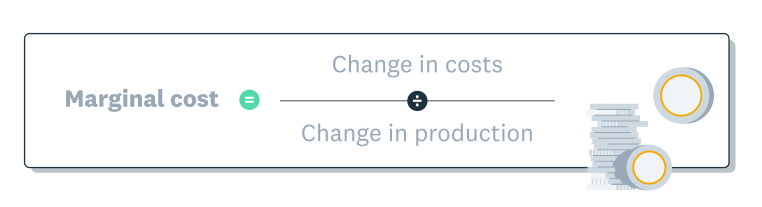
To use this formula, compare your total production costs at two different output levels. Subtract the lower cost from the higher cost, then divide by the number of additional units produced.
Understanding change in costs
Change in total cost is the difference between your production costs at two output levels. Include all costs that increase when you produce more:
- direct materials: raw materials and components used in production
- direct labour: wages for staff directly involved in making products
- variable overheads: energy, shipping, and supplies that rise with output
Exclude fixed costs like rent and insurance, as these don't change when you produce one more unit.
Understanding change in quantity
Change in quantity is the number of additional units you produce. For most calculations, this is simply the difference between your new and original output levels.
For example:
- product businesses: count physical units (one more widget, 10 more cakes)
- service businesses: count billable hours or completed jobs (one more consulting hour, five more client sessions)
Keep your unit of measurement consistent when comparing costs at different production levels.
Step-by-step calculation process
Follow these steps to calculate your marginal cost for any production decision.
- Determine your current output and total costs: Record how many units you produce and your total production expenses.
- Calculate costs at the higher output level: Estimate what your total costs would be if you produced additional units.
- Find the change in total cost: Subtract your current costs from your projected costs.
- Divide by the change in quantity: Divide the cost difference by the number of additional units.
Example: If producing 100 units costs $1,000 and producing 101 units costs $1,008, your marginal cost is ($1,008 – $1,000) ÷ 1 = $8 per unit.
Marginal cost example
Here's how Mohammed, a bakery owner, calculates his marginal cost:
Current situation: Mohammed produces 100 cakes at a total cost of $1,000 ($10 per cake). Adding one more cake increases his total costs to $1,005.
Calculation:
- Find the change in total cost: $1,005 – $1,000 = $5
- Calculate marginal cost: $5 ÷ 1 = $5 per additional cake
Decision: Mohammed's marginal cost ($5) is lower than his average cost ($10). It's worth considering whether he can sell that extra cake for more than $5; if so, expanding production adds to his profit.
The benefits of calculating marginal cost
Once you've calculated your marginal cost, compare it to your average cost of production to decide your next move:
- marginal cost is lower than average cost: you can increase profit by producing more units
- marginal cost is higher than average cost: keep production at current levels to protect your margins
When to use marginal cost in your business
Calculate your marginal cost when you're making decisions about production levels, pricing, or growth. Here are the most common scenarios where this calculation is useful:
- planning production increases: before expanding output, check whether the additional units will cost more or less than your current average
- setting prices: know your true cost per unit so you can price competitively while protecting your margins
- evaluating expansion opportunities: compare the marginal cost of in-house production against outsourcing or new equipment
- comparing product profitability: identify which products deliver the best return when you increase production
Review your marginal cost regularly, especially when input prices change or you're approaching capacity limits.
Marginal revenue vs marginal cost
Marginal revenue is the additional income you earn from selling one more unit. While marginal cost measures what you spend, marginal revenue measures what you gain.
Marginal revenue = Change in total revenue ÷ Change in quantity sold
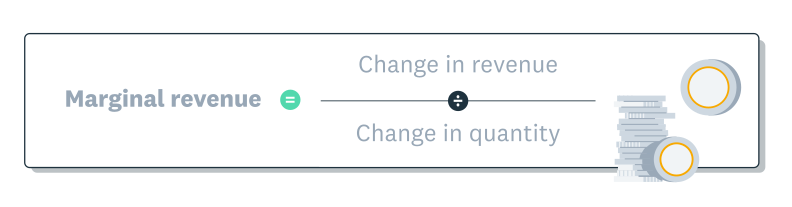
The profit maximisation rule: Your profits are highest when marginal cost equals marginal revenue. Beyond this point, each additional unit costs more to produce than it earns, reducing your overall profit.
Example of marginal revenue
Here's how Alison uses marginal revenue to make a business decision:
Scenario: Alison sells wallets for $30 at her market stall. A vendor across town offers to buy her surplus stock at $20 per wallet. Her marginal cost to fulfil this order is $22.
Analysis: Her marginal revenue ($20) is less than her marginal cost ($22). This deal would lose her $2 per wallet.
Options to make the deal profitable:
- negotiate a higher wholesale price to cover her costs
- find a closer vendor to reduce delivery expenses
- lower her production costs by sourcing cheaper materials
Simplify your accounting with Xero
Understanding your marginal cost helps you make smarter production and pricing decisions. Xero accounting software gives you real-time visibility into your costs and revenue, so you can spot opportunities to grow profitably.
With automatic calculations and customisable reports, you'll always know your numbers. Track your costs, understand your margins, and make smarter production decisions. Get one month free and see how Xero can help.
FAQs on marginal cost
Still have questions about marginal cost? Here are answers to some common concerns.
What causes marginal cost to increase?
Marginal cost increases when producing additional units becomes more expensive. Common causes include:
- labour costs: overtime pay or hiring temporary staff raises per-unit expenses
- material costs: sourcing from more expensive suppliers when primary sources run out
- capacity limits: needing new equipment, larger premises, or additional staff to produce beyond current capacity
- production inefficiencies: rushed processes or equipment strain that increases waste
How does marginal cost relate to supply and demand?
Marginal cost directly influences how much you produce. When your marginal cost is below the selling price, you're incentivised to increase output. When it exceeds the selling price, reducing production helps you avoid losses.
What's the relationship between marginal cost and contribution margin?
Contribution margin is your sales revenue minus variable costs. Marginal cost is the expense of producing one additional unit.
When your marginal cost is lower than your contribution margin per unit, producing more is profitable.
How do I know when to stop increasing production?
Stop increasing production when your marginal cost exceeds your marginal revenue, or when you reach capacity constraints. At that point, each additional unit reduces your overall profit rather than adding to it.
Do service businesses calculate marginal cost differently?
Service businesses use the same formula but measure different inputs. Instead of physical units, you might track billable hours, completed jobs, or client engagements. Your variable costs are likely to include contractor fees, software subscriptions, or travel rather than raw materials.
The principle is the same: work out what it costs you to deliver one more unit of your service, then compare that to what you earn from it.
Disclaimer
Xero does not provide accounting, tax, business or legal advice. This guide has been provided for information purposes only. You should consult your own professional advisors for advice directly relating to your business or before taking action in relation to any of the content provided.
Start using Xero for free
Access Xero features for 30 days, then decide which plan best suits your business.